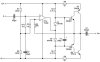
R7 should be a much higher value, especially if you want a reasonably flat low-frequency response. I would use 100k for R7.
You can simplify the circuit slightly by doing what I suggested in post #11. That is, (1) delete R7; (2) disconnect the junction of R1 and R2 from C2; (3) connect the junction of R1 and R2 to the "+" input of the op-amp.
As Steve says, R8 and R9 will greatly limit the output power of the amplifier. If the output transistors are overheating without those resistors, that is a separate problem that began in post #16 after you failed to connect the output transistors properly. Have you replaced the output transistors?
Connecting the op-amp to different places in relation to D1 and D2 will have almost no effect. Connecting it to the centre point will cause slightly more distortion because it is less tightly coupled to the bases of the output transistors. I recommend leaving it connected to Q1 base.
This amplifier uses fixed bias, set by D1 and D2. A better method is to replace D1 and D2 with an NPN transistor, with a resistor (e.g. 6k8) from collector to base, and a trimpot of slightly higher value (e.g. 10k) from base to emitter. This transistor must be coupled to the output heatsink to provide thermal feedback.
To set the output stage quiescent current, connect a current meter in series with the output stage (e.g. in series with Q2 emitter), set the trimpot to maximum resistance, power up, and adjust the trimpot for around 20~50 mA quiescent current. Leave the amp to warm up for 10 minutes, readjust the trimpot, and repeat a few times until the temperature and current stabilise.
That output stage, using Sziklai pairs, is probably not the best design. It's more usual to operate the output transistors as emitter followers.