Electronic flourescent tube starter

Joh Drinda

Jun 17, 2022
1
Joined
Jun 17, 2022
Messages
1
Since these starters are very expensive, I thought of soldering a few myself.
I saw a SIDAC circuit and bought a few of them, but it failed to work!
I must be doing something wrong! My tube has no capacitor. Maybe it's that why it won't work?
Here's a page that shows more of how they work: https://www.bristolwatch.com/ele/sidac.htm
I'm in N-Australia and we got 240VAC, so I built this circuit:
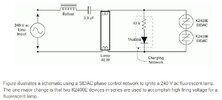
Sidac.jpg


HarryA1

Mar 4, 2009
481
Joined
Mar 4, 2009
Messages
481
I am confused with the two SIDACs (Silicon Diode for Alternating Current) in series. They are rated 220-250 volts switching each. 240 mains voltages would be in the order of 340*1,4 or 480 volts  peak. About the same as the two SIDACs; not much to switch with?

"These tasks of the starter are taken over by two 135 V sidac (or a single 270 V one). The starting voltage is thus 270 V, Which is below the peak value of the mains (about 340 V), but higher than the working voltage of a 20-40 W neon tube." 

see: https://circuit-diagramz.com/sidac-neon-tube-starter/

I will look at the circuit some more.

 
Last edited by a moderator:

Soren Thompson

Jul 9, 2022
1
Joined
Jul 9, 2022
Messages
1
I am confused with the two SIDACs (Silicon Diode for Alternating Current) in series. They are rated 220-250 volts switching each. 240 mains voltages would be in the order of 340*1,4 or 480 volts  peak. About the same as the two SIDACs; not much to switch with?

"These tasks of the starter are taken over by two 135 V sidac (or a single 270 V one). The starting voltage is thus 270 V, Which is below the peak value of the mains (about 340 V), but higher than the working voltage of a 20-40 W neon tube." 

see: https://circuit-diagramz.com/sidac-neon-tube-starter/

I will look at the circuit some more.
Thanks for the help. It is quite important to observe when conducting such experiments, because observation in science, especially in exact sciences, is incredibly important. At https://graduateway.com/essay-examples/observation/ you can read some new articles about observation and its role in scientific research.

 
Last edited by a moderator:

Daniel Meyers

Oct 28, 2022
1
Joined
Oct 28, 2022
Messages
1
I am confused with the two SIDACs (Silicon Diode for Alternating Current) in series. They are rated 220-250 volts switching each. 240 mains voltages would be in the order of 340*1,4 or 480 volts  peak. About the same as the two SIDACs; not much to switch with?

"These tasks of the starter are taken over by two 135 V sidac (or a single 270 V one). The starting voltage is thus 270 V, Which is below the peak value of the mains (about 340 V), but higher than the working voltage of a 20-40 W neon tube." 

see: https://circuit-diagramz.com/sidac-neon-tube-starter/

I will look at the circuit some more, before pay for research at https://writemypapers4me.net/pay-for-research-paper/.
I think you are absolutely right Harry. That may be the reason, I agree you are very observant. I can't boast of the same


Olivia Duke

Nov 15, 2022
3
Joined
Nov 15, 2022
Messages
3
I am confused with the two SIDACs (Silicon Diode for Alternating Current) in series. They are rated 220-250 volts switching each. 240 mains voltages would be in the order of 340*1,4 or 480 volts  peak. About the same as the two SIDACs; not much to switch with?

"These tasks of the starter are taken over by two 135 V sidac (or a single 270 V one). The starting voltage is thus 270 V, Which is below the peak value of the mains (about 340 V), but higher than the working voltage of a 20-40 W neon tube." 

see: https://circuit-diagramz.com/sidac-neon-tube-starter/drift hunters

I will look at the circuit some more.
Thanks!

 
Top