fm tranismiter

A

Alun

Jan 1, 1970
0
It's the sharp edges on the square waves that give the harmonics, many years ago I built an astable multi-vibrator with a CMOS chip that flashed a pair of LEDs, my mum complained because she could hear a click sound on her FM radio every time the LEDs flashed. Given that this circuit only oscillated at 1Hz and still generated VHF harmonics, a circuit running at 10.7MHz should have no problem, it wouldn't surprise me if you could hear the transmitter a 107MHz too.

Sasi, try tuning your radio to 107MHz and operating the transmitter.

I've managed to get the oscillator working, in the end I just soldered the components together with tinned copper wire. I managed to make the inductor from uninsulated tinned copper wire too, I stretched the coil very slightly so there small air gaps between the turns. This coil should have a higher Q and lower parasitic capacitance because the larger gaps will have a lower capacitance and air has a lower permittivity than the plastic varnish.

The signal is only about 200mV with the power supply at 5V and it's strongest in the middle of the coil,  the frequency is 89MHz with a 33pf capacitor, I haven't tried a diode yet, I'll do that when I make the PCB, and I'll tune the circuit to get the highest output with the least distortion.

 

audioguru2

Apr 6, 2004
12,026
Joined
Apr 6, 2004
Messages
12,026
Hi Alun,
Excuses and more excuses:

Alun said:
I've managed to get the oscillator working, in the end I just soldered the components together with tinned copper wire.
You couldn't even make a 100MHz oscillator on a circuit board so you had to use a tangle of heavy buss-wire. He, he. ;D

I managed to make the inductor from uninsulated tinned copper wire too, I stretched the coil very slightly so there small air gaps between the turns. This coil should have a higher Q and lower parasitic capacitance because the larger gaps will have a lower capacitance and air has a lower permittivity than the plastic varnish.
Now you are blaming the varnish on the wire?
 
Last edited by a moderator:
A

Alun

Jan 1, 1970
0
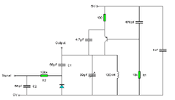
I still haven't got round to making a PCB (still bus bar I'm afraid) but I've managed to use a 1N4001 as a varicap diode!

It isn't as sensitive as the other circuit, I need about 500mVp-p to get the output frequency to change by 50KHz, in the UK the maximum deviation is 75kHz so I don't think you single transistor amplifier is man enough to give the required gain, if you used a Darlington transistor you'll probably do it though, but I'd rather not mess about and just use an op-amp.

C2 and R2 are optional but if you don't like RF getting into the audio amplifier I strongly recommend them.

And I've found a simple solution to your overmodulation problem, you'll obviosly have to add biasing resistors and a potential divider to scale the outout to the correct range.

RF_oscilator.GIF

Audio_Limiter.GIF


audioguru2

Apr 6, 2004
12,026
Joined
Apr 6, 2004
Messages
12,026
Hi Alun,
1) The graphs don't show the capacitance of a diode when it is slightly forward-biased. Is the capacitance change with voltage change still linear to avoid distortion?
2) How would your 1N4001 "varicap" work if it was 2 diodes back-to-back like your overmodulation limiter? Then the diodes would FM modulate the carrier and also limit the deviation to about 130KHz. FM stereo radios like my cheap Walkman should be able to pass a 130KHz deviation without much distortion.  ;D

 
A

Alun

Jan 1, 1970
0
audioguru said:
Hi Alun,
1) The graphs don't show the capacitance of a diode when it is slightly forward-biased. Is the capacitance change with voltage change still linear to avoid distortion?
The diode will only work as a varactor when it's reversed biased - this circuit won't oscilate unless the diode is reverse biased by more the a volt or so.

I don't know about distortion but it must be better than relying on the parasitic capacitances in the transistor to modulate the signal. I might test the linearity of several diodes and use the best one.

2) How would your 1N4001 "varicap" work if it was 2 diodes back-to-back like your overmodulation limiter? Then the diodes would FM modulate the carrier and also limit the deviation to about 130KHz. FM stereo radios like my cheap Walkman should be able to pass a 130KHz deviation without much distortion.  ;D
This circuit might solve the problem of overmodulation but it won't solve the distortion problem as it still will clip the waveform and cause distortion. This is still good because it will reduce interference to other radio stations. If you want to minimize over modulation then you could just reduce the gain of the amplifier, or you could consider an automatic volume control but that's a bit complicated for a simple circuit like this. :)

You can quite easily adjust the maximum deviation of this circuit. Set the amplifier's gain to a value that would give a peak output of about 50mV under the diode voltage drop for the loudest sound you want to transmit. Now include a potential divider as part of the biasing network to the oscillator to reduce the amplitude to a value that would give the maximum deviation you require.
 
Last edited:

audioguru2

Apr 6, 2004
12,026
Joined
Apr 6, 2004
Messages
12,026
Hi Alun,
The capacitance change of a diode seems to be very unlinear with voltage change across it.
On the graph you posted, the capacitance changes from 29pF at 0.1V reverse bias to 19pF at 1.0V reverse bias. But when you increase the bias voltage another 0.9V the cap changes by only a couple of pF. It seems to be a logarithmic change in capacitance with voltage change. I think it would produce even harmonic distortion. FM tuner manufacturers use two varicaps in series to cancel this distortion.
The 1N4001 diode has about 5 times as much capacitance as the 2N3904 transistor. Try a 1N4148 if the capacitance is too high.  ;D

View attachment 36859

 
A

Alun

Jan 1, 1970
0
audioguru said:
Hi Alun,
The capacitance change of a diode seems to be very unlinear with voltage change across it.
On the graph you posted, the capacitance changes from 29pF at 0.1V reverse bias to 19pF at 1.0V reverse bias. But when you increase the bias voltage another 0.9V the cap changes by only a couple of pF. It seems to be a logarithmic change in capacitance with voltage change. I think it would produce even harmonic distortion. FM tuner manufacturers use two varicaps in series to cancel this distortion.
The 1N4001 diode has about 5 times as much capacitance as the 2N3904 transistor. Try a 1N4148 if the capacitance is too high.  ;D
F = 1/(2pi*root(LC))

L & C are in a square root so a logarithmic decrease (exponential decay) in C is exactly what's needed to give a linear frequency change  with voltage input, and the graph of the 1N4001 is more logarithmic than the 2N3904 so the diode would be better. The transmitter manufactures use two diodes in series because it reduces RF leakage into the driving circuit, and my circuit uses an RC filter to achieve this.
 
A

Alun

Jan 1, 1970
0
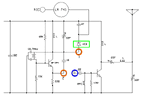
Sasi, you're right, I did miss of a few components of my schematic.

It had no emitter resistor so the transistor was bais incorrectly and there could be no emmitter feedback because I missed of the RF bypass capacitor. I ran it from 5V not 9V as it would get a bit warm with 9V, I could of also made the emmitter resistor a bit bigger

I can assure you I did include them when I built it or it wouldn't have worked. ;D

I'm very suprised audioguru didn't notice ;D
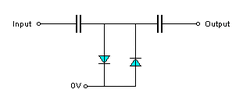
The idea of connecting the varactor diode the other way round is wrong because it would be forward biased and it will only act as a capacitor if it's reversed biased. In both the circuit you've modified from mine and your circuit the diode is forward biased. In the modified circut all of the signal would just go through the diode to ground. You might get some FM from your circuit but not because of the diode, it would be because the voltage on the transistor is changing and thus altering its capacitance, like the other transmitter circuits. Nice idea to use a LED  ;D but inorder for it to work as a varactor it would need to be reversed biased so it wouldn't light up! ;D

You have good idea though to use a tuned amplifier and if you play your cards right you could get it to operate in class C and get a very good efficiency. I don't know which would be the best place to connect A to. Audioguru connected it to the emitter or 2 in your circuit. When I looked at the emmiter waveform on my circuit the sine wave was very distorted and there were loads of harmonics. The collector was a lot better so I'd recommend  you connect 1 the collector to A. I hope the power output from your oscillator is high enough to drive your amplifier, you might want to add another stage of amplification before your final amplifier.

You will also need to run your pre-amp of a higher voltage than the oscilator or at least bias its out put so the output voltage is higher than the diode's,because if the voltage on the diode if lower than the voltage on the base it would become forward biased and stop working. I used a PNP transistor to avoid this problem, my circuit will work when the varactor voltage is > 1V or so, yours probably won't work untill it's greater than about 8V.

The 741 is also quite noisy so don't expect good sound quality, go for a TL071 or TL081 or even a LF351, and use the op-amp circuit posted a few pages ago as it includes pre-emphasis. The higher frequencies are always amplified more at the radio station to lower the noise and increase the broadcast quality. Your radio receiver will include a de-emphasis circuit and amplify the high frequencies less, so a transmitter without pre-emphasis will sound very poor.

Modified_Sasis_circuit1.GIF

RF_oscilator2.GIF

 
Last edited:

audioguru2

Apr 6, 2004
12,026
Joined
Apr 6, 2004
Messages
12,026
Alun said:
I'm very suprised audioguru didn't notice ;D
Hi Alun,
Sure I noticed. There are simple FM transmitter colipitts oscillators on the web without any emitter resistor and their designer says they work. I doubt it.

You have good idea though to use a tuned amplifier and if you play your cards right you could get it to operate in class C and get a very good efficiency. I don't know which would be the best place to connect A to. Audioguru connected it to the emitter or 2 in your circuit. When I looked at the emitter waveform on my circuit the sine wave was very distorted and there were loads of harmonics. The collector was a lot better so I'd recommend
 
A

Alun

Jan 1, 1970
0
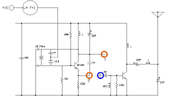
Yes C12 would make the impedance of your tuned amplifier about 53 ohms but this wouldn't be any worse than driving a very low impedance Yagi aerial, you might want to make C12 even smaller like 10pf you use the higher impedance collector output.

What's output of your RF oscillator section?

I measured only about 150mVp-p and that was the absolute maximum, but when I build it on a proper PCB I'm sure I could tweak it to a higher output.

What's the gain of your tuned amplifier?

This would depend on the Q of the LC tank (this will go down if you load it more), the beta of the transistor (which won't be that high at 100MHz), the emitter resistor, and the coupling capacitor at the base.

Sasi,
I still don't know try the emitter connection 2 hopefully your tuned amplifier will filter out the harmonics which are likely to be high because it's generated from a square wave.

On second thoughts, when I talked about adding the varactor to the tank circuit; this  unlikely to make any difference. The 10.7MHz resonator is the frequency determining element in this circuit, the LC collector load just filters out the 96.3MHz harmonic. Adding the varactor in parallel with the resonator is far more likely to make more difference, and thus frequency modulation.

And yes audioguru, the 741 does suck ;D and it's cheap and nasty but it's more than good enough for a variety of applications. For example you woundn't use a dual TL072 fet input op-amp for a PWM controller when a LM1548 dual 741 chip will do just fine, would you now?  ;D

Modified_Sasis_circuit2.GIF

 
Last edited:

audioguru2

Apr 6, 2004
12,026
Joined
Apr 6, 2004
Messages
12,026
Hi Alun,
Of course, I forgot, you can't tune or FM modulate the carrier, you modulate the ceramic filter.
The schoolboys tuned the capacitance to ground on one side (the input) of the ceramic filter, like a crystal oscillator in a clock is tuned.

View attachment 36873

 
A

Alun

Jan 1, 1970
0
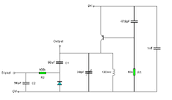
Audioguru, which configuration do you think will be better in Sasi's circuit?

My one where the capacitor's across the whole filter, or the student's circuit where it's just across half the filter.

I have a feeling mine will be more sensitive, but the student's might be better because the anode of the varactor is connected to ground, thus avoiding the biasing problem I talked about earlier. Also the diode will have less affect at 10.7MHz than at 100MHz so it will be a lot less sensitive and may  be unable to achieve sufficient deviation with a 1N4001 so you might have to use a the proper varactor like the one used in their circuit.

Edit:
Hang on a second, the deviation on the 10.7MHz signal will be multiplied by 9, as we're using the 9th harmonic, a deviation of just 8KHz will become 72KHz so a plain old 1N4001 might be ok after all. ;D

This raises another issue, remember me talking about limiting the deviation. Imagine if I set up the amplifier and limiter to give a 75kHz deviation at 88MHz with peek audio input, now if I retuned to 108MHz, the deviation would increase a lot because the same change in varactor capacitance will give a far greater deviation at this higher frequency. I could get round this problem by just using the varactor alone to tune the whole circuit but I might need to use more than one diode in parallel. I don't think I'll bother will limiting though it all seems too much trouble, :) I'll just set the gain to a value that will give 75kHz with the normal peak audio input. I'll still look into the varactor tuning idea as it might be cheaper than using a variable capacitor.

I'm still interested in the possibility of using an automatic volume control, is there a simple way I could incorporate this into the pre-emphasis op-amp circuit?

 
Last edited:

audioguru2

Apr 6, 2004
12,026
Joined
Apr 6, 2004
Messages
12,026
Hi Alun,
This 10.7MHz ceramic filter controlled FM transmitter won't be able to change its RF frequency much away from the 9th harmonic at 96.3MHz.
I'm surprised that Sazi got some very high frequency output out of his transistor's collector, because it is swinging at 10.7MHz, isn't it? The tuned circuit is ringing at its very high tuned frequency so will need a tap for the antenna.

The ceramic filter is already a tuned circuit so a capacitor across it might ruin its Q or make it resonate at a frequency too low. 

 
A

Alun

Jan 1, 1970
0
Well you can normally pull crystals a few kHz and they'll remain stable, but I can see your point, but if the studants managed to do it and I can't see a reason why we can't.  ;D

If you used a 1/4 wavelengh antenna  it will resonate at 96.3MHz and act as another tuned circuit, and help filter the harmonic.

 
Last edited:
Top