Free to download and try.
website: http://www.virtins.com
PC version: http://www.virtins.com/SCMISetup.exe
Pocket PC version: http://www.virtins.com/PocketINSSetup.exe
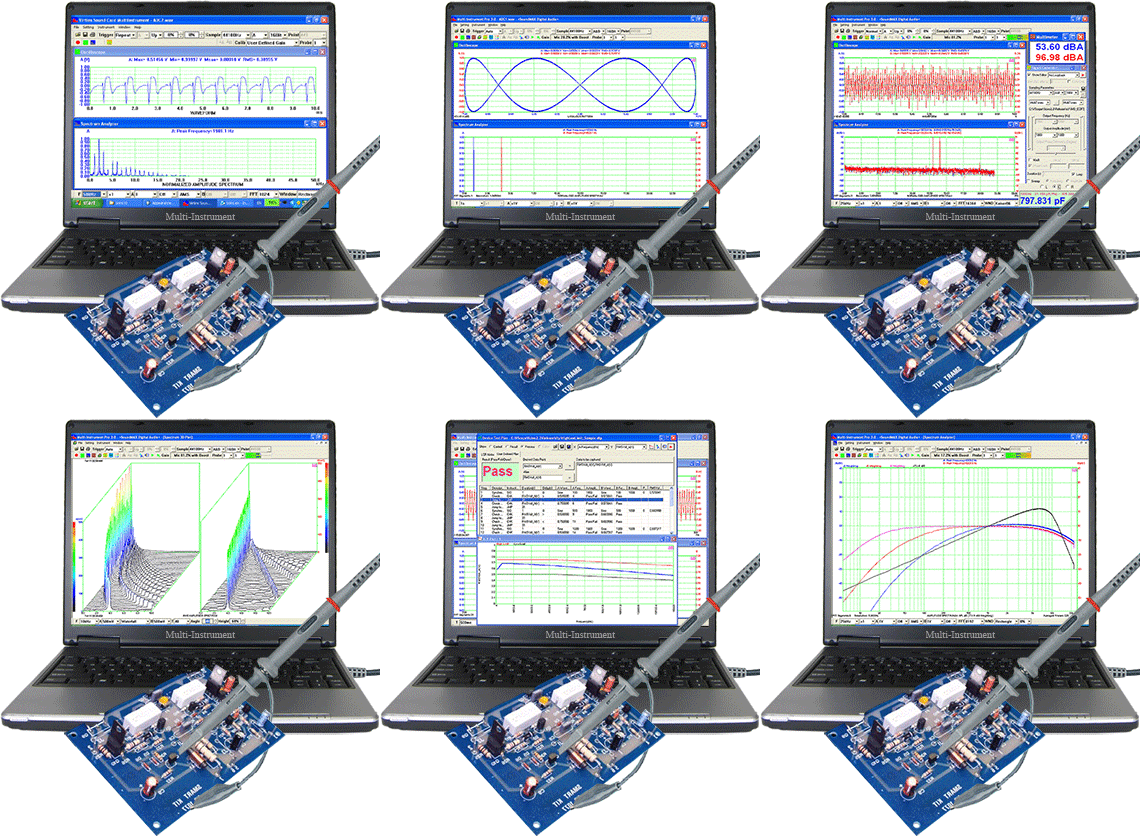
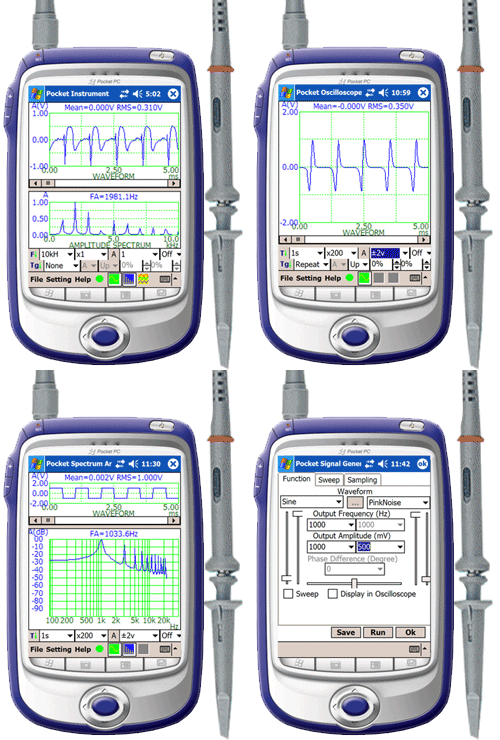
Virtins MultiInstrument consists of a sound card dual trace oscilloscope, a real time spectrum analyzer, and a signal generator and can run them concurrently. It features a specially designed data acquisition approach, which is able to monitor the input signal continuously without missing any trigger event before a frame of data is collected. It has a very fast screen refresh rate. It supports sophisticated triggering method including pre-trigger and post-trigger. A comprehensive range of functions are provided, including waveform addition and subtraction, Lissajous Pattern, transient signal recording, voltmeter, RMS amplitude spectrum, relative amplitude spectrum, octave analysis(1/1,1/3,1/6,1/12,1/24),THD, THD+N, SNR, SINAD, peak hold, phase spectrum, auto correlation, cross correlation, function generation, multitone generation, arbitrary waveform generation, white noise and pink noise generation and sweep signal generation. It Supports 8, 16, 24 bits and multilingual user interface, including English, French, German, Italian, Spanish, Portuguess, Simplified Chinese, Traditional Chinese, Japanese, and Korean.
website: http://www.virtins.com
PC version: http://www.virtins.com/SCMISetup.exe
Pocket PC version: http://www.virtins.com/PocketINSSetup.exe
Virtins MultiInstrument consists of a sound card dual trace oscilloscope, a real time spectrum analyzer, and a signal generator and can run them concurrently. It features a specially designed data acquisition approach, which is able to monitor the input signal continuously without missing any trigger event before a frame of data is collected. It has a very fast screen refresh rate. It supports sophisticated triggering method including pre-trigger and post-trigger. A comprehensive range of functions are provided, including waveform addition and subtraction, Lissajous Pattern, transient signal recording, voltmeter, RMS amplitude spectrum, relative amplitude spectrum, octave analysis(1/1,1/3,1/6,1/12,1/24),THD, THD+N, SNR, SINAD, peak hold, phase spectrum, auto correlation, cross correlation, function generation, multitone generation, arbitrary waveform generation, white noise and pink noise generation and sweep signal generation. It Supports 8, 16, 24 bits and multilingual user interface, including English, French, German, Italian, Spanish, Portuguess, Simplified Chinese, Traditional Chinese, Japanese, and Korean.


