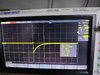
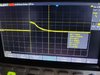
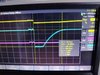
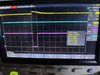
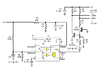
What do you see on your scope when connected to the common node of R4&R5 when you cycle 12V on/off?
It should be a ~0.7V positive pulse when 12V cycles off, and ~-0.7V negative pulse when 12V cycles on.
What do you see on your scope when connected to the common node of R4&R5 when you cycle 12V on/off?
It should be a ~0.7V positive pulse when 12V cycles off, and ~-0.7V negative pulse when 12V cycles on.
-ve pulse seems 1.94v while +be seems what you mentioned... 0.74v. I attached the pics.What do you see on your scope when connected to the common node of R4&R5 when you cycle 12V on/off?
It should be a ~0.7V positive pulse when 12V cycles off, and ~-0.7V negative pulse when 12V cycles on.
Rechecking....Yup. Q2 is not in the circuit. Either its emitter or its base are not connected, or neither is, or it's destroyed.
You are my God !!!! A jumper wire was faulty so base was never connected to gnd and was floating..... I see below nowRechecking....
You are my God !!!! A jumper wire was faulty so base was never connected to gnd and was floating..... I see below now![]()
Yeah... I'm sure that was the case... double ended male-male jumper wire ... could never have doubted it
BTW... 12V ON pulse, I need to delay by 2 sec... Is there any easy way to do it ... by RC ?
Ahhhh thats not acceptable... The 12V off I shall know instantaneously so as to stop microcontroller state machine.You could increase C3 to 330uF or so, but this would also delay 12V OFF. If that's acceptable, go for it.
Ahhhh thats not acceptable... The 12V off I shall know instantaneously so as to stop microcontroller state machine.
While 12V On I shall delay so that by that time motors and other electronics are up and powered, then only the microcontroller shall be informed of the 12V on.
Software is bit of black box and shall not change... So that's ruled out...How about a software delay then? Meanwhile what does "instantaneous" mean in the context of the ~4 second discharge you measured on 12V?
Software is bit of black box and shall not change... So that's ruled out...
I m planning to play with 555 thresholds for generating a faster off response later once I understand the working of ckt when it's complete.
Then I suggest increasing C3 as described, then adding a diode (e.g., 1N4004) in parallel with R6 with its cathode on the 12V end.
That RC will give you your ~2s delay on 12V ON, while the diode will bypass the RC on 12V OFF.
Oops! Bad idea. Won't work because the R6 diode won't conduct and trigger the 555 until 12V decays all the way down to 1V.
A better idea would be separate RC networks for the 555 trigger and threshold inputs.

Will give it a try today !!!Try this. Note that, in order to work, the circuit depends on the (undocumented) 555's behavior when both threshold and -trigger are simultaneously asserted, which will occur when 12V turns off. This is technically an undefined state, but it seems a "typical" LMC555 will have -trigger override threshold and drive OUT high, thus generating the correct "12V OFF" pulse "instantaneously."
Meanwhile "12V ON" will be delayed ~2s.
YMMV.
View attachment 55650
Will give it a try today !!!