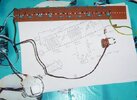
for a good output generator , ive found microwave oven ,moters to be effective , although the shaft is tight to turn . but with a pair of pliers ,i tried it and little did i know at first that, i was gona get a big shock, so i tested it more ,this moter when rotated sure puts out a good charge enougth to make me drop the moter. i biult a voltage multiplier circiut . this has 19 stages useing 1n4007 diodes and 3kv ceramics 0.0033uf , and to it i ran wires , from the microwave moter , then i rotated it a few times, as tight as it was to rotate, the pair of pliers i used , sure helped. every few times i rotated it i was able to get a tiny arc or small spark from the multiplier circiut.
 View attachment 35101
Last edited by a moderator: