@Kuberan,
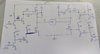
Assuming the high-side switching device is in-fact an N-Channel mosfet; I don't know how the high-side Mosfet would ever turn on ... the data sheet shows the IRF3205 has a gate threshold Voltage (Vgst) of ~4V. This would imply you need a minimum gate voltage of 16V (with respect to ground) to turn on the High-Side Mosfet and to reach the rated Rds ON of 0.008 ohms you would need a Vgs of at least 10V (ie 22V with respect to ground).
For low voltage (ie < ~30Vdc) H-Bridge circuits using P-Channel Mosfets for the High Sides and N-Channel Mosfets for the Low Sides usually results in the the easiest to DIY designs. As the Voltage increases (and perhaps in some cases as the Production Volume increases) using an N-Channel Mosfet for the High-Sides becomes increasingly desirable. To achieve N-Channel Mosfet High-Side switching specialized ICs are typically employed to create a floating High-Side switching voltage of Vcc + Vsw (where Vsw is typically 12V-15V).
This Link:
http://tahmidmc.blogspot.com/2013/01/using-high-low-side-driver-ir2110-with.html does an excellent job of explaining how both a High-Low Side Driver IC is used AND how a typical H-Bridge Motor controller might be designed.
Also, while running in one direction, the high side mosfet is heating.
While the IRF3205 is Nominally Rated @110A Continuous, you should note this rating is @25C.... In the datasheet (Page 5 Figure 9) there is graph showing the relationship of Id (Current) to TC (Case Temperature) that clearly shows the Package Thermal Limit to be Id = 75A ... and @ 75A this implies the device is eminently close to catastrophic failure even with an infinite heat sink.
On Page 3, Figure 4 shows the "Normalized" Rds_On with Respect to Tj (Junction Temprature) @Id = 107A is shown. While this essentially demonstrates the device in thermal runaway toward failure, it indicates a **realistic** Rds_On to Temperature relationship. Using this information can help determine heat sink requirements.
It is also important to note that while Vgst = 4V, most of the specifications are specified @ Vgs = 10V. @ a Vgs of less than 10V you should probably de-rate the device considerably. I would expect that using a high impedance 5V logic signal to drive an IRF3205 with no heat sink would put 10A continuous Id on the wrong side of the SOA (Safe Operating Area) box.
My abilities in thermodynamics are poor at best, but a few iterations of the conditions suggest that 10A continuous Id in an IRF3205 would certainly approach the device's 175 °C limit even with a Vgs of 10V:
When a TO-220 package is used without a heatsink, the package acts as its own heatsink, and the heatsink-to-ambient thermal resistance in air for a TO-220 package is approximately 70 °C/W
From:
https://en.wikipedia.org/wiki/TO-220
Initial conditions = 25 °C. 10A, Rds_On = .008 Ohms Vgs = 10V
Package Heat Gain = i^2 Rds_On
==> 10^2 * 0.008 = 0.8W
===> 0.8W * 70 °C/W = 25 °C + 70 °C = 95 °C
From Figure 4 @ 95 °C the "Normalized" Rds_On ~ 0.015 Ohms
==> 10^2 * 0.015 ohms = 1.5W
===> 1.5W * 70 °C/W = 25 °C + 105 °C = 130C
From Figure 4 @ 105 °C the "Normalized" Rds_On ~ 0.016 Ohms
==> 10^2 * 0.016 ohms = 1.6W
===> 1.6W * 70 °C/W = 25 °C + 112 °C = 137C
From Figure 4 @ 137 °C the "Normalized" Rds_On ~ 0.018 Ohms
==> 10^2 * 0.018 ohms = 1.8W
===> 1.8W * 70 °C/W = 25 °C + 126 °C = 151C
From Figure 4 @ 151 °C the "Normalized" Rds_On ~ 0.019 Ohms
==> 10^2 * 0.019 ohms = 1.9W
===> 1.9W * 70 °C/W = 25 °C + 133 °C = 158C
While an IRF3205 driven @ 5V might survive a 10A Id for some period of time w/o a heatsink, the thermal stress would almost certainly lead to premature failure. I would use rather robust heatsinks and even seriously consider using forced air (a fan) if I were going to design/build this circuit.
Hope This Helps!
Fish