Help, transistor circuit not working

Scuba_steve

Sep 21, 2014
1
Joined
Sep 21, 2014
Messages
1
Hello everyone,

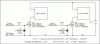
First post here. I am trying to use a transistor to turn on and off a Meanwell LDD-1500L LED Driver.
http://www.meanwell.com/search/LDD-L/LDD-L-spec.pdf

The transistor in use is a 2n3904, and it is being controlled by an Arduino. The power supply is 36V. The issue is it simply is not working. It is always on. I even reversed the transistors in case I made the bonehead mistake of installing them backwards!

Ignore the resistor capacitor portion btw. It is there for analog dimming. It is not even currently present in the circuit as of right now.

Please help!

LDD_1500.jpg
 
Last edited:

KrisBlueNZ

Sadly passed away in 2015
Nov 28, 2011
8,393
Joined
Nov 28, 2011
Messages
8,393
Hi Scuba_steve and welcome to Electronics Point :)

Thanks for giving us full information on the LED drivers you're using.

The LDD-1500L can draw up to 1.5 amps. The 2N3904 is rated for a maximum collector-emitter current of only 0.2 amps. You'll have to use something different. I recommend using a MOSFET.

But you have the transistor connected the wrong way. I assume you want to connect the switching device (transistor or MOSFET) between the negative side of the LDD-1500L and the 0V (negative) rail of your circuit, while the positive side of the LDD-1500L is permanently connected to a positive supply rail.

This is fine, and is a good way to control the circuit, but you need to swap the collector and emitter of the transistor.

This will become clearer if you redraw the schematic so the positive supply rail runs along the top, the 0V rail runs along the bottom, and the transistors and LDD-1500Ls are positioned appropriately between them, like this:

270390.001.GIF

I have suggested three alternatives for the MOSFET. These are all available from Digi-Key (http://www.digikey.com) pretty cheaply, and other suitable devices are probably available from other suppliers. Choose a "Low VGS" or "Logic level gate" type N-channel MOSFET with a VDS(max) at least 50% higher than the supply voltage for the LDD-1500Ls, an ID(max) of at least 3A, and an RDS(on) of less than 200 mΩ (0.2Ω) at VGS = 4.5V to avoid the need for a heatsink.

Alternatively, you could use Darlington transistors such as the BD675/7/9 or TIP120/1/2. These waste a bit of voltage and will dissipate some power, so a small heatsink may be needed. They will drop into the above circuit, with the collector at the top, and you can remove the zeners.

I have assumed that your Arduino outputs are 0V/5V. If they're 0V/3.3V then some extra circuitry will be required, or you can use special very-low-VGS MOSFETs, but these are only available in SMT (surface mount technology) packages.
 

Colin Mitchell

Aug 31, 2014
1,416
Joined
Aug 31, 2014
Messages
1,416
"But you have the transistor connected the wrong way."
That's why you have to draw a circuit according to CONVENTION.
You cannot expect to see a fault in a circuit if you draw it "up-side-down," "inside-out," "back-to-front" or with crayons.
 
Top