Hoover Vacuum Cleaner Brush Roller Stopped Spinning

Bhavick

Aug 28, 2023
12
Joined
Aug 28, 2023
Messages
12
Hi,

I've got a upright vacuum cleaner, it's a Hoover HL700P 001. The model is:91LA1737 and the serial number is:39100519 2040 0278.


What's happened is a couple of days ago while using it the brush roller at the bottom stopped spinning. I have removed the brush roller and cleaned it of any dirt and debris. I've also checked the belt and it seems in good condition, no stretching or breakages. I am suspecting it's the brush roller motor although am not 100% sure. Hoover doesn't sell a replacement motor for this specific model am at a loss as to what to try or test on it if anyone can please advise?

Many Thanks
 

Alec_t

Jul 7, 2015
3,817
Joined
Jul 7, 2015
Messages
3,817
Welcome to maker.pro!
The Hoovers I've owned have never had a separate motor for the roller. Does yours?
Despite appearances I suspect the drive belt has stretched. A new belt is under extremely high tension on the pulleys.
 

Bhavick

Aug 28, 2023
12
Joined
Aug 28, 2023
Messages
12
Welcome to maker.pro!
The Hoovers I've owned have never had a separate motor for the roller. Does yours?
Despite appearances I suspect the drive belt has stretched. A new belt is under extremely high tension on the pulleys.

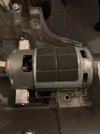
When I opened up the bottom of the hoover I saw this which i am assuming is the motor as it's directly connected to the belt. Please see attached picture with red arrow.
 

Attachments

  • IMG_1960.jpg
    IMG_1960.jpg
    220 KB · Views: 15

Martaine2005

May 12, 2015
5,276
Joined
May 12, 2015
Messages
5,276
That definitely looks like a motor. If it has a rating plate, look for the voltage. If it’s (probably is) mains voltage, you can test it with your mains supply.

Martin
 

Bhavick

Aug 28, 2023
12
Joined
Aug 28, 2023
Messages
12
That definitely looks like a motor. If it has a rating plate, look for the voltage. If it’s (probably is) mains voltage, you can test it with your mains supply.

Martin
Hi,

Where do you check for the rating plate? How do you check the motor with your mains supply? I have a volt meter if that helps.
 

Alec_t

Jul 7, 2015
3,817
Joined
Jul 7, 2015
Messages
3,817
With power off, check that the wiring to that motor is secure.
Check that the brushes (inside those white blocks on the left of the pic) are running smoothly on the commutator (visible through that 'window' in the motor.
Does the motor shaft/pulley rotate smoothly when the belt pulley is turned by hand?
Do you still get the normal noise when the hoover is powered up?
 

Bhavick

Aug 28, 2023
12
Joined
Aug 28, 2023
Messages
12
With power off, check that the wiring to that motor is secure.
Check that the brushes (inside those white blocks on the left of the pic) are running smoothly on the commutator (visible through that 'window' in the motor.
Does the motor shaft/pulley rotate smoothly when the belt pulley is turned by hand?
Do you still get the normal noise when the hoover is powered up?

Hi,

Yes the belt pulley rotates smoothly when you do it by hand and all wiring to the motor is secure. I cannot see any visible stretching in the belt at all in fact everything looks fine. The hoover is operational when you switch it on it's just that the brush roller at the bottom doesn't spin when you try and activate it. You do that by pushing back slightly on the handle and it normally activates the brush roller.
 
Last edited:

Alec_t

Jul 7, 2015
3,817
Joined
Jul 7, 2015
Messages
3,817
You do that by pushing back slightly on the handle and it normally activates the brush roller.
Ah, that indicates there is a rotary brush motor separate from the main suction motor. So moving the handle back must operate a switch (not the primary on/off one) in or near the handle. Perhaps the switch itself is faulty?
 

Martaine2005

May 12, 2015
5,276
Joined
May 12, 2015
Messages
5,276
Also, check continuity of each wire from motor to the switch. If it’s a mechanical movement, the wire may have broken. Simple fix.

Martin
 

Bhavick

Aug 28, 2023
12
Joined
Aug 28, 2023
Messages
12
Ah, that indicates there is a rotary brush motor separate from the main suction motor. So moving the handle back must operate a switch (not the primary on/off one) in or near the handle. Perhaps the switch itself is faulty?

OK that's fine but do you know where the switch is located and how to test it?
 

Bhavick

Aug 28, 2023
12
Joined
Aug 28, 2023
Messages
12
Also, check continuity of each wire from motor to the switch. If it’s a mechanical movement, the wire may have broken. Simple fix.

Martin

I'm assuming i need to check the two wires leading off the brush roller motor at the bottom of the hoover to where ever it goes?
 

Alec_t

Jul 7, 2015
3,817
Joined
Jul 7, 2015
Messages
3,817
Yes. Do you have a test meter to check continuity?
 

Alec_t

Jul 7, 2015
3,817
Joined
Jul 7, 2015
Messages
3,817
I'm assuming the hoover has a standard 13A UK plug and your 'voltmeter' is actually a multimeter?
With the hoover unplugged from the mains , the primary switch turned on, and the hoover handle pulled back to where the brush roller should work, check for continuity (near zero Ohms resistance) between the plug N pin (the one on the right when looking at the socket-side of the plug) and the motor terminal N connection (blue wire ). Repeat for the plug L pin and the motor terminal L connection (brown wire).
 

73's de Edd

Aug 21, 2015
3,730
Joined
Aug 21, 2015
Messages
3,730
If its this part that you are having problems with . . .it sez that its vacuum powered . . . not with use of a a separate motor.
Plus you say that its roller brush spins O.K . . . so see if the vacuum routed into it is clogged up.
HOWTODOITTOIT . . . . .
Note where the Hoover main units hose screws onto this attachment.
Disconnect the hose and cover its end with your palm to seal off air flow . . . .then turn on and power up that " Heaving Hoover " and listen to motor speed . . . take analytical aural note of motor speed / noise experienced.
Remove palm to permit free air flow . . . . take analytical aural note of the then change in of motor speed / noise experienced.
If you have flow restriction happening within that attachment, when you then reconnected to the hose and do testing, the motor speed will more closely resemble the affectation, as when you covered the hose end with your palm.
Thaaaaaaaasssit.


1693396373976.png
 
Last edited:

Alec_t

Jul 7, 2015
3,817
Joined
Jul 7, 2015
Messages
3,817
I'm having second thoughts about there being a separate motor for the brush roller, but can't explain how the brush roller rotates (or rather used to rotate) only if the Hoover handle is pulled back, if the normal motor noise is heard with the handle upright.
If the brush roller is vacuum powered as suggested in post #15 there would be no obvious need for the roller drive belt.
 

Bhavick

Aug 28, 2023
12
Joined
Aug 28, 2023
Messages
12
Hi,

Sorry guys maybe I have not explained it properly. The suction works perfectly find when you detach the handle and use any of the accessories on the end of it. The brush roller on the bottom only starts rotating when you slightly pull the hoover back which activates the brush roller and it starts spinning once you push it back up again it stops. The brush roller has completely stopped working regardless of if you push it back or forward. Maybe there isn't a separate motor it's actually just one?

Yes i do have a multimeter.
 

Alec_t

Jul 7, 2015
3,817
Joined
Jul 7, 2015
Messages
3,817
With the handle attached but pulled back, and the Hoover upside-down (so that there is no brush friction), does the motor in the pic rotate when the Hoover is switched on (keeping fingers etc well clear!)?
 

73's de Edd

Aug 21, 2015
3,730
Joined
Aug 21, 2015
Messages
3,730
Sir Bhavick . . . . .

Our most revered,honnable and esteemed Sir Alec . . .TEEEEE . . . . . . sez . . . .

With the handle attached,but pulled back, and the Hoover upside-down (so that there is no brush friction), does the motor in the pic rotate when the Hoover is switched on
and then . . . and then . . . .AND THEN . . . . AND THEN . . . .
What you wants to do NEXT, is to press that now well used palm, into the hose pet attachments rotating brush to see if progressive pressure into it, still has the brush spinning . . .OR . . . . IF the belt quickly starts slipping /or / stopping and results in no brush rotation. ? ? ?
NOW . . . . this photo below will probably explain the solution . . . .thanks to some KNOCK OFFS of this type of unit . . . . if them not being downright mold DUPLICATES.
(Also, thanks be, to the easily visible clear plastic utilized portion !)
Prepare yerself's for an ear-splitting trumpet fanfare . . . .
Ta . . . D A A A A A A A A !

1693523451648.png

Now do duly note that the principle of operation is the vacuum hose connection at the very top, pulling in air that has to pass thru the blades of that yellow impeller. ( Think of an olde tyme water wheel and its paddles . . . . with air flow being the drive media . . . vice . . . aqua pura et vitae.)
You can see that impeller ends at the foreground, in its then being coupled into a 9 tooth cogged pulley.
Then a cogged drive belt couples into a MUCH larger drive pulley at the end of your exposed rotating roller brush.

OPINES . . . . with that drastic of a hard bend around that small diameter of cog pulley, I am suspect of the utile of a quite supple belt media of HD vinyl or silicone rubber VICE use of a conventional multi ply media belt construction.
ALSO, at the beater brush pulley the belt will be pressing down into a groove in the two pulley sides . . . . .with no cogging being used within the big pulley.
Also note the mechanical torque multiplication afforded via the two pulley diameter ratios chosen, due to the comparatively quite feeble capabilities of the vacuum driven impeller.

WHATTOCHECHFORNOWWITHUSEOFTHEKNOWLEDGEINFLUXOFALLOFTHISNEWLYINCOMINGINFORMATION . .
With the potential of your being able to visually see the end of the rotating beater brush end and its pulleys engagement into the belt. When you "palmed" the brush hard enough to see it stop, was the belt still moving while the pulley was stationary ?
OR was both pulley AND belt at a standstill, suggesting that you had stalled the WHOLE power train, going all the way back to the vacuum impeller .

What I strongly suspicion, is that with accumulated time and use that long pet hairs have wound around that impellers innermost shaft and
mattted up to cause a progressing constant braking action.
That impeded impeller rotative cabability is no longer SPINNING up to, brand new . . . day ones . . . performance RPM's. . . . .thereby, stalling out easily.

Thaaaaaaaaassssit . . . .

73's de Edd . . . . .


On some days . . . I absolutely amaze myself . . . . . whilst on other days . . . . I find myself putting my laundry in the oven . . . . . .


.
 
Last edited:

Alec_t

Jul 7, 2015
3,817
Joined
Jul 7, 2015
Messages
3,817
The post above mentions a cogged belt. Is the belt cogged or smooth?
 
Top