isolated motor feedback circuit

bob_s

May 22, 2004
20
Joined
May 22, 2004
Messages
20
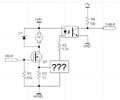
I have a motor circuit which needs to have feedback for current flow through the motor (see attachment). The input drive is pulse width modulated at 50khz. The motor draws up to 6A. How do I get the optoisolator to turn on when current flows?

motor_feedback.jpg


bob_s

May 22, 2004
20
Joined
May 22, 2004
Messages
20
I'm not interested in the amount of current flowing but rather that it is flowing. The schematic only shows a portion of my circuit. It does already have current limiting. However, I only have a digital input available to use in my sensor circuit.

I believe the stall current for this motor is about 1A. So if the opto is turned on when the current is greater than 1A that would be great.


audioguru2

Apr 6, 2004
12,026
Joined
Apr 6, 2004
Messages
12,026
Bob,
Most DC motors stall with a HUGE current, just measure its resistance then use Ohm's Law. Isn't that why your circuit has current-limiting?
So maybe you need just a decision:
a) No current. The motor has burned-out.
or
b) Normal current. All is well.
or
c) Current-limit. The motor has stalled.

You could even detect other problems such as:
d) Low current. The drive-belt has broken.
and
e) Higher than normal current. Something is binding and the motor may over-heat.


bob_s

May 22, 2004
20
Joined
May 22, 2004
Messages
20
I'm sorry. What I meant to say is that the motor does require a minimum amount of drive in order to move with it's load and that works out to about 1A or more of current flow. I need this motor to move very slow in some circumstances.

I would like to have the feedback that you just described. But I am limited to one digital input to my controller circuit. I am using a PIC microcontroller and have an EXT interrupt pin available that I can use to count pulses, etc... At this point I would be happy with just a "yes" it's flowing or "no" it's not. These motors have physical limit switches which open and introduce reverse bias diodes interupting current flow and this is what I need to know is happening. The current stops at the limit and will only flow in the opposite direction until the switch closes again shorting out the diode.

One thought that I had was to use a pair of op-amps. Feading the voltage of a small current sense resistor (0.1ohm) into the first amplifier (unity gain) and then an inverting amplifier (x10 ) to turn the opto isolator on. I am just not sure how to set this circuit up.


ante1

Jan 24, 2004
4,138
Joined
Jan 24, 2004
Messages
4,138
Bob,
If the stall current is 1A, under which circumstances do you expect 6A?

Ante ::)


ante1

Jan 24, 2004
4,138
Joined
Jan 24, 2004
Messages
4,138
Bob,

I guess we where writing simultaneously as I saw you message after I was finished with mine. Is it only motion you want to detect? In that case an opto sensor will come in handy, giving an output while the shaft moves and non when it stops.

Ante ::)


bob_s

May 22, 2004
20
Joined
May 22, 2004
Messages
20
I already have motion feedback. Having current feedback as well gives me a better indication of what is happening (limit switch, obstruction, etc..).


ante1

Jan 24, 2004
4,138
Joined
Jan 24, 2004
Messages
4,138
Bob,

What is the highest value possible for R2? This will determine if the opto LED can be driven right off the voltagedrop or else you need an op-amp to boost the voltage.

Ante ::)


bob_s

May 22, 2004
20
Joined
May 22, 2004
Messages
20
I wouldn't want to have more than 1V drop. Less is better.


bob_s

May 22, 2004
20
Joined
May 22, 2004
Messages
20
Ok. So how do I set up the circuit? I am not that familiar with opamp circuits.

Bob


ante1

Jan 24, 2004
4,138
Joined
Jan 24, 2004
Messages
4,138
Bob,

I have replaced your R2 with two resistors. The op-amp will (I hope) put out approx 3Volts when 6 A is passing through the


ante1

Jan 24, 2004
4,138
Joined
Jan 24, 2004
Messages
4,138
Bob,

Was this any help to your problem?

Ante ::)


bob_s

May 22, 2004
20
Joined
May 22, 2004
Messages
20
Ante,

I've been busy dealing with another issue and have not been able to try this circuit out yet. Could you explain the theory of this circuit to me? Why you chose the values? What was your train of thought? I would like to understand the theory better before using this circuit.

Thanks


ante1

Jan 24, 2004
4,138
Joined
Jan 24, 2004
Messages
4,138
Bob,

I will try my best:
The voltage drop over R2-1 (U=R*I) is amplified in U1 by a factor of 10. This factor is set by R1 and R2. The maximum current = 6A the resistance of R2-1 is 0.05R which gives 0.05 * 6 = 0.3 Volts. The output of U1 is 0.3 * 10 = 3 Volts. The reason for R2-2 is to raise the potential above ground to make the op-amp (U1) work better. Thus the output varies from 0 to 3Volts linear with the current 0


audioguru2

Apr 6, 2004
12,026
Joined
Apr 6, 2004
Messages
12,026
Ante,
I am sorry but your circuit has problems: :(
1) The opto won't be active until the current through the sense resistors exceeds about 2.8A.
2) The opamp's output will be 3.63V with 6A of current through the sense resistors.
3) R2-2 is not needed when using a 324 quad opamp.
4) You show the pinout for an LM358 dual opamp, which is the same as an LM324, except it is dual instead of quad.
The data sheet for the LM358 is here:
http://www.national.com/ds/LM/LM158.pdf

I have re-arranged your circuit to make it better:
1) I have included the opto's LED in the feedback loop of the opamp so that the current through that LED exactly follows the current through the sense resistor, without any dead-zone.
2) I changed the opamp's gain so that the voltage at the LED's cathode is exactly 3V when 6A of current flows in the sense resistor.
3) I eliminated R2-2, since the LM324 and LM358 have inputs that can operate very well down to ground.
My revised circuit is here: ;D

 

audioguru2

Apr 6, 2004
12,026
Joined
Apr 6, 2004
Messages
12,026
OOOps,
I always make this mistake:
The gain of a non-inverting opamp is 1 PLUS the resistor ratio, so when 6A of current flows in the sense resistor then the voltage at the LED's cathode is 3.3V. If R2 is 910K then the voltage will be 3.03V.

 
Top