LOAD RESISTOR IN A MOSFET AMPLIFIER

shaiqbashir

Jun 4, 2005
251
Joined
Jun 4, 2005
Messages
251
Thanks a lot Audioguru! your help has really improved my ideas and designs. But one thing that i always want to ask to you is

How to add an AC negative feedback in an amplifier circuit. Can u give me an example please. After adding it, according to u, it would give me sufficienlty low output impedance, so my amplifier would not be affected by any load, then would it be able to drive an 8-ohm speaker.


Thanks a lot in advance!

 
A

Alun

Jan 1, 1970
0
Hang just a miniute, don't most amplifiers use resistors for feedback so both the DC and AC feadback are the same unless of course they're using conpensation capacitors.

shaiqbashir,
Negitive feedback in its simplest form is when an inverting amplifier with a very high gain has a resistor connected from the output to the input, since the out is opposite to the input a fraction of the output signal cancels out the input signal, this has the affect of reducing the gain a lot but the noise and bandwidth are increased a lot, and the output impedance, noise and  harmonic distortion are reduced also.

See the attached PDF it explains all. ;D

feedback.pdf


Attachments

  • feedback.pdf
    47.6 KB · Views: 11

audioguru2

Apr 6, 2004
12,026
Joined
Apr 6, 2004
Messages
12,026
Hi Shaiq,
Before you add negative feedback, you need to calculate the required output current and design a circuit that can deliver that amount of current to the load without much loss. Your output circuit needs to be push-pull, so that it can drive the speaker equally positive and negative. It must switch its output transistors smoothly from one pulling up to the other pushing down, to prevent crossover distortion. The circuit of your amplifier should have excessive gain so that negative feedback will use the excess to reduce the output impedance and reduce the gain to a predictable lower amount.
Look at opamps. They have a gain of about 200,000. With negative feedback they are nearly perfect.
The circuit that I posted is like a high-power opamp that you need. ;D

Hi Alun,
Many amplifiers have their negative feedback capacitor-coupled to ground so that their closed-loop gain doesn't amplify their input offset DC voltage. ;D

 
A

Alun

Jan 1, 1970
0
Hi fowzulniyaz,
Why don't you just stay tuned to this thread or look at the projects section of this site.

Want a common source amplifier with a very low output impedance, and high voltage swing?

Easy, just use a simple inverting complementary pair. ;D

I don't know about distortion and noise but if you set the gain to a low value or even better used an op-amp to drive it and let the negitive feedback clean things up.

Inv_comp_pair.PNG


audioguru2

Apr 6, 2004
12,026
Joined
Apr 6, 2004
Messages
12,026
Hey Alun,
You have sketched a "smoke signals" amplifier! ;D
Using the Mosfet and its mate that Shaiq is using that are rated for 30A, both complimentary Mosfets would be conducting against each other so hard that if the power supply doesn't smoke, then the Mosfets certainly will. I think it will make 3 puffs of smoke:
1) The power supply.
2) The weaker p-channel Mosfet, but it might survive without the power supply.
3) The n-channel, but it might survive without the others.

But since it operates as class-A, it won't have any crossover distortion and it will keep you nice and warm. ;D ;D

 
A

Alun

Jan 1, 1970
0
I wasn't really thinking, I just copied the cmos inverter circuit, how come it doesn't blow up then?


audioguru2

Apr 6, 2004
12,026
Joined
Apr 6, 2004
Messages
12,026
Hi Alun,
Your Mosfet amplifier will provide only 6.2W to an 8 ohm load at clipping, but draw 600W from a 20V supply. Very inefficient! :eek: :eek:
An ordinary CD4069 Cmos inverter draws only about 1mA with a 5V supply, about 5mA with a 10V supply and about 10mA with a 15V supply when used as a linear amp.
A 74HC04 inverter will draw from 10mA to 30mA (beyond its 25mA max output rating) with a 5V supply when used as a linear amp, so they are not recommended for use as a "Classic Cmos 2-inverter oscillator". ;D

 
A

Alun

Jan 1, 1970
0
audioguru said:
Hi Alun,
Your Mosfet amplifier will provide only 6.2W to an 8 ohm load at clipping, but draw 600W from a 20V supply. Very inefficient! :eek: :eek:
It's ok you don't need to tell me, don't worry I understand  ;D and I can see my error, both of the mosfets will be biased on all the time and it will operate in class A. The gate of the P-channel will always be lower and the source turning it on and the N-channel will always have the gate above the source turining it on too, as both transistors are on the power consumption will be very high.

An ordinary CD4069 Cmos inverter draws only about 1mA with a 5V supply, about 5mA with a 10V supply and about 10mA with a 15V supply when used as a linear amp.
A 74HC04 inverter will draw from 10mA to 30mA (beyond its 25mA max output rating) with a 5V supply when used as a linear amp, so they are not recommended for use as a "Classic Cmos 2-inverter oscillator". ;D
I know amazing isn't it?

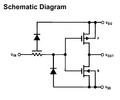
The internal diagram looks very similar to my circuit, but why is mine a power wasting class A amplifier and the CMOS inverter an effiecnt class B/AB amplfier?

How do they ensure that both of the transistors don't turn at the same time?

Do the diodes and input resistor have some magic property or something? ;DCD4096_cmos_inverters.pdf

cmos_inverter_schematic.PNG


Attachments

  • CD4096_cmos_inverters.pdf
    78.8 KB · Views: 3

audioguru2

Apr 6, 2004
12,026
Joined
Apr 6, 2004
Messages
12,026
audioguru said:
An ordinary CD4069 Cmos inverter draws only about 1mA with a 5V supply, about 5mA with a 10V supply and about 10mA with a 15V supply when used as a linear amp.
A 74HC04 inverter will draw from 10mA to 30mA (beyond its 25mA max output rating) with a 5V supply when used as a linear amp, so they are not recommended for use as a "Classic Cmos 2-inverter oscillator". ;D
I know amazing isn't it?

The internal diagram looks very similar to my circuit, but why is mine a power wasting class A amplifier and the CMOS inverter an effiecnt class B/AB amplfier?

How do they ensure that both of the transistors don't turn at the same time?
They do turn on at the same time in class-A. That is why they draw supply current. But they are puny little thingys (for speed) with a fairly high "on" resistance.

A power Mosfet has thousands of bigger Mosfets, called cells, in parallel. That's why their input capacitance is so high, and their "on" resistance is so low. ;D
 
Last edited by a moderator:
Top