You are using an out of date browser. It may not display this or other websites correctly.
You should upgrade or use an alternative browser.
You should upgrade or use an alternative browser.
Scroll to continue with content
Another way to write τ>>t would be t<<τ or t=0+ for initial start-up or turn-on of the circuit.
But a capacitor doesn't know if it is in a LPF or HPF, it just behaves according to the defining equation Ic=Cd/dtVc. So at t=0+ the voltage across the capacitor is zero (and rising) but the current through the capacitor and the rate of change of the voltage across the capacitor are determined by other components in the circuit.
At t=0+ there is current flowing through the component and no voltage across the component. Would you call that a short circuit?
But a capacitor doesn't know if it is in a LPF or HPF, it just behaves according to the defining equation Ic=Cd/dtVc. So at t=0+ the voltage across the capacitor is zero (and rising) but the current through the capacitor and the rate of change of the voltage across the capacitor are determined by other components in the circuit.
At t=0+ there is current flowing through the component and no voltage across the component. Would you call that a short circuit?
Another way to write τ>>t would be t<<τ or t=0+ for initial start-up or turn-on of the circuit.
But a capacitor doesn't know if it is in a LPF or HPF, it just behaves according to the defining equation Ic=Cd/dtVc. So at t=0+ the voltage across the capacitor is zero (and rising) but the current through the capacitor and the rate of change of the voltage across the capacitor are determined by other components in the circuit.
At t=0+ there is current flowing through the component and no voltage across the component. Would you call that a short circuit?
Keep in mind that current does not pass through a capacitor. The rate of charge imbalance on the plates simulates the presence of a current in the capacitor circuit.
Ratch
That kind of thinking is so mired in the time domain. Linear circuit theory is based in the complex-frequency domain where capacitive current obeys Ohm's Law. However, the circuits in the complex-frequency domain are the Laplace transform of their counterpart in the time domain. While time domain explanations are certainly true, they lack the conceptual simplicity of the complex-frequency domain where circuit analysis is done on the other side of the Laplace transform, and capacitive current does flow through its transformed counterpart from the time domain. I graduated from the time domain a long time ago, and I'm not going back (except through the inverse Laplace transform).Keep in mind that current does not pass through a capacitor.
That kind of thinking is so mired in the time domain. Linear circuit theory is based in the complex-frequency domain where capacitive current obeys Ohm's Law. However, the circuits in the complex-frequency domain are the Laplace transform of their counterpart in the time domain. While time domain explanations are certainly true, they lack the conceptual simplicity of the complex-frequency domain where circuit analysis is done on the other side of the Laplace transform, and capacitive current does flow through its transformed counterpart from the time domain. I graduated from the time domain a long time ago, and I'm not going back (except through the inverse Laplace transform).
Both time and frequency analysis are mathematical methods which do not supplant the physics of circuits containing electrical components. Whether the charge passes through components like inductors and resistors, or accumulates and depletes on the plates of a capacitor makes no difference in analyzing the current existence in the component branch of the circuit. For either method, it is wrong to say that charge passes through a capacitor.
A lot of folks are calling the relationship of impedance, voltage, and current by the wrong name. V=I R is not Ohm's law. Ohms law is a property of a material (electrical linearity), not a formula (Impedance triangle) for determining circuit parameters. See post #22 on the second page of the first link below. I will be happy to discuss this with anyone.
http://www.electro-tech-online.com/threads/ohms-law.430/page-2
http://www.launc.tased.edu.au/online/sciences/PhysSci/done/electric/resistnc/Resistance.htm
Ratch
Hi, I have a question about LPF and HPF in RC circuit.
I know that in LPF when τ>>t the capacitor is close to be a short.
but what happens in HPF when τ>>t ? that capacitor is close to be a short also?
Thanks for your help!
I am having a hard time understanding your "question". What does HPF and LPF mean? Is it high or low power factor, high or low possible frequency, or maybe even high or low pass filter? It is good practice to fully write out unfamiliar acronyms one time at first. Assuming that you are referring to a filter, are you asking about the startup transient? A filter becomes useful when it enters its steady state operation. Are you asking about the capacitor behavior at its initial startup? If so, what voltage? Ramp, sinusoidal, step, triangle, or what? A little more definition of your question would go a long way for other folks to understand it.
Ratch
If you Laplace transform a capacitor, whaddya get? Actually though, linear circuit analysis is not concerned with the physics of electrical components. What we call a 'capacitor' is just a model of a one-port network where current flowing through the network behaves according to the differential equation Ic=Cd/dtVc. It makes no sense to discuss the device physics of this 'capacitor' since it is just a mathematical model labeled 'capacitor'.Both time and frequency analysis are mathematical methods which do not supplant the physics of circuits containing electrical components.
That is why we maintain consistency and say that current flows through a capacitor.Whether the charge passes through components like inductors and resistors, or accumulates and depletes on the plates of a capacitor makes no difference in analyzing the current existence in the component branch of the circuit.
You are the only one saying "charge passes through a capacitor."For either method, it is wrong to say that charge passes through a capacitor.
Indeed, there is a whole world full of these folks. You should discuss your complaint with them.A lot of folks are calling the relationship of impedance, voltage, and current by the wrong name.
That may be how Georg Ohm characterized his work when he first published his empirical findings in 1827, but what we call "Ohm's Law" has been reformulated numerous times since then and Georg Ohm wouldn't even recognize it today, especially Ohm's Law for AC.V=I R is not Ohm's law. Ohms law is a property of a material (electrical linearity)
I'm sure the feeling will be mutual.I will be happy to discuss this with anyone.
If you Laplace transform a capacitor, whaddya get? Actually though, linear circuit analysis is not concerned with the physics of electrical components. What we call a 'capacitor' is just a model of a one-port network where current flowing through the network behaves according to the differential equation Ic=Cd/dtVc. It makes no sense to discuss the device physics of this 'capacitor' since it is just a mathematical model labeled 'capacitor'..
The model has to be based on the physics of the component, otherwise it has no relationship with the component. Any capacitor model has to acknowledge a discontinuity of current in a capacitor. Otherwise, the capacitor would just be a resistor, and would not store energy in a electrostatic field by unbalancing the charge on its plates. You can say that current exists in the branch containing a capacitor, but it is dead wrong to say that charge flows through a capacitor.
That is why we maintain consistency and say that current flows through a capacitor..
That is consistently wrong.
You are the only one saying "charge passes through a capacitor.".
No, I am saying that charge does not flow through a capacitor.
Indeed, there is a whole world full of these folks. You should discuss your complaint with them..
You are one of those folks. Therefore, I am calling you on it.
That may be how Georg Ohm characterized his work when he first published his empirical findings in 1827, but what we call "Ohm's Law" has been reformulated numerous times since then and Georg Ohm wouldn't even recognize it today, especially Ohm's Law for AC.
Physical laws are based on physics, and are immutable. Therefore, they can not be changed or reformulated unless they are incorrectly stated in the first place. Both the principle of linearity and the V,I,R relationship are correct and different. That makes Ohm's law a misnomer when used to incorrectly describe one of the above relationships. But which one is not Ohm's law? Lots of physics books and EE profs say Ohm's law pertains to electrical linearity. The popular press and the masses say it is about the VIR relationship. Keep in mind that a consensus of opinion is not proof. I have to ask why does the distance, velocity, time relationship not have a name also. Something like Newton's spacial law. I can speculate that somewhere someone published a incorrect statement which said the VIR relationship was Ohm's law, and nobody bothered to correct it until it got too widespread and ingrained to change easily. The same is true about "imaginary" numbers, which are not really imaginary.
I'm sure the feeling will be mutual.
Bring them on!
Ratch
That is just plain false. Oliver Heaviside demonstrated how to treat the current flowing through a capacitor exactly the same as current flowing through a resistor. This concept is fundamental to linear circuit theory.Any capacitor model has to acknowledge a discontinuity of current in a capacitor. Otherwise, the capacitor would just be a resistor
Note that I posted some of Heaviside's work on that topic a while back. But our illustrious moderators seemed to think it was inappropriate for this site, and removed it. So if you missed it then, you missed out and I'm not going to post it again.
You are still the only one here talking about charge through a capacitor.No, I am saying that charge does not flow through a capacitor.
As one of the illustrious members of our community once said: "Skin that smoke wagon, and see what happens!"You are one of those folks. Therefore, I am calling you on it.
You seem to think that "Ohm's Law" must exactly reflect what Ohm published in 1827, but in fact we can attach that title to anything we want. No immutable law has been broken. So your premise is false, and your argument is therefore invalid.Physical laws are based on physics, and are immutable. Therefore, they can not be changed or reformulated unless they are incorrectly stated in the first place.
Throw down, boy! Or are you just going to stand there and bleed?Bring them on!
That is just plain false. Oliver Heaviside demonstrated how to treat the current flowing through a capacitor exactly the same as current flowing through a resistor. This concept is fundamental to linear circuit theory.
I cannot comment on something to which I do not have access. However, you must know that a capacitor cannot allow any charge to pass through it. Otherwise it could not accumulate energy by producing a electrostatic field.
Note that I posted some of Heaviside's work on that topic a while back. But our illustrious moderators seemed to think it was inappropriate for this site, and removed it. So if you missed it then, you missed out and I'm not going to post it again.
That's a shame, but I understand.
You are still the only one here talking about charge through a capacitor.
You talked about "current through the capacitor" in post #2 of this thread. Since current is the rate of charge flow, you, yourself, effectively said that charge is flowing through a capacitor.
As one of the illustrious members of our community once said: "Skin that smoke wagon, and see what happens! Throw down, boy! Or are you just going to stand there and bleed?
Whatever that means.
You seem to think that "Ohm's Law" must exactly reflect what Ohm published in 1827, but in fact we can attach that title to anything we want. No immutable law has been broken. So your premise is false, and your argument is therefore invalid.
You said in post #7 of this thread that Ohm's law has been reformulated, and even Ohm would not recognize it. I said in post #8 that Ohm's law is concerned about the material property of electrical linearity, not VIR. We are talking about a misnomer, not a change in a physical law or the way it is presented. Ratch
Since you insist on misinterpretation, I'd say that is your problem - not mine.You talked about "current through the capacitor" in post #2 of this thread. Since current is the rate of charge flow, you, yourself, effectively said that charge is flowing through a capacitor.

Since you insist on misinterpretation, I'd say that is your problem - not mine.
I don't know how else what you said could be interpreted ... you are the one clearly stating "current flowing through a capacitor", not Ratch
and since you don't seem to be able to get over that issue, the problem does indeed seem to be yours
Dave
I keep trying to explain how to interpret that statement, but you keep insisting your misinterpretation is paramount.I don't know how else what you said could be interpreted ...
This is a clue about linear circuit theory for those who may aspire to advanced study of network analysis and synthesis. Device physics are not relevant to circuit analysis. What is important are network models and the mathematical description of electrical characteristics at the network ports. For instance, as described above, a capacitor is a one port network model where a differential equation defines the relationship between the current flowing through the port and the voltage across the port. That is all. Device physics is another discussion, but not this one. Those who speak of current flowing through the network model of a 'capacitor' do not wish to be dragged into a discussion of capacitor device physics. How can you tell who those individuals are? They'll be the ones talking about circuit theory.
I keep trying to explain how to interpret that statement, but you keep insisting your misinterpretation is paramount.
This is a clue about linear circuit theory for those who may aspire to advanced study of network analysis and synthesis. Device physics are not relevant to circuit analysis. What is important are network models and the mathematical description of electrical characteristics at the network ports. For instance, as described above, a capacitor is a one port network model where a differential equation defines the relationship between the current flowing through the port and the voltage across the port. That is all. Device physics is another discussion, but not this one. Those who speak of current flowing through the network model of a 'capacitor' do not wish to be dragged into a discussion of capacitor device physics. How can you tell who those individuals are? They'll be the ones talking about circuit theory.
Network analysis or circuit theory are not in conflict with the physics of the capacitor. A capacitor has its unique and particular differential equation description due to its property of not allowing any electrical charge to flow through its dielectric. It instead allows the charge to accumulate and deplete on its plates. This movement of charge from one plate to the other causes a current to exist in the branch containing the capacitor, but no charge passes through the dielectric. This current can be analyzed by either time domain methods or frequency domain methods without claiming that charge passes through a capacitor.
Ratch
Then please show from the defining differential equation Ic=Cd/dtVc that current does not flow through the capacitor network model.A capacitor has its unique and particular differential equation description due to its property of not allowing any electrical charge to flow through its dielectric.
Then please show from the defining differential equation Ic=Cd/dtVc that current does not flow through the capacitor network model.
OK, I will, but first lets make the equation a little more clear. Ic = C*D(Vc,t), where D(Vc,t) means the derivative of Vc with respect to "t". Now, if the charge passed through the capacitor, then the voltage would be constant like a resistor, and D(Vc,t) would always be zero. That would make the differential equation false. So, charge has to be able to accumulate and deplete on the capacitor plates in order to product a counter voltage. This counter voltage together with the constant value of applied voltage produces a variable voltage across the capacitor. This variable voltage produces a derivative which constantly changes in value and gives the correct differential equation of the capacitor. Ic is the accumulation/depletion current, not the current passing through the capacitor, which is always zero. To summarize, a capacitor must disallow current through it in order for it to be a capacitor.
Ratch.
You have changed the question from one of current flowing through a network model to the issue of charge movement in the physical approximation of the network model. Since you did not answer the original question, you get zero points for that response.Now, if the charge passed through the capacitor,...
You have changed the question from one of current flowing through a network model to the issue of charge movement in the physical approximation of the network model. Since you did not answer the original question, you get zero points for that response.
You have changed the question from one of current flowing through a network model to the issue of charge movement in the physical approximation of the network model. Since you did not answer the original question, you get zero points for that response.
I have shown that the mathematical differential equation describing the current existing in a capacitor branch cannot be written without assuming current does not exist through the dielectric. By showing what happens when current does and does not exist through the capacitor, I believe I answered the question submitted in your post #15. If you cannot understand that, I don't know to explain it better.
Ratch
I understand what you did, and that is why I know you failed. When asked to analyze the network model of a capacitor, you immediately jump to the physical approximation of the capacitor network model and analyze that instead. The reason you fail is that you wear blinders that keep you from correctly seeing the problem. It is as though your worldview looks like this:If you cannot understand that, I don't know to explain it better.
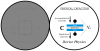
When analyzing the network model of a capacitor one needs to turn off their view of device physics and see the linear circuit theory view instead:
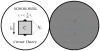
Notice that the network model has no plates and no dielectric material, it just has a differential equation. So the DF is all you have to work with. Also note that the behavior of the network model of a capacitor is defined in terms of the current flowing through the capacitor. So it is no surprise that you don't know how to explain it better. And that is why those who discuss linear circuit theory are correct when referring to current flowing through a capacitor.
I understand what you did, and that is why I know you failed. When asked to analyze the network model of a capacitor, you immediately jump to the physical approximation of the capacitor network model and analyze that instead. The reason you fail is that you wear blinders that keep you from correctly seeing the problem. It is as though your worldview looks like this:
View attachment 20294
When analyzing the network model of a capacitor one needs to turn off their view of device physics and see the linear circuit theory view instead:
View attachment 20293
Notice that the network model has no plates and no dielectric material, it just has a differential equation. So the DF is all you have to work with. Also note that the behavior of the network model of a capacitor is defined in terms of the current flowing through the capacitor. So it is no surprise that you don't know how to explain it better. And that is why those who discuss linear circuit theory are correct when referring to current flowing through a capacitor.
I understand what you are saying. Both methods work for circuit analysis. What I am further stating is that the model cannot justify the differential term unless there is a discontinuity in the charge flow. Specifically, no charge flows through the capacitor.
Ratch
Similar threads
- Replies
- 11
- Views
- 6K

- Replies
- 2
- Views
- 2K

- Replies
- 7
- Views
- 2K

- Replies
- 0
- Views
- 2K