LPF and HPF

hevans1944

Hop - AC8NS
Jun 21, 2012
4,968
Joined
Jun 21, 2012
Messages
4,968
I think the OP (if they are still around) should rephrase their question in light of the entertaining discussion between @Ratch and @Laplace. And here is a helpful Venn Diagram:
upload_2015-5-30_14-57-48.jpeg
 

Ratch

Mar 10, 2013
1,102
Joined
Mar 10, 2013
Messages
1,102
I think the OP (if they are still around) should rephrase their question in light of the entertaining discussion between @Ratch and @Laplace. And here is a helpful Venn Diagram:
View attachment 20303

Actually this is more of a situation than a problem. Unlike determining a yes or not answer of whether a model accurately reflects reality, this problem is a matter of personal preference that has no definitive solution. It is like determining how much sugar to put in your coffee. The tradeoff between privacy and security is a matter that will have to be decided by the elected powers that be. The correct answer is determined by the future consequences of which no one can be sure.

Ratch
 

hevans1944

Hop - AC8NS
Jun 21, 2012
4,968
Joined
Jun 21, 2012
Messages
4,968
I love the Internet and the World Wide Web. It is the greatest innovation in communication since the invention of writing. As for privacy, good luck finding any of that with modern technology doing the snooping.

Many years ago I worked for a company heavily involved with work for the intelligence and reconnaissance community, highly classified stuff that required an in-depth background investigation that took years before you could be "read in" to certain programs. To participate in this community required that you totally give up privacy "for the greater good" and national security. In return you got to see and work with stuff that ordinary folk were not even aware existed. The I&R community heavily guards their methods and sources. For example, one day I was shown surveillance photos, taken on a military installation, that were used to investigate a certain person's suspected illegal activities. How this turned out was not important. How the high-resolution images were covertly acquired from a distance of more than a mile away is what was important. The images appeared as if they were taken from just a few feet in front of the subject, who was of course totally oblivious to the fact that they were being photographed.

Most of us go through life blissfully unaware that every little detail of our lives is now open to recording and later inspection by someone, somewhere, whether that be by a government or a private entity. And most of the time it doesn't matter. But the ultimate end of the total loss of privacy was described by George Orwell in his novel "1984". I can remember approaching that year with some trepidation, but by that time also realizing most of the surveillance techniques described in the novel were already in place and being used by governments everywhere. The dire consequences had not yet reared their ugly head. Maybe, with sufficient oversight by our elected officials, Orwell's dire predictions will never occur. And maybe the Easter Bunny will allow the Tooth Fairy to leave a basket of large, gold, goose eggs under my Christmas Tree this year.

The loss of privacy is serious, but more serious is what is being done with the information gathered and stored. In the past there were analysts who pored over the "take" looking for specific things. The more that "take" increased, and the better the quality became, the more analysts were required to, well, analyze the information. It was becoming unmanageable as technology opened the flood gates to massive amounts of new information... more information than a mere army of human beings could possibly process in a life-time, much less in real time. But not to worry! Just-in-time we developed massive computer and data storage technology that not only increased the "take" beyond biblical proportions, but could also store it (forever) and analyze it with or without human interpretation. This is being done today. What! Me worry?
 

Ratch

Mar 10, 2013
1,102
Joined
Mar 10, 2013
Messages
1,102
Interesting narrative. I don't see how we can stop it. Passing laws only slows the snoops down. Sooner or later they pop up again. The information gleaned is too vital for government needs and wants. And sometimes, they really need it. One has to assume that anytime one steps out in public, and even a lot of private areas, they are being surreptitiously observed. Any audio utterance and communication device is also under observation. It is a transparent world.

Ratch
 

hevans1944

Hop - AC8NS
Jun 21, 2012
4,968
Joined
Jun 21, 2012
Messages
4,968
You and I can do almost nothing to stop it. All we can do is fear it, embrace it, and learn how to live with it. Yes, it truly is a transparent world... and I am not sure that is a "good" thing or a "bad" thing. I grew up in an area of the country where folks were very private, often refusing to divulge even their first name to a stranger. Today we practically advertise everything about ourselves on the Internet. We are all surely being affected by that ancient Chinese curse: "May you live an interesting life." I just hope it doesn't get too interesting before I die.
 

Merlin3189

Aug 4, 2011
250
Joined
Aug 4, 2011
Messages
250
Hi, I have a question about LPF and HPF in RC circuit.
I know that in LPF when τ>>t the capacitor is close to be a short.
but what happens in HPF when τ>>t ? that capacitor is close to be a short also?
In HPF when τ>>t there is no problem. The changes at HF all take place in times less than τ , so a series capacitor having a low impedance is just what a HPF wants.

In LPF when τ>>t , ( ie looking at a time much shorter than the time constant), HF signals which change in times shorter than τ are attenuated by the 'close to .. a short' of a parallel capacitor. But LF signals change over times greater than τ . By the time a LF signal has reached its peak, t > τ , the capacitor is charged up and is not anything like 'close to .. a short'. So LF signals are not greatly attenuated by the parallel capacitor.

Your comment, "the capacitor is close to be a short", is perfectly understandable, but you have to ask yourself, what does a short mean when the voltage and current are not in phase! With a capacitor you often find that the peak current occurs when there is no voltage across it and zero current flows when the voltage is maximum. Peak current with 0 voltage is a bit like a short, but since the current falls as the voltage rises, it is also very different.

Finally, I don't think it is helpful to talk about time when you are looking at the steady state properties of filters. Filters attenuate AC signals - HPF attenuates AC frequencies below the cut off, and LPF attenuates AC frequencies above the cut off. (DC is, if you like, the infinitely low frequency and is comparable with an infinitely high frequency. But infinities are always things to be cautious about.)
The properties of filters are calculated on the basis of AC signals which continue much longer than τ and frequency is the parameter which helps here. Unless you are looking at the transient response of a filter (in which case, rather you than me!!) then always t >>>τ ! And when you look at transient response, you are looking at the filter's response to a broad band signal containing frequencies from 0 (DC) to infinity, not just to a single frequency. So if you apply a transient to a filter, you always get some output, whether it is HP or LP.
 

Ratch

Mar 10, 2013
1,102
Joined
Mar 10, 2013
Messages
1,102
In HPF when τ>>t there is no problem. The changes at HF all take place in times less than τ , so a series capacitor having a low impedance is just what a HPF wants.

In LPF when τ>>t , ( ie looking at a time much shorter than the time constant), HF signals which change in times shorter than τ are attenuated by the 'close to .. a short' of a parallel capacitor. But LF signals change over times greater than τ . By the time a LF signal has reached its peak, t > τ , the capacitor is charged up and is not anything like 'close to .. a short'. So LF signals are not greatly attenuated by the parallel capacitor.

Your comment, "the capacitor is close to be a short", is perfectly understandable, but you have to ask yourself, what does a short mean when the voltage and current are not in phase! With a capacitor you often find that the peak current occurs when there is no voltage across it and zero current flows when the voltage is maximum. Peak current with 0 voltage is a bit like a short, but since the current falls as the voltage rises, it is also very different.

Finally, I don't think it is helpful to talk about time when you are looking at the steady state properties of filters. Filters attenuate AC signals - HPF attenuates AC frequencies below the cut off, and LPF attenuates AC frequencies above the cut off. (DC is, if you like, the infinitely low frequency and is comparable with an infinitely high frequency. But infinities are always things to be cautious about.)
The properties of filters are calculated on the basis of AC signals which continue much longer than τ and frequency is the parameter which helps here. Unless you are looking at the transient response of a filter (in which case, rather you than me!!) then always t >>>τ ! And when you look at transient response, you are looking at the filter's response to a broad band signal containing frequencies from 0 (DC) to infinity, not just to a single frequency. So if you apply a transient to a filter, you always get some output, whether it is HP or LP.

Why is the time constant "tau" being discussed with respect to a filter and its frequency response? A simple RC filter can have an infinite number of values with the same time constant. Time constants are fine for transient responses, but in the steady state, the resistance, reactance, and the way the components are connected together determine the filter characteristics. For the RC filter mentioned above, one can have a very large resistance and small capacitance and vice versa, all with the same time constant. The frequency response will vary widely depending on the values of R and C.

Ratch
 

Merlin3189

Aug 4, 2011
250
Joined
Aug 4, 2011
Messages
250
Why is the time constant "tau" being discussed with respect to a filter and its frequency response?
Because that's how OP asked the question. I do suggest that time domain is not a good way to look at filters.

A simple RC filter can have an infinite number of values with the same time constant. Time constants are fine for transient responses, but in the steady state, the resistance, reactance, and the way the components are connected together determine the filter characteristics. For the RC filter mentioned above, one can have a very large resistance and small capacitance and vice versa, all with the same time constant. The frequency response will vary widely depending on the values of R and C.
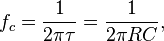
As far as I understand it, for a simple RC filter, time constant and corner frequency are just inversely proportional.

a46f9dcf564bebc67c377f985203d301.png


7d87bc118166402407c6194a521f4eac.png


Large R and small C or small R and large C can have the same TC and same fc providing RC product is the same.

I quite agree, time constant for transient response (if you really have to) and for steady state behaviour in freq domain, t is always very much longer than one time constant.

I just tried to respond to OP in the terms they asked the Q, since the general discussion seemed to me to have veered off and left the original question unaddressed.
 

Laplace

Apr 4, 2010
1,252
Joined
Apr 4, 2010
Messages
1,252
...the general discussion seemed to me to have veered off...
It is annoying whenever a serial pedant hijacks a thread to focus instead on terminology that is normally used in discussing circuit theory, and mercilessly explains why it would be wrong when taken literally in the realm of device physics.

Webster's New Collegiate Dictionary
pedant - one who is unimaginative or who unduly emphasizes minutiae in the presentation or use of knowledge

Webster's New World College Dictionary
pedant - a person who puts unnecessary stress on minor or trivial points of learning, displaying a scholarship lacking in judgement or sense of proportion
 

Ratch

Mar 10, 2013
1,102
Joined
Mar 10, 2013
Messages
1,102
It is annoying whenever a serial pedant hijacks a thread to focus instead on terminology that is normally used in discussing circuit theory, and mercilessly explains why it would be wrong when taken literally in the realm of device physics.

Webster's New Collegiate Dictionary
pedant - one who is unimaginative or who unduly emphasizes minutiae in the presentation or use of knowledge

Webster's New World College Dictionary
pedant - a person who puts unnecessary stress on minor or trivial points of learning, displaying a scholarship lacking in judgement or sense of proportion

Much of the descriptive language used to describe technical activities are really slang terms. In the electrical field, we find phrases like "current flow", which literally means the redundant and ridiculous phrase, "charge flow flow", instead of saying current exists or is present. Or charging/discharging a capacitor or battery (with what?), when they really mean energizing it. Even NASA uses silly space slang like "space walking" to describe outside activity, even though the astronauts/cosmonauts will not walk away if their tether breaks.

Therefore, it is not wrong or out of place to use, instead of slang, the precise phrase and language that correctly describes what is happening even though most folks think they understand the slang that is disseminated.

Ratch
 
Top