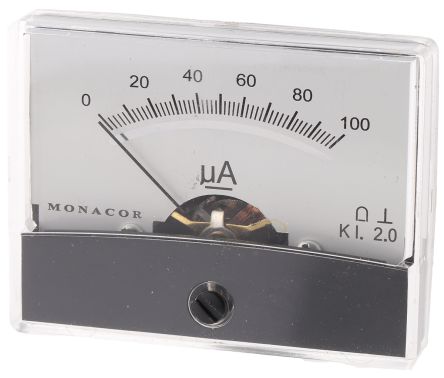
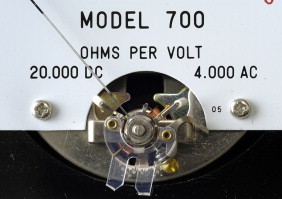
A meter that consists of a coil and pointer is called a MOVEMENT. And it has a certain sensitivity. Generally the sensitivity is 30uA or 10uA.
For a movement with a sensitivity of 30uA, it will take 30 microamps to defect the pointer full scale.
At this stage you cannot use the term OHMS PER VOLT. It is simply a MOVEMENT.
If you add a resistor in series with the coil, the movement will be turned into a VOLTMETER.
If a resistor is placed across the coil, it will be turned into an AMMETER.
When you create a VOLTMETER with a 30uA movement, and say you want a full scale reading of 10 volts, you want the 10 volts to create a current through the coil and series resistor of 30 microamps. At the moment we will neglect the resistance of the coil.
To get a current-flow of 30 microamps, we need a resistor of:
Now, without any calculator, we look at it this way: If the resistor is 10 ohms, the current will be 1 amp. If the resistor is 10k, the current will be 1mA. But we want one-third of a milliamp and so the resistor needs to be 30k.
A VU meter is generally connected to an amplifier circuit and the designer of the circuit will choose a movement or even a voltmeter or milliamp meter and connect it to the circuit and add resistors in either series or parallel until he gets the desired reading.
That's why a VU meter does not have a standard value. It's a movement that's adapted to the circuitry.