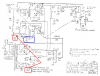
More questions about transformers.

loftsman325

Apr 29, 2016
4
Joined
Apr 29, 2016
Messages
4
I am new and have a question regarding chassis grounding of secondary windings if the primary winding is floating and chasis is not connected to earth ground if you connect more than one of the secondaries to chasis would this be essentially putting the secondaries in series and would the common conection to chasis change the voltage of the secondary windings?
 

(*steve*)

¡sǝpodᴉʇuɐ ǝɥʇ ɹɐǝɥd
Moderator
Jan 21, 2010
25,510
Joined
Jan 21, 2010
Messages
25,510
it all depends what you do. The windings could be in series, parallel, or shorted out.
 

Minder

Apr 24, 2015
3,561
Joined
Apr 24, 2015
Messages
3,561
The practice of earth grounding a secondary is commonly done where say a high voltage supply transformer is used for a local 120v control circuit as in industrial machines etc, once you isolate by this method, the earth grounded neutral is lost, so it is customary to connect one leg of the secondary to the service ground, right at the transformer, these two conductors are now used as earth ground and local neutral conductor in the usual way.
Incidentally this is done at your residential service entry where the transformer centre tap is connected to earth ground and then constitutes a neutral conductor.
M.
 

loftsman325

Apr 29, 2016
4
Joined
Apr 29, 2016
Messages
4
Well in particular I have the attached transformer the 400/800v is rectified the -64 is grounded to chassis the 12.3v is grounded to same chassis all is well till you add a capacitor to the 12.3 v after the diode all of a sudden my 12.3v goes to 22v I either have a faulty transformer or it is gathering voltage from ground I thought maybe i have a leaky capacitor but have tried several and still get 22v when referenced to chassis also on the -64 i have both legs connected via a diode
 

Attachments

  • jb_76_be_sch.pdf
    344.9 KB · Views: 66

Y2KEDDIE

Sep 23, 2012
259
Joined
Sep 23, 2012
Messages
259
Often confusion follows when talking about Earth and Neutral.
Instead of calling it a Neutral, think of it as "The other current carrying conductor", or "return current conductor".
An Earth Ground or Bonding wire is only intended to carry " fault current" , and we don't want " fault currents".

When a green ground wire is attached to a chassis, it only purpose is to provide a path to Earth ground if another "Live conductor" should accidently make connection with the chassis. In this case the chassis potential is Zero and if your body provides a path to ground when you touch the chassis, the green ground wire will provide the lowest resistance path to ground and(not though your body)

Assuming residential wiring in the US: The black (120V) wire is the feed, and the white (sometimes called the neutral), is the return current carrying conductor. Back at the Service Entrance box the Whites and ground terminals are bonded (and only here are they connected). Since the return wire (white) carries load current, and has resistance, it can and will develop a voltage drop. Depending on the load current, the drop can be quite high, and thus a shock hazard from the so called neutral wire.

Grounding at the Service Entrance point assures a direct connection to ground, with the lowest voltage drop.
 

Minder

Apr 24, 2015
3,561
Joined
Apr 24, 2015
Messages
3,561
Keep in mind that after rectification and capacitor smoothing the resultant DC voltage will be 1.414 x the applied AC.
M.
 

Minder

Apr 24, 2015
3,561
Joined
Apr 24, 2015
Messages
3,561
Largely the confusion arises in N.A. because of the terminology of using 'Ground' as a term for P.S. common, system common and for earth ground.
Even schematics show an earth ground symbol whether common is Earthed or not.
For countries such as the UK, the term 'Earth' is used if referring to an earth grounded conductor.
M.
 

dorke

Jun 20, 2015
2,342
Joined
Jun 20, 2015
Messages
2,342
Well in particular I have the attached transformer the 400/800v is rectified the -64 is grounded to chassis the 12.3v is grounded to same chassis all is well till you add a capacitor to the 12.3 v after the diode all of a sudden my 12.3v goes to 22v I either have a faulty transformer or it is gathering voltage from ground I thought maybe i have a leaky capacitor but have tried several and still get 22v when referenced to chassis also on the -64 i have both legs connected via a diode
Note that the 12.3V is AC.
Show on the pic where exactly do you connect the capacitor?
 

(*steve*)

¡sǝpodᴉʇuɐ ǝɥʇ ɹɐǝɥd
Moderator
Jan 21, 2010
25,510
Joined
Jan 21, 2010
Messages
25,510
to me it looks like a "live chassis" design where one side of the mains is connected to the metal chassis. It was common in old valve designs but it is potentially lethal and should not be used.
 

loftsman325

Apr 29, 2016
4
Joined
Apr 29, 2016
Messages
4
Steve i understand where you are coming from however it really gets away from my original question which is if the secondary windings voltage would be effected by sharing the same connection to chassis. I understand that the chassis is essentially live in reference to earth and if the transformer where to short to chassis if you got between chassis and earth ground it could be fatal as is well with many older tools toasters etc... I respect this concept just not sure of how these voltages effect each other
 

(*steve*)

¡sǝpodᴉʇuɐ ǝɥʇ ɹɐǝɥd
Moderator
Jan 21, 2010
25,510
Joined
Jan 21, 2010
Messages
25,510
The circuit as drawn will not affect the voltage across the secondary, but the entire circuit can be at mains potential with respect to earth.
 

dorke

Jun 20, 2015
2,342
Joined
Jun 20, 2015
Messages
2,342
The circuit you have drawn doesn't agree with the schematics.
The schematics looks rather strange though.
The transformer secondary voltage should be 2x6.3+12.3=24.9Vac,
you can check that.
Why do you need to add a captor anyways?
12.png 1462044431661.jpg
 
Top