motor advice

Crafts4Me

Feb 10, 2022
161
Joined
Feb 10, 2022
Messages
161
the forums has been helping me loads for my projects.
i am a serious hobbyist and like to stretch the limits of diorama and modeling.
electricity is still a challenge
i am trying to build a moving diorama using bicycle chains. 2 chains attached = 2 meters in a long oval of about 1 + meter length
the load for the chains is mini people and cars small people under 3" tall weighing less than 1 oz so maybe 10 people?
i need to work with 12v only. the set up and box for the depth of the motor is about 1/3/4 inches max for the motor then the shaft can have up to about 3/4 of an inch.
i tried numerous motors and failed on them all, they will not pull the chain
probably not enough power
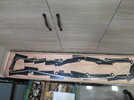
picture of base idea with the chain attached posted below.
please advise a motoe that will fit my size and alo the speed/torque.
i do need it as slow speed as possible as the people are strolling not racing
 

Attachments

  • chain and gears.pdf
    171.5 KB · Views: 14

Minder

Apr 24, 2015
3,561
Joined
Apr 24, 2015
Messages
3,561
Is that 1-3/4" dia?
If so, quite a small motor.!
You may need a high gear reduction to accomodate that size, an automotive wreckers may supply an answer e.g wiper or seat moving mechanism.
You may be hard pressed to find the right size for the load though?
 

Crafts4Me

Feb 10, 2022
161
Joined
Feb 10, 2022
Messages
161
hi
shaft length 3/4 " max
motor height max 1 3/4 "
total motor 2-3 "
what i tried to copy is a 30w DC 12v motor
its too big for my application
any other ideas?
width is unlimitted for the motor itself the issue is the height
 

Martaine2005

May 12, 2015
5,276
Joined
May 12, 2015
Messages
5,276
hi
shaft length 3/4 " max
motor height max 1 3/4 "
total motor 2-3 "
what i tried to copy is a 30w DC 12v motor
its too big for my application
any other ideas?
width is unlimitted for the motor itself the issue is the height
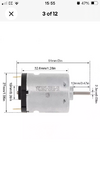
IMG_6143.png
 

Martaine2005

May 12, 2015
5,276
Joined
May 12, 2015
Messages
5,276
Can you use the above for reference of what you are measuring please.
 

Crafts4Me

Feb 10, 2022
161
Joined
Feb 10, 2022
Messages
161
size looks gook shaft must be longer or much shorter with a screw in shaft
must be powerful enough to revolve 2 bicycle chains attached
 

Martaine2005

May 12, 2015
5,276
Joined
May 12, 2015
Messages
5,276
Erm, the above motor picture isn’t a suggestion for you to use. But instead a reference of where and what to measure so that we understand.
Depth and height can be misleading. So by telling us the size of the reference picture along with your motor size, we will all be on the same page:)
 

Crafts4Me

Feb 10, 2022
161
Joined
Feb 10, 2022
Messages
161
thanks
sizing will do except shaft is too short
please help figure out the strenght and power motor i need
i appreciate it
thanks
 

Minder

Apr 24, 2015
3,561
Joined
Apr 24, 2015
Messages
3,561
The initial break-away torque you need can be measured uding a spring scale and a defined length of an arm of some sort arm attached radially to the arm.
That motor looks a little on the weak level for what your app seems to need?
 

Martaine2005

May 12, 2015
5,276
Joined
May 12, 2015
Messages
5,276
Those cogs also look like not having bearings but have bushes. These might also create drag.
 

Crafts4Me

Feb 10, 2022
161
Joined
Feb 10, 2022
Messages
161
hi
alternate idea since what i need to pull waighs up till about 1 lb what else do you suggest? maybe aplastic bile chain or will i be able to repurpose a plastic drag chain? then the motor doesnt need tobe so strong the extra weight is the bike chains
any idea how to accomplish what i need to do in a leightweignt fashion?
 

hevans1944

Hop - AC8NS
Jun 21, 2012
4,968
Joined
Jun 21, 2012
Messages
4,968
Let's see if I understand the problem... you have two bicycle chains that you have joined to make one longer chain. The chain somehow is attached to something that weighs about a pound or so. The chain is used to move the attached figures (small "dolls" representing people) around the diorama. You now need a motor to pull the chain, presumably using a sprocket to drive the chain. Did I miss anything?

How is the chain supported to prevent excessive sliding friction? Have you measured the torque that must be applied to your chain sprocket to get the chain to move? How much torque is required to keep the chain moving? Once started, does the chain move continuously? Can you photograph a sketch of your diorama, or a take a picture of what the diorama looks like, and upload it here? That would give us a better idea of what you are trying to DO, so some of us here can make SUGGESTIONS on how you might go about doing it.
 

Crafts4Me

Feb 10, 2022
161
Joined
Feb 10, 2022
Messages
161
hi
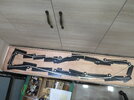
see photos
as a hobbyist i never needed to know torque and force etc as my mini motors made my mini people move and spin. this is on a much larger scale than ever before for me. 12" wide x 60 " long. the "cover" that holds the display is 2mm plywood. the magnbets work through the wood so that isnt the issue
the chain is too heavy to be pulled by small motors
i use 12v only
i just purchased 20' of Knex chain hoping that would be much lighter. it will be a few weeks till received
i still need the main idea, revolving chain on a very slow pace meaning i would need a speed adjuster.
along the platform will be about 6 people and animals and whrn the chain moves solowly and the prople are attched via magent they give the appearanc eof moving (best said Magnorail alternative).
since it is so long round trip about 9.5 feet i am not sure what motor i would need
another caveat is that the depth of the space i have for the motor is just under 2"
please advise as i really want my display to work
 

Attachments

  • IMG_1954.JPG
    IMG_1954.JPG
    263.4 KB · Views: 3
  • IMG_1955.JPG
    IMG_1955.JPG
    286.2 KB · Views: 3

hevans1944

Hop - AC8NS
Jun 21, 2012
4,968
Joined
Jun 21, 2012
Messages
4,968
It is always wise to make some measurements before attempting to do anything constructive. As a wood butcher, I was taught to measure twice, cut once. This was taught to me because we could not afford to purchase a wood stretcher: if I were to cut once, and then measure to find out I cut it too short, a wood stretcher would correct the error. It's really tough, being poor. Worse is being both poor and ignorant, but both conditions are correctable with sufficient effort.

This measurement philosophy applies to your animated diorama too. You mentioned the diorama dimensions are twelve inches wide and sixty inches long, mounted on a 2mm thick piece of plywood. Surely you tested this thickness to verify that whatever magnets you attached to the chain would still have a strong enough magnetic field (it varies in strength inversely as the square of distance) to support your diorama figures? And, no, I am not calling you Shirley. So extend this to determining what kind of motor you need.

Using a less weighty plastic chain makes more sense than using a steel bicycle chain, except the bicycle chain and the sprockets it uses are probably less expensive. OTOH, you show a picture of an actual installation using bicycle chain. The only problem seems to be getting the chain to move. BTW, so-called "bicycle chain" comes in many sizes; you could choose a smaller version. I would stay with the "bicycle chain" and look for ways to reduce the sliding friction. Mount Teflon strips for the chain to slide against, perhaps? Use sprockets with integral ball-bearings supporting the sprocket on its stationary shaft? Maybe use plastic sprockets? But it certainly seems like you need a different motor.

So, the FIRST thing you need to do is DETERMINE how much torque on the driving sprocket you need to move the chain at whatever velocity you deem appropriate. With that information in hand you can begin looking for a suitable motor. I recommend you investigate stepper motors first. These have a huge torque-to-weight ratio and come in all sorts of sizes, but you have to know the torque and speed requirements to successfully choose a motor that works for you.

Please let us know how you want forum members to help you complete this project.
 

Crafts4Me

Feb 10, 2022
161
Joined
Feb 10, 2022
Messages
161
hi
the magnets work. that was tested many times
i messed up with the chain
i will try the Knex chain as that is very light weight
explain torque please. i am clueless in the motor i need. this is my first serious motorized project. all the other ones used a mini tiny 12v motor that did the jb of a single action.
this is the fiurst time i need the motors to make my people walk that long distance.
it is meant to run for hours at a time maybe 12-14, then shut off with a timer and then resume the next morning.
 

hevans1944

Hop - AC8NS
Jun 21, 2012
4,968
Joined
Jun 21, 2012
Messages
4,968
The length of the chain affects the weight (mass) that must be moved initially. Each time the chain is stopped, for whatever reason, this mass must be accelerated again. Torque is the rotational equivalent of Newton's Laws describing linear motion. The most famous is this one: F = M x A, where "F" is the force (in Newtons), "M" is the mass (in kilograms), and "A" is the acceleration (in meters per second squared). The rotational equivalent of linear force is T = F x D, where "T" is the torque (in Newton-meters), "F" is the force creating the torque, and "D" is the perpendicular distance from the rotation axis to which the rotational force, F, is applied at right angles to the rotation axis.

It is important that you get a "gut" feeling for what torque is. Much later you may want to explore how torque and the resulting rotary motion creates a gyroscopic effect, but that is not important here. Here is a simple experiment that is easy to perform: take bicycle and turn it upside down so the wheels spin freely. The front wheel is easiest to use for this experiment. Now, use your hand to spin the front wheel. You could also use the pedals and bicycle chain to spin the rear wheel. Notice that it takes some effort to do this. The force you must apply to make the wheel spin is called torque. The larger the wheel, and the heavier it is, the more torque you need to get the wheel moving. But wait! Remove your hand and the wheel keeps spinning! Who ordered that? I dunno, but we call that angular momentum. It is responsible for storing angular (rotational) energy. Like linear energy, angular energy is conserved, but that isn't important to this discussion either.

Torque is the "twisty" force that makes things with mass move in a circular fashion. It is fairly easy to measure with a spring-scale. You just attach a "lever arm" to the shaft you want to rotate, measure the distance from the axis of the shaft to the point on the lever arm that you will apply the force, then you pull on the lever arm with a steady hand while observing how much force the spring-scale indicates. The product of the lever arm length and the force indicated on the spring-scale is proportional to the torque being applied to the shaft. Torque, like momentum, is a vector. It always points parallel to the axis being rotated, the direction depending on whether clockwise or counter-clockwise rotation is produced. Again, this is not important to you.

The only thing important to you right now is KNOWING how much torque is required and KNOWING what motor will produce this torque at the required rate of rotation. I suggest you first find out how much torque you need, then use a search engine and/or a machine-AI to help you find one that will also fit into your diorama. Again, a stepper motor sounds to me like it would be ideal for your application. Some electronics required (you have come to the right place for that!).
 
Top