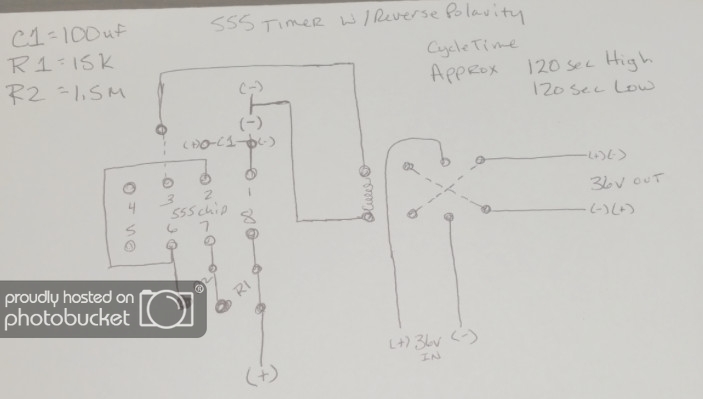
You won't get very good stability. The problem is leakage current in the electrolytic that's used for timing.
When you need a slow oscillator (or any long delay) using a resistor and a capacitor, the resistor and the capacitor both need to be fairly high values. That means the capacitor pretty much needs to be an electrolytic, and because the resistor is a high value too, the charge/discharge current is pretty low.
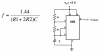
You want 180 seconds ON, 180 seconds OFF, so the cycle time is 360 seconds, so the frequency is 0.0027778 Hz. If you want a square wave, R1 needs to be small, so we can ignore it in the formula. So the formula becomes f = 1.44 / (2 R2 C).
(R2 C) = 0.72 / f
= 259.2 seconds
So the product of R2 (in ohms) and C (in farads) must be about 260. For example, we could use 220 µF and 1.2 MΩ (product is 264).
Electrolytics have leakage current, which effectively subtracts from the charge current. Nichicon make a range of electrolytics called KL which are specifcally designed for low leakage. They have a 220 µF, 16V part which is available from Digi-Key:
http://www.digikey.com/product-detail/en/UKL1C221MPD1TD/493-10482-1-ND/4318096
Regarding leakage current specification, the data sheet says: "After 1 minute's (for case size 10 × 12.5 or smaller) or 2 minutes' (for case size 10 × 16 or larger) application of rated voltage, leakage current is not more than 0.002CV or 0.2 µA whichever is greater." The "0.002CV" means 0.002 × capacitance (in farads) × voltage rating, and the result is in amps. This is 0.002 × 0.00022 × 16 which is 7 µA.
A 555 oscillator running from 12V using a 1.2 MΩ resistor charges the capacitor at 3.333 µA at the lowest current point in the cycle. And that capacitor is specified for a maximum leakage curent of 7 µA. So it's possible that the oscillator would simply stop working, because the charge current coming through the 1.2 MΩ resistor is less than the capacitor's leakage current.
It's unlikely that the capacitor will have that much leakage current - that's a conservative worst-case specification - but even if its leakage current is only 1 µA, the oscillator timing will be affected noticeably - the ON time (pin 3 high) will be lengthened, and the OFF time (pin 3 low) will be shortened. And you want the two durations to be as close as possible to each other.
You could reduce the power supply voltage and use an electrolytic with a lower voltage rating, which would reduce the 0.002CV product, but not by a great amount. And you can't get any benefit from using a higher capacitance and lower resistance, or vice versa, because the leakage current specification is proportional to the capacitance and the charge current is inversely proportional to the resistance, so changes to both cancel each other out and you're back where you started.
This is why people say that the 555 is not really suitable for cycle times longer than a few dozen seconds, or a minute at the most. You're welcome to try it for yourself though. If you do, use a modern enhanced 555 with low input leakage current, not an original bipolar one. The ICL7555 or TS555 are both suitable, though they have a lower output drive capability.