ohms law help

G

gregfox

Jan 1, 1970
0
Hello,
I'm trying to determine what resistor I would have to use to get 500mV from a 3 Volt
Supply.
E=IR requires a current, so I don’t know how to calculate for the resistance. I would like to know the methodology used.
I was hoping there was a scientific way of doing that.
Thanks!
to_e.png


audioguru2

Apr 6, 2004
12,026
Joined
Apr 6, 2004
Messages
12,026
It is simple.
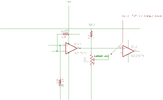
You want R9 to have 2.5V across it and want R10 to have 0.5V across it. The opamp is Cmos with zero input current so high value resistors can be used if you want.
R9 must have a value that is (2.5/0.5=) 5 times higher than R10. A problem is that R10 is a variable resistor that will have a wide range of value, maybe 20%.

Let R9 be 100k ohms and let R10 be 20k ohms. 

 
G

gregfox

Jan 1, 1970
0
Thank you for your reply, (the best yet over several forums) and yes, when I measured the input current of pin 9 (IC1C) my meter read “0”.
The problem is I R10 has to be 10k ohm (because the only 10 turn pot I have is 10K, too cheap to buy another for $20) therefore should R9 be 50 K ohm?

Would it be fair and correct to use a low value (something) for “I” ergo R=V/I  and solve for R9  R=2.5/.00001 = 250,000 ohm?

OR… would one just assume an infinite value for “ I” and say if R9 must be 5 times R10, and R10 is 10K, then let R9 be 10K * 5 = 50K.
Thank you for you help.


audioguru2

Apr 6, 2004
12,026
Joined
Apr 6, 2004
Messages
12,026
gregfox said:
The problem is I R10 has to be 10k ohm (because the only 10 turn pot I have is 10K, too cheap to buy another for $20) therefore should R9 be 50 K ohm?
50k is not a standard value. Use two 100k resistors in parallel.

Would it be fair and correct to use a low value (something) for “I” ergo R=V/I  and solve for R9  R=2.5/.00001 = 250,000 ohm?

would one just assume an infinite value for “ I” and say if R9 must be 5 times R10, and R10 is 10K, then let R9 be 10K * 5 = 50K.
What is "I"? The input current of the Cmos opamp is nothing.
Don't forget that the "10k" of the pot is not accurate, it could be anywhere from 8k to 12k.
 

Kevin Weddle

Feb 23, 2004
1,620
Joined
Feb 23, 2004
Messages
1,620
ohm's law. It is the equation from which electronics is derived. I wanted to clamp Q2 but it limits the versatility of the simple variable voltage supply.

 
R

remonx6

Jan 1, 1970
0
Sounds very interesting and helpful! Thanks for sharing gregfox.
u can easily calculate it 500mV from a 3 Volt by using this formula E=IR. also if u want calculate Ohm's law used Ohm's official website www.ohmslawcalculator.com  and http://www.actpcb.com/ohmslaw-calculator best for Ohm's law calculation. let me know after calculation.

Thanks helpful link usually 1st semester we learned about ohm's law after 4 years i remember those days..
Thanks Author
 
Top