Outdoor Light Status Indicator

audioguru2

Apr 6, 2004
12,026
Joined
Apr 6, 2004
Messages
12,026
Hi Ante,
Yeah, I'm going to be an old and bold technician by trying a 2A current through my LEDs that have an absolute max instantaneous current rating of only 100mA.

If I use a blue LED, do you think the bonding wire will glow orange brighter than the LED? ??? ;D
Do you think the junction will glow red, orange or white hot? ??? ;D
Do you think the clear plastic will turn brown or black around the hot stuff inside? ??? ;D

Seriously, I'll keep the power dissipation of the LEDs within their rating and compare the normal-current brightness to new LEDs after my tests if the LEDs still work.

 

Robertc65

Dec 2, 2004
32
Joined
Dec 2, 2004
Messages
32
Audioguru,

No offense intended just trying to be funny. I  also used to make pipe bombs and such but you sure can't do that anymore without people over reacting. My electronics experience consists of 13 years repairing consumer electronics equipment which I thankfully quit doing before you could buy a VCR or DVD player from Walmart for $29.95. I gave it up in 1994 and have worked as an Enterprise Computer systems engineer ever since. I do still like to experiment and build electronic gadgets, but I have no real circuit design experience. I just use schematics and such that I find on sites like this and know enough to integrate them and get them working most of the time. 

Back to trying to light an LED with 110 volts AC. Can I do this with just a resistor or two or is it more involved?

Thanks again

Rob

 
A

Alun

Jan 1, 1970
0
This is how it's often done:
index.php


This is how I do it:
index.php

I know you're supposed to include a 1k resistor in series to limit the surge and protect the LED when the capacitor charges but I've never had a problem, and you should also add 1M in parallel to discharge the capacitor but I didn't bother because the capacitor discharged though the circuit connected in parallel.

You can also connect LEDs in series and in revrse paralell with each other:
http://www.electronics-lab.com/forum/attachments/acwhiteleds.pdf


audioguru2

Apr 6, 2004
12,026
Joined
Apr 6, 2004
Messages
12,026
I think that using a full-wave bridge rectifier is best so that the LED doesn't flicker. ;D


Robertc65

Dec 2, 2004
32
Joined
Dec 2, 2004
Messages
32
Do the circuits you posted use a typical 1.5 volt LED or are you refering to an LED designed to run at 110 volts?

Yes I agree Audioguru I would not be happy if it were blinking so I like the idea of a full wave bridge also.

Thanks

Rob


audioguru2

Apr 6, 2004
12,026
Joined
Apr 6, 2004
Messages
12,026
Hi Robert,
Most red LEDs are 1.7V to 2.0V. Blue, green and white LEDs are 2.9V to 3.9V. You can purchase LEDs with a built-in current-limiter that are designed for 5V or 12V but certainly not 110V.
Use the full-wave bridge rectifier with a capacitor for 110VAC. ;D


Robertc65

Dec 2, 2004
32
Joined
Dec 2, 2004
Messages
32
So how much voltage will be going to my LED in this type of circuit while using a bridge. I don't see anything here that limits the voltage down to below 10Volts or so? I quess I just don't understand.

 
A

Alun

Jan 1, 1970
0
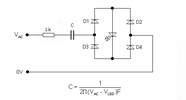
You don't need to limit the voltage to an LED, just the current an LED always has a constant voltage drop across it just like a normal diode except it's 1.9V or 3.5V instead of 0.6V. Normally a resistor does this but with AC a capacitor can be used as it has an impedance and limitts the AC current. By the way but even though I got away without using a 1k resistor (to limit the surge current) when I used my circuit to power a high brightness LED I would recommend you add one as some LEDs might be more sensitive.

VLED can be normally ignored as it's quite low compared to the mains v oltage but if you want to power more than 10 3.5V blue LEDs in series then I recommend you take it into consideration.

mains_LED.GIF

 
Last edited:

Robertc65

Dec 2, 2004
32
Joined
Dec 2, 2004
Messages
32
Thanks for all of the ideas. That is just what I need. I must be brain dead. I'm was not  thinking that an LED is really a diode. I don't have to be concerned about the voltage drop.

I have a 6 week old baby at home who has proven to be nocturnal. As a result I have been very sleep deprived lately. Sorry for the confusion. You guys are a great help.

 
Top