OUTPUT IMPEDANCE

shiva garg1

Feb 2, 2004
49
Joined
Feb 2, 2004
Messages
49
In all analog cicuits we hear about output imedance. What is the need of output impedance and what is its physical meaning.


audioguru2

Apr 6, 2004
12,026
Joined
Apr 6, 2004
Messages
12,026
Shiva,
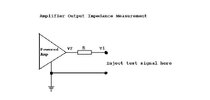
The meaning of output impedance is the output resistance of an amplifier. The output impedance of most amplifiers is very low, due to their high current ouput transistors and a huge amount of negative feedback. You can measure it by injecting a signal into the amplifier's output through a small-value resistor and measure the resulting very small signal at the amplifier's output. The measured attenuation of the injected signal is a voltage divider and the output impedance is calculated from it.
The amplifier's negative feedback reduces the output impedance because it "fights" any change of voltage at the output. If an ouside signal attempts to force the amplifier's output positve, then the negative feedback will make the output go negative by the same amount, cancelling the signal at the output. The same applies for an outside signal attempting to force an amplfier's output negative, then the feedback will make the amplifier's output go positive by the same amount. That is why you can't simply parallel amplifier outputs.
The very low output impedance of an amplifier is very useful:
1) The output voltage changes very little from having no load to having a low resistance load (varying load current).
2) The ability to drive a filter network without affecting its calculated values. If the input resistor of a low-pass filter was driven by an amplifier having a high output impedance, then that input resistor will appear to have a much higher value, changing the filter's response.
3) The ability of a speaker amplifier to damp the resonance of the speaker and its crossover network.


Kevin Weddle

Feb 23, 2004
1,620
Joined
Feb 23, 2004
Messages
1,620
This is simply the resistors and transistors at work. The transistors are most likely driven by the signal as opposed to being left open. In other words you won't be left with a signal trying to drive the collector of a transistor. The change in voltage therefore produces a change in current which gives you the impedance. The output impedance could even be dependent on the load.


shiva garg1

Feb 2, 2004
49
Joined
Feb 2, 2004
Messages
49
AUDIOGURU, how can i measure the output impedance by injecting a small signal at output through resistance and meauring small resulting signal at amplifier output .Can u plz explain me by simple ckt diagram.Am i right that due to small output impedance amplifier can drive small load without overloading.


audioguru2

Apr 6, 2004
12,026
Joined
Apr 6, 2004
Messages
12,026
Shiva,
I have sketched a simple schematic for measuring the output impedance of an amplifier. For R, use a low-value resistor, such as 10 ohms. Use a signal generator that is capable of driving such a low resistance, or use an amplified generator.
1) Measure the signal voltage at the injection point.
2) Measure the signal at the output of the amplifier being tested. It will be very small.
3) Calculate the signal current through R, (V1 - V2) divided by R.
4) Calculate the amplifier's output impedance, V2 divided by current.
Note that the amplifier's output impedance increases with increasing frequency.

An amplifier's output impedance has nothing to do with it overloading.
An amplifier overloads when it cannot produce enough output voltage across a load because:
1) It doesn't have enough power supply voltage. That's why most audio amps create bad distortion when you turn up the volume too high.
2) It cannot provide enough output current. Most audio amps and opamps "current limit" to protect themselves. An opamp current limits at about only 30mA. An audio amp can't drive dozens of paralleled 8 ohm speakers.
3) It overheats and reduces its output to protect itself, or just shuts-down completely until it has cooled.

Attached sketch:

 
Last edited by a moderator:

ante1

Jan 24, 2004
4,138
Joined
Jan 24, 2004
Messages
4,138
audioguru,

I think you missed the sketch, or I am having a problem here! :eek:

Ante ::)


MP1

Dec 7, 2003
3,399
Joined
Dec 7, 2003
Messages
3,399
Shiva, here is also an article from the web:

http://www.mitedu.freeserve.co.uk/Theory/inzoz.htm

MP


Kevin Weddle

Feb 23, 2004
1,620
Joined
Feb 23, 2004
Messages
1,620
This is where I have trouble with the datasheets. Sometimes the data can be irrelevant. In this case, they should show the output portion of the circuit with a signal applied. That way you could add your resistance and determine how it will affect the output. What they are actually saying is that your load should be "independent" of the operation.

 
Top