Paint &electronics.

AJB2K3

Jun 26, 2004
185
Joined
Jun 26, 2004
Messages
185
Everyone at some point has to decorate the project cases but what paint to use.
A project im working on (in car PSU for the PS) has to look factory fitted to what i want to do is, have an exposed finned heatsink painted white or blue with a ford badge on it but will paint trap the heat in?
If so is there a conductive paint that wont insulate the sink? :-\


ante1

Jan 24, 2004
4,138
Joined
Jan 24, 2004
Messages
4,138
AJB2K3,

The heatsink will lose some of its efficiency if you paint it. A heatsink is never painted just anodized for efficiency reasons so don

View attachment 35644


MP1

Dec 7, 2003
3,399
Joined
Dec 7, 2003
Messages
3,399
...also, if the heat sink is actually doing some work, it will get hot enough to cause the paint to peel off. Not a good idea. Ante has a good suggestion with anodizing. Otherwise, if you do not need to actually change the color, you might be able to get that brushed aluminum effect with some type of abrasive tool.

MP


GreekPIC

Aug 1, 2004
251
Joined
Aug 1, 2004
Messages
251
Another vote for anodizing. It can be done at home, it makes the surface harder and you can use lots of colors.

If you worry about conductivity be shure to drill and tap the holes for connectors and components after anodizing (the oxide layer created during the anodizing proccess isn't conductive).

 
Last edited by a moderator:

AJB2K3

Jun 26, 2004
185
Joined
Jun 26, 2004
Messages
185
Cool i can do it at home.
I asked because i have a pile of computer ally and a large uncoated heat sink. if i every get the parts together ill post pics but -
@GreekPIC when you done post pics of your setup and write an artical, fellow enthueast(sorry for bad spelling) will want to know how.


vainajala

Jun 7, 2004
68
Joined
Jun 7, 2004
Messages
68
If a non-anodized aluminium heatsink is anodized black, does this improve its effiency? What kind of improvement can be expected?


GreekPIC

Aug 1, 2004
251
Joined
Aug 1, 2004
Messages
251
Anodizing doesn't affect heat efficiency. It makes the sink's surface harder and provides a means of adding colour without painting (and loosing efficiency)

 
A

Alun

Jan 1, 1970
0
If a non-anodized aluminium heatsink is anodized black, does this improve its effiency? What kind of improvement can be expected?
Black is a very good colour for radiating heat, that's why you'll find lots of heatsinks are anodized black. So anodizing a heatsink black will increase it's efficiency.
 

MP1

Dec 7, 2003
3,399
Joined
Dec 7, 2003
Messages
3,399
You have that backwards....black actually absorbs heat. Put that black heat sink in the direct sun and watch the efficiency rapidly drop as opposed to to raw aluminum one.

Anodizing on heat sinks was purely introduced for the color aspect. The buyer thinks it is cool to have color. Thus, more sales.

The benefit is protection from corrosion. Anodizing protects from the corrosion you see on bare aluminum when it is aged or in the elements of the weather.

MP

 
A

Alun

Jan 1, 1970
0
You have that backwards....
No.

black actually absorbs heat.
Yes it does absorb heat more efficiently but it also radiates heat better too.

Put that black heat sink in the direct sun and watch the efficiency rapidly drop as opposed to to raw aluminum one.
True, but that's only because it's absorbing energy from the sun, a black heat sink in the dark will radiate more heat than a reflective aluminium one.

Anodizing on heat sinks was purely introduced for the color aspect. The buyer thinks it is cool to have color. Thus, more sales.
Incorrect, they are black to increase the radiating efficiency. Car radiators are black and so are the pipes on the back of freezers and refrigerators and all for the same reason.

Dark surfaces are nearer to an ideal radiator or black body than reflective ones.
http://en.wikipedia.org/wiki/Black_body
http://www.timedomaincvd.com/CVD_Fundamentals/xprt/rad_xfr.html

The benefit is protection from corrosion. Anodizing protects from the corrosion you see on bare aluminum when it is aged or in the elements of the weather.
True.

MP,
The black anodised vs untreated heatsink debate is not a simple one, when a heatsink is in still air a black one is best because lots of the heat transfer is by radiation. In situations where forced air cooling is used an untreated one is probably better because the anodised surface has a slightly higher thermal resistance. As you correctly pointed out black objects absorb surrounding radiation more effectively too so it depends on how much heat is being radiated from neighbouring components too. Other factors also include the shape of the heatsink and the components mounted to it, not to mention whether the surounding surfaces are just reflecting the heat back.
 

MP1

Dec 7, 2003
3,399
Joined
Dec 7, 2003
Messages
3,399
I will stand on my original comments....

BTW: The radiator theory is bogus. The black paint had nothing to do with heat. An unpainted radiator was ugly due to the way it was manufactured years ago. Black was the standard under the hood. The newer ones are manufactured differently and do not need the paint to hide the brazing. Now most car manufacturers have switched from these to the aluminum non painted radiator cores. (Which in itself would blow your theory out of the water).

MP

 
A

Alun

Jan 1, 1970
0
Now most car manufacturers have switched from these to the aluminum non painted radiator cores.
Yes the paint on the radiator probably increased the turmal resistance too. To be pickey the turm radiator is wrong anyway because they do not emit most of the energy by radiation they do by either convection (in the house) or force air cooling (in the car). You could argue the same about heat sinks but too all my experiance this isn't the case.

(Which in itself would blow your theory out of the water).
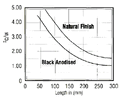
Not my theory, see the attached image of an extract of a heatsink datasheet. A black anodised heatsink of the same dimensions has a significantly lower thermal resistance than an untreated one.heatsink.gif

 
Last edited:

Dazza

Jun 21, 2004
591
Joined
Jun 21, 2004
Messages
591
Hi,

Matt/flat black, was preferred over gloss black in regards to painting a radiator, because Matt black has more surface area.

When it comes to the colour of the paint you choose, I doubt it would make any difference in regards to the heat being disbursed from within an object, what can make a difference is the type of paint you use and its formula.

Paint your radiator any colour in a matt/flat and it will disbursed heat just the same, although if you add sunlight, black will be less efficient.


MP1

Dec 7, 2003
3,399
Joined
Dec 7, 2003
Messages
3,399
Alun,
That is not a datasheet. What you have posted is a "Sales Brochure". Where does it say the efficiency is derived from the color? There is simply not enough information in this document to make such a determination.

MP

 
Last edited by a moderator:
A

Alun

Jan 1, 1970
0
But look at the graph:
heatsink.gif

The X-axis is the lengh.
The Y axis is turmal resistance in temperature rise per watt or

 
Last edited:
A

Alun

Jan 1, 1970
0
One very interesting way of proving the blackbody theory is by filling two plastic bottles with hot water, wrap one in aluminium foil and leave the other unwrapped.

Now as long as you don't leave them in the sun or in front of a fire the unwrapped bottle will cool down more quickly than the wrapped one. Aluminium foil is a very good thermal conductor and as it's in thermal contact with the plastic bottle so you would think it would act as a heat sink, but this isn't the case. Plastic may seem transparent but it's opaque in the mid-infrared region where objects at these temperatures emit the most heat. The bottle with the reflective surface will cool down more slowly and thus radiate less energy.

 
Top