Phototransistor Information

saiello

Dec 7, 2006
21
Joined
Dec 7, 2006
Messages
21
Hi, I'm using a phototransistor ( SFH300-3 ) in my circuit that has rise/fall times of around 10uS. I need a phototransistor that will respond to 2uS or quicker pulses of light. When the manufacturer specifies a rise time for example, does this mean that the phototransistor has to be illuminated for this length of time for it to reach it's full gain given a certain voltage drop and illumination? Or, will it respond to shorter length pulses, where the rise/fall times are just reaction times and that the full gain will eventually be reached after the rise time has elapsed? If this isn't that case, is it possible to improve the response time of a phototransistor or will I simply need to source a better performing one?

Thanks,
Salvatore.


audioguru2

Apr 6, 2004
12,026
Joined
Apr 6, 2004
Messages
12,026
Hi Salvatore,
The rise time of a phototransistor is the time it takes for its current to rise from 10% to 90% after continuous light shines on it.
The fall time is the time it takes for the current to drop from 90% to 10% after the light is turned off. So the highest modulation frequency is 50kHz for the output to be nearly max.

Phototransistors are slow. Photodiodes are much faster. IR receiver ICs use a photodiode.


saiello

Dec 7, 2006
21
Joined
Dec 7, 2006
Messages
21
Great! There's the SFH2030 that has a rise/fall time of 5nS! Currently the phototransistor in my circuit is supplied with 5V and acts as an input to a LM311N comparator. Can I use the photodiode as a drop-in replacement for the phototransistor or will there be issues I need to address?

Thanks,
Salvatore.


audioguru2

Apr 6, 2004
12,026
Joined
Apr 6, 2004
Messages
12,026
A phototransistor produces about 60 times more current than a photodiode. The transistor part amplifies the small leakage current through its collector-base diode.
A photodiode can also be used as a small signal voltage source since it can act like a tiny solar cell.


saiello

Dec 7, 2006
21
Joined
Dec 7, 2006
Messages
21
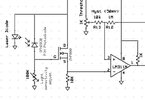
Hi, Will this circuit work ( see attached )? I've determined that the worst case scenario is that a 1uS flash of light needs to be detected with a 66us delay before the next flash. Once I get this last problem nailed down I can build my board!

Light_Detector.jpg

SFH2030F.pdf


Attachments

  • SFH2030F.pdf
    199.2 KB · Views: 0

audioguru2

Apr 6, 2004
12,026
Joined
Apr 6, 2004
Messages
12,026
Hi Salvatore,
The Mosfet isn't needed. Connect the input of the comparator directly to the photodiode.

I don't know how much is the output signal from the photodiode. If it is a strong signal then the circuit will work. But if the signal is weak then the LM311 is too slow.
The sales sheet of the LM311 recommends using an LM6511 for much higher speed.

View attachment 40304


saiello

Dec 7, 2006
21
Joined
Dec 7, 2006
Messages
21
Hi audioguru,
I've checked the datasheet for the LM311 and according to the Electrical Characteristics table the response time is 200nS given a 100mV input step and 5mV overdrive(?) which appears to be the very much the same as the LM6511 which has a 180nS response time with a 100mV input step and 25mV overdrive, again as indicated by the Electrical Characteristics table. I found the graph you attached in the LM311 datasheet, but I also found one ( see attached ) that appears to show that the LM311 is capable of much faster switching and which also ties in with the values that the table shows. I'm a tad confused as to which graph I should be refering to..!

View attachment 40305


audioguru2

Apr 6, 2004
12,026
Joined
Apr 6, 2004
Messages
12,026
The difference in the response times is the amount of volts the output needs to slew. It takes a long time for the output to swing 30V. With only 5V for its supply then the output goes high pretty quick. It goes low even quicker.

It depends on how strong is the signal from the photo-diode. The datasheet doesn't show how slow the comparator switches with a weak input signal.

 
Top