Puggy Potty Alarm

CRE

Nov 20, 2004
61
Joined
Nov 20, 2004
Messages
61
Horay! Well, I swapped the ceramic cap I had in there (I wasn't positive of the value) and put in a 10nf Met. Poly. with the second pull up resistor and it works like a charm!

I understand the basics of most parts of this circuit, but the cap and pullups escape me... I kinda see some of the picture, but I'm not understanding the whole thing... care to break it down for this nooB?

 
Last edited by a moderator:
A

Alun

Jan 1, 1970
0
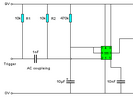
The 555 on the left hand side is a mono-stable, that's triggered when pin 2 is grounded. Pin 2 only needs to be grounded for a short time for it to trigger a couple of hindered nanoseconds will do. If it's kept grounded for longer than the delay it will stay triggered until it's taken  positive again.

When the trigger is grounded pin 2 will be grounded too as the AC coupling capacitor is not charged, as it charges up through R2 and pin 2 becomes positive and will remain so until the AC coupling capacitor is discharged and it's grounded again. To discharge the AC coupling capacitor just disconnect the trigger from ground and it will discharge through R1 and R2.

R1 and R2 are just pull-up resistor their value isn't criticle, the 1nf capacitor is an AC coupling capacitor it's value can be between about 470pf and 100nf. 1nf was recommended on the data-sheet because the RC time constant is so short it won't affect the delay much, your 10nf will a bit more but it won't be noticeable for the delay in this circuit.

The problem you had was because the capacitor was far too big or short circuited, it may have been a 100uf tantelum bead, so it's time constant was very long or infinite if it was short circuited.

555_Mono.PNG

 
A

Alun

Jan 1, 1970
0
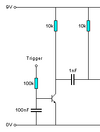
You might want to make the trigger more sensitive, you can do this by adding a transistor. It's positive trigger now, the 100K protects the transistor and the 100nf capaciror filters out any noise.

Tone_burst_Amp_trigger.PNG

 
A

Alun

Jan 1, 1970
0
By the way ignore the circuit in post 18 I used the old op-amp circuit with the + terminal mistake! ;D


CRE

Nov 20, 2004
61
Joined
Nov 20, 2004
Messages
61
It was definitely shorted.... because the 555 was still getting the trigger pulses. That's pretty muvh how I thought it was working, but

 
A

Alun

Jan 1, 1970
0
Yes I forgot it in post 18, you do need the potential divider I'd just modfied an old coppy of the circuit, instead of the lastest version - ;D sorry.


CRE

Nov 20, 2004
61
Joined
Nov 20, 2004
Messages
61
Ok, so far, so good (excellent actually  ;D)....

Now, how about an auto reset on the trigger? I imagine I could accomplish it myself using an opamp/comparator, but can it be done using fewer parts such as a transistor in combination with another cap and pullup resistor?

Something which'll reset the trigger once the voltage across the two contacts returns to 0v or possibly once the resistance becomes great enough for it not to trigger the alarm.


audioguru2

Apr 6, 2004
12,026
Joined
Apr 6, 2004
Messages
12,026
Hi Alun,
Your favouite "rail-to-rail" Cmos opamp has some serious limitations with its output current. Like all Cmos ICs, its output current capability reduces as its supply voltage is less.

In this circuit, it is driving the high capacitance (maybe 15nF) of a piezo transducer which is a fairly heavy load (2.7K ohms) at 4KHz. Since its drive is bridged, the 2.7K appears like 1.35K. With only a 9V supply, A CA3130 won't work very well.

View attachment 36759


CRE

Nov 20, 2004
61
Joined
Nov 20, 2004
Messages
61
Good to know, AudioGuru, so would one of the other opamps I listed as having on hand work better than a 741? The 741 seems to run fine... but I haven't tried a different one... all my others are dual or quad.


CRE

Nov 20, 2004
61
Joined
Nov 20, 2004
Messages
61
Well, I had it running fine on my breadboard.... I think I burned one of the ICs..... seres me right for not keeping enough IC Sockets on hand.

I was wondering, if I use a larger bypass cap will it reduce battery life?

 
A

Alun

Jan 1, 1970
0
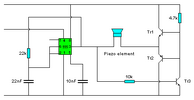
Of, if op-amps aren't good enough try maiking your own inverting complementary pair.

Tr2 2N2905, BC550, BC549 or any similar PNP transistor.
Tr1 & Tr3 2N2222, BC547, BC337 or any similar NPN transistor.

tone_burst_output.PNG


audioguru2

Apr 6, 2004
12,026
Joined
Apr 6, 2004
Messages
12,026
Hi CRE,
So you had a shorted capacitor and now a fried IC. Maybe they were damaged when you powered the circuit with two batteries in series.

The circuit by Alun provides automatic reset. The 1st 555 is a few seconds timer. It is triggered when the contacts have a current path from wetness. They can remain conducting and the 1st 555 will time-out by itself because the trigger input is capacitor-coupled.

A larger bypass cap can be added in addition to the recommended 0.1uF ceramic disc one to extend the battery's life since the supply voltage won't fluctuate so low during the project's sound output. I always use at least 100uF.

Alun's latest post showing a 3-transistor circuit instead of an opamp will also extend the battery's life, and give the loudest possible output when using only a 9V battery.

A 15V supply made from a 9V battery plus four AAAA, AAA or AA battery cells will make your project much louder.  ;D 

 
A

Alun

Jan 1, 1970
0
audioguru said:
A 15V supply made from a 9V battery plus four AAAA, AAA or AA battery cells will make your project much louder.  ;D 
I hope you're joking, I don't think this is a good idea because the AAA cells are a different capacity to the 9V battery, and this would create a very large cell inbalence.

So you really want a very loud sound do you?
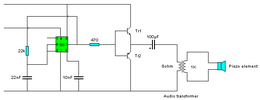
This will give you the most power from 9V so much so it might destroy the piezo element, I recommend running this of a 6V lantern battery or even 3 1.5V D cells in series to give 4.5V. tone_burst_output_audio_xformer.PNG

 
Last edited:

audioguru2

Apr 6, 2004
12,026
Joined
Apr 6, 2004
Messages
12,026
Hi Alun,
A 9V battery has six AAAA cells inside. Additional AAA cells would just last twice as long as the 9V battery. When the sound level begins to drop too low, only replace the 9V battery and replace the AAA cells the next time.

Your idea of using a stepup transformer and only a 4.5V battery would strain the 555 to its limit of output current and therefore it won't produce much output voltage. The 8 ohm to 1K ohm transformer would reflect the 2.7K piezo back to the 555 as a 21.6 ohm resistor. A 555 driving a 21.6 ohm resistor with only a 4.5V supply would have a typical output voltage of only about 1.2Vp-p and supply a peak current of about 55mA. The 1.2V stepped-up by the transformer is only 13.4Vp-p, less than the 15Vp-p if a bridged amp circuit is used with a 9V battery. A Cmos 555 would be worse because it can't deliver much output current at low supply voltages.  ;D 

 
A

Alun

Jan 1, 1970
0
audioguru, notice the complementary pair on the output of the 555. ;D


audioguru2

Apr 6, 2004
12,026
Joined
Apr 6, 2004
Messages
12,026
Hi Alun,
I have re-calculated a loss of 2.7V from typical curves of the LM555 from its datasheet. Therefore the transformer will receive only 1.8Vp-p when the circuit has a 4.5V supply.

View attachment 36770

 
A

Alun

Jan 1, 1970
0
The 555 sees 470 plus a 0.7V drop for the transistor, so its output current will only be (4.5-0.7)/470 = 8.1mA.

But you're right about the  output voltage being lower than expected but this is due to the saturation voltage of each transistor not the 555 as they are connected as emmiter followers. Perhaps this circuit will be able to be run of 9V with no problems.

 
A

Alun

Jan 1, 1970
0
This might not be quit so good!

The maximum peek voltage for a piezo element is typically 30V.

An 8ohm to 1K audio transformer has a turns ratio of 1:125 so the piezo could be damaged with input voltages as low as 0.25V!


audioguru2

Apr 6, 2004
12,026
Joined
Apr 6, 2004
Messages
12,026
Hi Alun,
The 555 has a fair amout of voltage loss in its output because it uses cascaded emitter-followers to obtain a high output current rating. I forgot to include your complimentary pair of emitter-followers in my previous calculation, so the total output voltage loss is about 4 X 0.7V = 2.8V. Therefore with a 4.5V supply, the transformer will get only 1.7Vp-p.

The turns ratio of a transformer (and also its voltage step-up ratio) is the square-root of its impedance ratio!
So the 1.7Vp-p is stepped-up to about 19Vp-p.  ;D

View attachment 36772

 
Top