PWM Without PWM IC

terramir

Jan 3, 2005
33
Joined
Jan 3, 2005
Messages
33
I was writing up a post on pwm after someone said that pwm didn't regulate voltage, and how before and after the filter capacitor the voltage is either 12 or 0V before but let's say 8V afterwards.
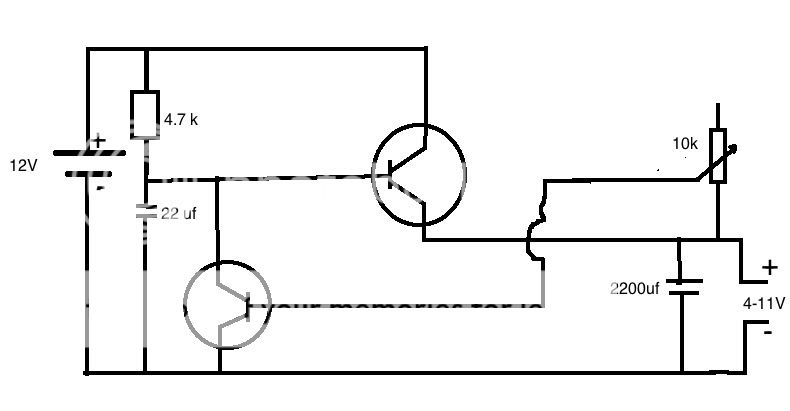
This gave me an idea about a adjustable voltage regulator that would work sort of like this the transistor or a mosfet starts in an on state after a capacitor charges when the input turns on, however; another transistor shorts the cap to the ground, instead of letting it supply the base current, when a certain voltage has been reached after the first filter cap on the output. Basically when A certain voltage has been reached the main transistor or mosfet turn's off, when it goes below the threshold it turns back on this could be temperature controlled as well.
What do you guys think?
A. how wasteful will this circuit be I figure I can keep the waste down by using a high gain as the main transistor/mosfet, hence only needing a low current on the control part of the circuit?
B. How far down can I narrow the hysteresis?
C. is this circuit feasible with thermistor control, I figure I could up the voltage by using a PTC so the higher the temperature the higher the resistance to the shorting circuit so the voltage would increase as the temperature rises.
What do you guys think could this be done simply and cheaply, what I would like to use this for is fans so I could let's say adjust the fans for 5V's but after a while if the temperature rises the fans would start spinning faster until the temperature drops.
Please any feedback will be welcome :)
terramir


Hero999

Oct 28, 2007
2,433
Joined
Oct 28, 2007
Messages
2,433
It sounds like you're trying to build an inductorless switching regulator which is doomed to failure. Shorting the capacitor to 0V is just going to waste energy.

Use a buck regulator which includes an inductor to limit the charging current and can be made with plenty of cheap controller ICs or even a couple of transistors.


terramir

Jan 3, 2005
33
Joined
Jan 3, 2005
Messages
33
I'm not sure you exactly know what I mean I would be shorting very little current to 0V  Maybe this will help envision what I had in mind
Regulatorcircuit.jpg


Mind you where the variable resistor is there could be a resistor and a variable resistor as well as a PTC to regulate for temperature.
you said something about an inductor I'm open to suggestions but I wanted to keep it as simple as possible while still burning as little energy off as possible and keeping it cheap.
Let's say the adjusted value is 8V if the voltage at the capacitor is 8.2V it would trigger the shorting transistor and the main transistor would turn off, then as the capacitor discharges into the load the the voltage would drop, to let's say 7.8V and the grounding transistor would turn off. of course this is really simplistic but you probably get my drift.
terramir
Open to suggestions here, just want to keep it as cheap and simple as possible

 
Last edited by a moderator:

audioguru2

Apr 6, 2004
12,026
Joined
Apr 6, 2004
Messages
12,026
Your circuit is completely wrong. Its output voltage will change when the temperature changes.
Every voltage regulator uses a reference voltage that does not change. But your "voltage regulator" uses the base-emitter voltage of a transistor that changes when the temperature changes. It also changes when the transistor is replaced.


terramir

Jan 3, 2005
33
Joined
Jan 3, 2005
Messages
33
I understand that the voltage would change when the temperature is changed, there would be a pot that changes the base voltage at STP, but if the temperature rises (with a ptc in series with the rheostat (pot without using third leg)) the resistance on the base would of the shorting transistor would increase hence the transistor would short the Base current to the main transistor current at a higher voltage, this is intentional, because then the fans would rotate at a higher speed to bring down the temperature.
the question here is not a reference voltage, because I dun care about that, these can be individually calibrated. the question is is there a way to make this circuit more efficient, cheaply like using an op-amp or a comparator to do the switching, as long as it's cheap, (op-amps and comparators can be had for less than a buck) I care about the over all efficiency. And I suspect this circuit may have problems with partial on states, which means loss of energy and heating of the mosfet, with one of those to I might just get discreet switching states. Unless I can choose a transistor for switching that has the tendency to turn on at a certain voltage let's say 0.7V but turns off at 0.68V then that would be discreet enough alright without going into op-amp's or comparators.
I need suggestions, and I understand as well that the transistor heating up will make a difference as well, however this thing will be cooled by the same fans that are being controlled.
terramir

 
Last edited by a moderator:

Kevin Weddle

Feb 23, 2004
1,620
Joined
Feb 23, 2004
Messages
1,620
The circuit is a basis for a voltage regulator. But voltage output will not be as it is set to be. The voltage regulation can be improved with an output capacitor.


Hero999

Oct 28, 2007
2,433
Joined
Oct 28, 2007
Messages
2,433
It's a simple linear regulator not a PWM regulator.

Why not build a circuit with the LM317 which is much simpler and will produce a much better regulator?


jonfon

Feb 1, 2011
1
Joined
Feb 1, 2011
Messages
1
I would like to know if I can create a 555 PWM with a 47khz pulse and pipe it into an LM324 to adjust the frequency higher. I would like to test the hho PWM and see if what is said about water DC current and frequency do affect the production of gas.. I have see on the web some posting using the LM324 with Current, freq and voltage adjustment but I wonder if we can do the merger of the two..

 
Top