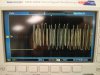
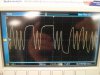
I was probing an RS-232 connection at work and came across this waveform. At first it looked okay but as I zoomed in I noticed there were no nice clean transitions, is it normally this rounded or is this waveform being distorted by something?
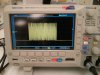
It looks like there's some serious low-pass filtering occurring somewhere! Excessive cable capacitance maybe? Slew-rate-limited driver trying to transmit a high data rate?
Does it work? RS232 is pretty resilient. The voltage swings required for the receiver are generally far smaller than provided by the drivers. This is partially to overcome issues with driving long cables (I expect this is a fairly long cable).
Having said that, this might not be real RS232 as the signal does not seem to be be swinging from a positive to a negative value. It looks to be swinging from 0 to some higher voltage (around 10V?)
For me it looks like this is a normal RS232 +/- 12V signal, with some cable RC included.
From the pictures I would assume you are running 115200 baud, and that is speedy if you have som cable length involved.
RS232 is defined with max cable length vs max speed, due to the design of the interface.
After the standard there is a deadband between +/-3V, and your signal is well above that, as far as I can tell.
I suppose there are no problems wih this communication?
no I don't think there is problems. I don't use this signal, I just happened to be probing it with a scope and saw how rounded everything was. just goes to show how not everything is textbook examples
The reason for the rounding is a combination of capacitivity in the cable, a small resistance in the cable, and last but not least the 300 ohm serial resistance in the RS232 driver output. Together this will make a lowpass filtering effect on the signal, and the max frequency of the transmission is highly depending on the length of the cable.