Schematic Help

SparkyCal

Mar 11, 2020
863
Joined
Mar 11, 2020
Messages
863
Can I please get help with this?

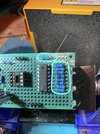
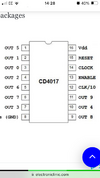
As you can see by the picture of the circuit I am building, I am connecting the resistors to the 4017 Chip. The circled resistor at the very top, is connected to Pin 9 ( I thought I would mention this, as it is not obvious from the picture).

My question is this:

The circuit is building one of those Knight Rider police light things.

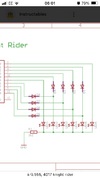
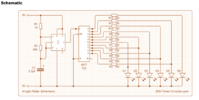
The schematic shows that a total of 10 resistors are being used (2 220 Ohms, and 8 100 Ohms. But I only have 9 resistors soldered on my board. I am obviously missing one resistor but I cannot figure out which pin on the 4017 I should connect the missing 100 Ohm resistor to.

Thank-you for your help.
 

Attachments

  • Screenshot 2025-03-18 at 10.08.20 PM.png
    Screenshot 2025-03-18 at 10.08.20 PM.png
    435.1 KB · Views: 13
  • IC-4017-Pin-Diagram.jpg
    IC-4017-Pin-Diagram.jpg
    10.2 KB · Views: 13
  • IMG_8323.jpg
    IMG_8323.jpg
    343 KB · Views: 13

AnalogKid

Jun 10, 2015
3,045
Joined
Jun 10, 2015
Messages
3,045
Obviously a wiring error, probably at least two. Without a decent photo of the bottom side of the board, what do you expect from us? Make a sketch of the physical component layout, with a rectangle for each resistor. Based on your wired connections to the 4017, label each rectangle with the resistor's reference designator from the schematic. Draw in the wired connections and see where the sketch does not match the schematic.

Other than the errant connection dot above D1, the schematic looks ok. It is not a great solution, and could be improved. First, all of the LED resistors are incorrect. Assuming an LED has a forward voltage (Vf) of 2 V, the circuit tries to put 7 V across a 220 ohm resistor. That requires 32 mA. When operating on 10V, the 4017 outputs are rated for only 2.6 mA typical. While you can cheat this up a bit because only one output at a time is on, and because CMOS output stages have a relatively high output impedance that acts as a mild form of overcurrent protection, the resistors still are way too low in value. For the outputs driving the two-100-ohm configuration, the overcurrent is even worse. Plus. half the output current is wasted.

A solution is to replace all of the 100 ohm resistors with small signal diodes such as a 1N914 or 1N4148. This gets you the isolation needed with two outputs driving one LED. Next, replace the two 220 ohm resistors with a direct connection from the two 4017 outputs to their LED anodes. Last, insert a 1.3 K resistor in series with each LED from its cathode to GND. Instead of 10 resistors, there now are 8 diodes and 6 resistors. The LED current will be around 5 mA. The two end LEDs will be a little brighter.

If you want more LED current, you can have the 4017 outputs drive a transistor array that them can pull way more current through the LEDs.

ak
 
Last edited:

Harald Kapp

Moderator
Moderator
Nov 17, 2011
14,271
Joined
Nov 17, 2011
Messages
14,271
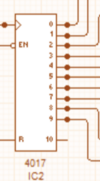
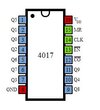
It seems you wired the 4017 all wrong. The numbers 0 ...9 shown in the schematic

1742363019539.png
are not pin numbers but designate functions/outputs. Here the assignment is, see the pinout you posted, as follows:
0 = Q0 = pin 3
1 = Q1 = pin 2
2 = Q2 = pin 4
etc. [update: see post #5 by @Martaine2005)

The 4017 also needs to be connected to gnd (8) and Vcc (16) which is not shown in the schematic. Additionally it is good practice to add a 100 nF capacitor (or similarly 220 Nf, 330 nF or whatever you have at hand) with wires as short as possible between teh Vcc and gnd pins of teh 4017.

It is also recommended to place a capacitor (10 nF ... 100 nF) from pin 5 of the NE555 timer to gnd for better stability of operation.
 
Last edited:

AnalogKid

Jun 10, 2015
3,045
Joined
Jun 10, 2015
Messages
3,045
Use diodes like this example.
That is close to what I described, but . . .

It places a reverse voltage across the two outside LEDs when any of the four inside LEDs are on. Not a problem when running on 5 V, but at 9 V and above there can be enough reverse voltage to cause the outside LEDs to go into reverse breakdown. In post #2 I solve this with individual resistors for each LED so there is no common connection across the LED cathodes. But another solution is to add diodes in series with the two outside LEDs. With this, you are back to the single current limiting resistor. I should have mentioned this, but late ... tired ... whatever.

ak
 
Last edited:

SparkyCal

Mar 11, 2020
863
Joined
Mar 11, 2020
Messages
863
Thank you for all the advice. The IC may be upside down on my board. I asked part way through the build because that’s when the question arose and that is why showing any more of the board wound not be of use. In any event, I will study tge advice closely when I am at home. Thanks to all
 

SparkyCal

Mar 11, 2020
863
Joined
Mar 11, 2020
Messages
863
Please note that the little half moon indent on the 4917 is on the bottom of the photo I posted.
 

SparkyCal

Mar 11, 2020
863
Joined
Mar 11, 2020
Messages
863
The way I was counting on the 4017 is 1, 2, 3 4, etc from bottom right upward. That is why the horizontal circled single resistor is my 9. But the schematic calls for 10
 

Harald Kapp

Moderator
Moderator
Nov 17, 2011
14,271
Joined
Nov 17, 2011
Messages
14,271
It places a reverse voltage across the two outside LEDs
I don't see this happen. The LEDs are at the bottom of the schematic and always either forward biased or not biased at all. The only diodes getting reverse biased are D1 ... D8 and these can sustain a much higher reverse bias when using universal diodes like e.g. 1N914 or 1N4148.
But the schematic calls for 10
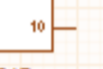
I'm not sure what you mean here. The output #10 is unused:
1742450263381.png
Pin #10 would be output #4:
1742450291131.png

Have you read and understood my post #4? Your wiring, which we don't see in the photos, may be all wrong.
It looks like you connected the resistors directly to pins 1 through 9, but these are not the outputs Q0...Q8. You should have stumbled when trying to connect output #0
1742450452389.png
as there is no pin 0 on the ic. Maybe read my post #4 again?
that is why showing any more of the board wound not be of use
Wrong. Seeing the wiring would definitely help understand what you're doing
 

SparkyCal

Mar 11, 2020
863
Joined
Mar 11, 2020
Messages
863
You should have stumbled when trying to connect output #0
1742450452389.png


as there is no pin 0 on the ic. Maybe read my post #4 again?


That is exactly why I posted. Could not figure out pin 0 as there is no pin 0. I will have to start again if I decide to redo this. But it sounds like there is a better way of doing it using diodes.
 

AnalogKid

Jun 10, 2015
3,045
Joined
Jun 10, 2015
Messages
3,045
I don't see this happen. The LEDs are at the bottom of the schematic and always either forward biased or not biased at all. The only diodes getting reverse biased are D1 ... D8
Not so. Referring to the schematic in post #5 -

LED1 and LED6 are direct-connected to CMOS outputs. When counter output 3 (for example) is high, outputs 0 and 5 are low. The current path is from output 3 through D3 and LED3, to the cathodes of LED1 and LED6. Because R1 lets these cathodes rise above GND, that node voltage reverse-biases LED1 and LED6.

Assuming the output can source sufficient current, it is at 9 V, the D3 Vf is 0.6 V, and the LED3 Vf is 2 V. That puts 6.4 V across R1, LED1, and LED6. Depending on the LEDs, that might be OK. But if the circuit is powered by a 12 V wall wart, or moved into a car, now the reverse voltage is 9.4 V or more, and that is not OK.

ak
 
Last edited:

ahsrabrifat

Jan 18, 2025
76
Joined
Jan 18, 2025
Messages
76
Can I please get help with this?

As you can see by the picture of the circuit I am building, I am connecting the resistors to the 4017 Chip. The circled resistor at the very top, is connected to Pin 9 ( I thought I would mention this, as it is not obvious from the picture).

My question is this:

The circuit is building one of those Knight Rider police light things.

The schematic shows that a total of 10 resistors are being used (2 220 Ohms, and 8 100 Ohms. But I only have 9 resistors soldered on my board. I am obviously missing one resistor but I cannot figure out which pin on the 4017 I should connect the missing 100 Ohm resistor to.

Thank-you for your help.
Please take a multimeter and test the board against your schematic. Test all the pins of the 4017. Test all the lines between the 4017 and the resistors one by one. That will reveal, which pin is missing the resistor. And by the way, did you simulate the circuit before making the board? I suggest you run a simulation to check if your reference circuit is functional. I did not read all the comments. But I can already see from some of the answers that there are some issues with the design. Here is a detailed tutorial on how to make a knight rider LED chaser circuit based on CD4017. You can also download and use the gerber files.


Martaine2005

May 12, 2015
5,276
Joined
May 12, 2015
Messages
5,276
Because R1 lets these cathodes rise above GND, that node voltage reverse-biases LED1 and LED6
That R1 along with the other half of the schematic should have been cropped out. My mistake.
My point was simply to show where to place the diodes.
I use series resistors for each LED.
 

Martaine2005

May 12, 2015
5,276
Joined
May 12, 2015
Messages
5,276
@SparkyCal
The diagram below shows PIN numbers vs inputs and outputs.
It does not follow as one would expect.
Output 0 = pin 3
Output 1 = pin 2 etc.
 

Attachments

  • IMG_5636.png
    IMG_5636.png
    260.3 KB · Views: 3

AnalogKid

Jun 10, 2015
3,045
Joined
Jun 10, 2015
Messages
3,045
That R1 along with the other half of the schematic should have been cropped out. My mistake.
My point was simply to show where to place the diodes.
I use series resistors for each LED.

There is nothing wrong with the single-resistor approach; it is a common thing with 4017 LED circuits because of the decoded outputs. You just have to remember that the "off" outputs are a MOSFET switch to GND, not an open circuit.

ak
 

Harald Kapp

Moderator
Moderator
Nov 17, 2011
14,271
Joined
Nov 17, 2011
Messages
14,271
LED1 and LED6 are direct-connected to CMOS outputs. When counter output 3 (for example) is high, outputs 0 and 5 are low. The current path is from output 3 through D3 and LED3, to the cathodes of LED1 and LED6. Because R1 lets these cathodes rise above GND, that node voltage reverse-biases LED1 and LED6.
I see. My bad, I overlooked the voltage drop on the series resistor.
 

Harald Kapp

Moderator
Moderator
Nov 17, 2011
14,271
Joined
Nov 17, 2011
Messages
14,271
Could not figure out pin 0 as there is no pin 0.
I think you still have not understood my post #4. The numbers in your schematic (post #1) are not pin numbers. The numbers you see within the rectangle that marks the 4017 are the count outputs, also marked as Q0 ... Q10 in the datasheet.
0 = active high when count = 0, else low
1 = active high when count = 1, else low
2 = active high when count = 2, else low
etc.

The corresponding pin numbers are
3
2
4
see post #4 and the pinout in your post #1.

See also post #15.
 

AnalogKid

Jun 10, 2015
3,045
Joined
Jun 10, 2015
Messages
3,045
The numbers you see within the rectangle that marks the 4017 are the count outputs, also marked as Q0 ... Q10 in the datasheet.
Slightly off topic, but this is a source of confusion regarding the CD4017.

The 4017 has 10 outputs. Usually these can be labeled Q0 - Q9, or Q1 - Q10, but not both (Q0 - Q10). The original RCA datasheet (now owned by Texas Instruments) labels the outputs "0" through "9" - *with the quotation marks* but without the Q prefix. This was back before labeling counter outputs with the Q prefix was standardized. Some manufacturers use Q0 - Q9 while others use Q1 - Q10, fomenting chaos in the streets.

I prefer Q0 - Q9 because it is consistent with many other dividers and binary/BCD counters.

ak
 

Harald Kapp

Moderator
Moderator
Nov 17, 2011
14,271
Joined
Nov 17, 2011
Messages
14,271
Right. The output labeled "10" in post #1 should better be labeled clock or carry as e.g. in post #15.
 
Top