Schematic question ...

roughshawd

Jul 13, 2020
616
Joined
Jul 13, 2020
Messages
616
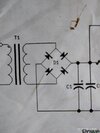
My PSU is a simple AC to DC voltage dropper that employs a transformer and a few transistor and some rc. The transformer is center tapped, and the schematic I got for it, shows the tap as grounded, and the circuits divided with a 200v 35w cap.

I'm increasing the amperage capabilities of the PSU, with larger diodes which failed...

On a different schematic, the transformer is not center tapped, and the rectifier is placed between the +positive and -negative leads on the secondary. It doesn't look right to me. I need your opinion...
I think the diode in the upper left of the bridge is backwards....
Am I seeing a short, or is it ok to dump that lossy circuit ground, back into the secondary?
 

Attachments

  • 17297969312585210661829011503075.jpg
    17297969312585210661829011503075.jpg
    172 KB · Views: 12

bertus

Moderator
Nov 8, 2019
3,835
Joined
Nov 8, 2019
Messages
3,835
Hello,

For a larger current capability, you will need a larger transformer.
Just placing bigger diodes does not work.

Bertus
 

Alec_t

Jul 7, 2015
3,817
Joined
Jul 7, 2015
Messages
3,817
The diodes are the right way round in the pic you posted.
 

roughshawd

Jul 13, 2020
616
Joined
Jul 13, 2020
Messages
616
I see what I did.... The negative changes to positive when it crosses the diode... Oooh how'd it do that???

Ok, but aren't bigger diodes used to replace ones that burn up? I think the transformer is bigger than the diodes could handle.... So they cooked???
 

bertus

Moderator
Nov 8, 2019
3,835
Joined
Nov 8, 2019
Messages
3,835
Hello,

What is the transformer rating?
What type of diodes is used?

Bertus
 

roughshawd

Jul 13, 2020
616
Joined
Jul 13, 2020
Messages
616
I think it's a 120vac to 35vac and the supply was rebuilt in the early 70's by a communications shop on an island in Alaska. It worked when the ambient temp was very low...
I moved back to civilization and it overheated... The transformer tests at 35 v in the secondary. Fused 120v US source...
 

bertus

Moderator
Nov 8, 2019
3,835
Joined
Nov 8, 2019
Messages
3,835
Hello,

Some diodes from the 1N5400 series might work.
The 1N5401 is rated for 70 Volts RMS and 3 Ampere.
An higher number like 1N5407 can also be used.

Bertus
 

roughshawd

Jul 13, 2020
616
Joined
Jul 13, 2020
Messages
616
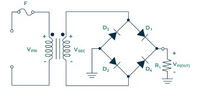
Just to keep the line open...1729993616946.pngThis was posted on the web as a "center tap recitifier". The image however, is missing the tap... Uh- OK! I would consider the ground to be where the tap would connect, and that the circuit load at Vp(out) would also be part of the the ground buss, as it isn't really doing anything right now... but the schematic is correct, the diode numbers are opposing just the way they are suppose to be, with D1 following the positive+. I have one other debacle.... the power runs from poistive to negative through the secondary... why isn't D1 where D4 is? Doesn't it make more sense to trace the circuit, in the direction that the current is flowing? and another thing... when the + positive passes through D1, isn't it supposed to become -negative at RL Vp(out)? the schematic defines it as + positive?
 

AnalogKid

Jun 10, 2015
3,045
Joined
Jun 10, 2015
Messages
3,045
First, that is not a "center-tapped" anything. There is no center tap. It is the simplest possible isolated AC to DC converter. Note that there is no filter capacitor on the output of the bridge, so there will be 100% ripple across the load. The ripple will be unipolar, wo the + and - indications across Rl are correct.

AND -

Ignore the + and - indications on both sides of the transformer. Both are wrong. They are not just incorrect, they are wrong. An AC transformer does not have + and - terminals, polarities, etc.

The black dots are correct. They indicate the phasing of the two windings.

There is no information encoded into the assignment of reference designators in a diode bridge. Any designation can be on any part. Just be glad there are any at all and take the win.

ak
 

AnalogKid

Jun 10, 2015
3,045
Joined
Jun 10, 2015
Messages
3,045
and another thing... when the + positive passes through D1, isn't it supposed to become -negative at RL Vp(out)? the schematic defines it as + positive?
No idea what this means.

When electrons flow through a diode, that flow creates a voltage differential across the semiconductor junction. For a normal rectifier this is called the diode's "forward voltage", Vf, the voltage across the diode when it is "forward-biased". Thus, the cathode is at a negative potential ***with respect to the anode***. Nothing "becomes negative". With respect to some other reference potential (Ground) in the circuit, the voltage at the cathode will measure 0.7 V less than the voltage at the anode.

ak
 

roughshawd

Jul 13, 2020
616
Joined
Jul 13, 2020
Messages
616
OK I also need to know if I have a component such as a diode, does the polarity change when it goes through it, or is the diode immune to polarity because it allows the pass through? So if I have a resistor where +-----VVVVV------ then - out here... is a diode subject to the same foop? let-r-rip kind of look at that scenario?
 

roughshawd

Jul 13, 2020
616
Joined
Jul 13, 2020
Messages
616
Hey I think it's coming back to me... Everything in the mains is negated and the sequenced output is gotten from the C-tap. It was signal until AnalogKid got his hands on it !!! then everything went sideways....
 

roughshawd

Jul 13, 2020
616
Joined
Jul 13, 2020
Messages
616
I'm getting 25.8 vdc from the negative transformer output line, through the first diode out to the second diode. But I am not getting anything through the second diode. But that's good for my experiment, down from 37.8vac straight off the trans secondary. If I split that with a voltage divider circuit, I should get around 12.9v + and 12.9v -.
 

hevans1944

Hop - AC8NS
Jun 21, 2012
4,968
Joined
Jun 21, 2012
Messages
4,968
If the secondary of your step-down power transformer were center-tapped, you could (1) remove the "ground" where D2 and D3 are connected, (2) connect the center-tap of the transformer secondary to "ground", and (3) get a negative output voltage where D2 and D3 are connected together, and (4) get a positive output voltage where D1 and D4 are connected together.

This is a full-wave rectifying bridge circuit, whether the center-tap is grounded or absent. At any given half-cycle of the AC line voltage, two of the diodes will be forward biased and two will be reverse biased. If all you need is a single polarity of output, and a center-tapped secondary is available, diodes D2 and D3 can be eliminated and the center-tap becomes "ground" with a positive output voltage from the common connection between D1 and D4 and "ground". On the other hand, if you DON'T have a center-tapped transformer, diodes D2 and D3 allow you to have a positive output at twice the voltage that the center-tapped circuit provides.

For the circuit you have shown, with polarity markings on opposite ends of the windings, imagine that these markings represent the polarity of one half-cycle of the AC waveform. A half-cycle later, these polarities will be reversed, so let's treat that as a separate incident.

In the first case, when the top of the secondary winding is positive with respect to the bottom of the winding, diodes D1 and D2 will be forward biased through load resistor RL. A half-cycle later the top of the secondary winding is negative with respect to the bottom of the winding. In other words the + and - signs on your schematic reverse. This causes diodes D4 and D3 to become forward biased, again the circuit is from the bottom of the winding, through D4, then through the resistive load to "ground," and finally through D3 to the other terminal of the winding.

Note that "ground" in your circuit serves no purpose at all, except to act as a common point of reference for measuring the voltage drop across RL. If you remove the connection to "ground" at D2 and D3, and ground the center-tap of the secondary, you will have a bi-polar output power supply: positive output where D1 and D4 are connected together, and negative output where D2 and D3 are connected together. It will still need filtering because of the 120 Hz full-wave rectified sine waveform.
And it is online as a center tap rectifier.
Please provide a working link to where this circuit is described as a "center tap rectifier" because it clearly is not.
 

bertus

Moderator
Nov 8, 2019
3,835
Joined
Nov 8, 2019
Messages
3,835
Hello,

Have a look at the pages of the attached PDF from 13 and on for the use of a center tapped transformer.

Bertus
 

Attachments

  • Unit12.pdf
    788.3 KB · Views: 3

roughshawd

Jul 13, 2020
616
Joined
Jul 13, 2020
Messages
616
If the secondary of your step-down power transformer were center-tapped, you could (1) remove the "ground" where D2 and D3 are connected, (2) connect the center-tap of the transformer secondary to "ground", and (3) get a negative output voltage where D2 and D3 are connected together, and (4) get a positive output voltage where D1 and D4 are connected together.

This is a full-wave rectifying bridge circuit, whether the center-tap is grounded or absent. At any given half-cycle of the AC line voltage, two of the diodes will be forward biased and two will be reverse biased. If all you need is a single polarity of output, and a center-tapped secondary is available, diodes D2 and D3 can be eliminated and the center-tap becomes "ground" with a positive output voltage from the common connection between D1 and D4 and "ground". On the other hand, if you DON'T have a center-tapped transformer, diodes D2 and D3 allow you to have a positive output at twice the voltage that the center-tapped circuit provides.

For the circuit you have shown, with polarity markings on opposite ends of the windings, imagine that these markings represent the polarity of one half-cycle of the AC waveform. A half-cycle later, these polarities will be reversed, so let's treat that as a separate incident.

In the first case, when the top of the secondary winding is positive with respect to the bottom of the winding, diodes D1 and D2 will be forward biased through load resistor RL. A half-cycle later the top of the secondary winding is negative with respect to the bottom of the winding. In other words the + and - signs on your schematic reverse. This causes diodes D4 and D3 to become forward biased, again the circuit is from the bottom of the winding, through D4, then through the resistive load to "ground," and finally through D3 to the other terminal of the winding.

Note that "ground" in your circuit serves no purpose at all, except to act as a common point of reference for measuring the voltage drop across RL. If you remove the connection to "ground" at D2 and D3, and ground the center-tap of the secondary, you will have a bi-polar output power supply: positive output where D1 and D4 are connected together, and negative output where D2 and D3 are connected together. It will still need filtering because of the 120 Hz full-wave rectified sine waveform.

Please provide a working link to where this circuit is described as a "center tap rectifier" because it clearly is not.
The web addr is https://www.geeksforgeeks.org/bridge-rectifier/
 

roughshawd

Jul 13, 2020
616
Joined
Jul 13, 2020
Messages
616
said...

AND -

Ignore the + and - indications on both sides of the transformer. Both are wrong. They are not just incorrect, they are wrong. An AC transformer does not have + and - terminals, polarities, etc.
just for signature sake.... if you forget the + and - in any electronic device, you can immediately be tagged with the word... 'hacker' forthwith part of a group of idiots who often shock themselves albiet with even their intellect! So it's a good idea to remember, that when a signal crosses a component, the polarity changes because the wave form acrossed it goes from passive to lossy, and of course that the way its been done for a long long time! So if you know something I don't..(very possible) be frugal and standardize it in some kind of important post on 'historically important electronic knowledge' previously unpublished, thanks the management. i.e.
Positive ---component--- Negative
This helps us center tapped junkies from over powering all the cheap wiring used in todays equipment...
 
Top