Series Potentiometers?

AutoNub

Oct 5, 2011
4
Joined
Oct 5, 2011
Messages
4
Hello! I'm controlling a current by changing the resistance using a 10 turn, 10k ohm potentiometer. However, it doesn't give me the precision or amount of control I'd like on the bottom end (for example, from 5mA to 2A out of a total of 52A). The slightest amount of pressure on the knob will change the amperage, which makes it virtually impossible to control with such precision. So I'm thinking I can add a 100 ohm potentiometer in series with the 10k ohm potentiometer (or in some other configuration using the two potentiometers) to give me the 10 turn variable resistance I need to precisely control the amperage on the low end (as described earlier).

Does anyone have any idea how I can acheive this? Using a PLC or other expensive devices/components are not an option. I'm hoping to find the right configuration with the components at my disposal, but I could incorporate new components if they are very cheap.


More details:

The configuration I am currently using with the single 10k ohm potentiometer is shown here (on the bottom right of the second page).

Here's an image of the configuration currently being utilized with my 50A power supply (as shown in the above link): see attachment.


Thanks in advance for the assistance!
 

Attachments

  • Remote Current Adjustment.JPG
    Remote Current Adjustment.JPG
    20.7 KB · Views: 780
Last edited:

shrtrnd

Jan 15, 2010
3,901
Joined
Jan 15, 2010
Messages
3,901
First.
I have many times found pots that are unreliable at the low and high-end resistances, because the 'stop' on the pot is not exactly at the ends of the carbon-trace of the pot
itself. Apparently this is an acceptable inconvenience in mass-produced pots.
I'm just telling you this, so you'll know it happens, in case you're trying to squeeze
precision from a pot with this issue.
Second.
There are linear pots, that have linear resistance over the entire range, BUT,
There are also Audio pots, that have logrithmic resistance over the range of the pot.
Do you have the right pot for your application?
Third.
I use your suggestion when I experience the problem you mention, by adding a
resistor (you have to experiement for the best value) in series with the pot to do what
you said you're trying to do.
That's my 2-cents worth. I'm sure you'll get other suggestions upcoming from other
helpful people on this site.
Good luck figuring this out.
 
Last edited:

AutoNub

Oct 5, 2011
4
Joined
Oct 5, 2011
Messages
4
Does anyone know exactly how to configure them properly though? I hooked them up in what I thought was a series configuration but measured a maximum resistance of only 9.49k ohms. Granted, neither potentiometer's actual maximum resistance was ideal, but the math still doesn't make sense to me yet. The 10k pot is measured at an actual resistance of 9.69k ohms and the 100 ohm pot is measured at 105.9 ohms. These two in series should give me 10.1059K ohms (10,105.9 ohms). I configured the two pots as having the wiper from the 10k ohm pot going to the positive terminal of the 100 ohm pot, with multimeter leads connected from the positive terminal of the first pot to the wiper of the second pot. The pots were connected together with the wiper of the first pot connected to the positive terminal of the second pot. I'm assuming this configuration is wrong, though.

To summarize, I'm hoping someone here can first confirm using the two potentiometers will give me the extra precision control I'm hoping to accomplish, and also the exact configuration necessary. Before I actually hook any of these potentiometer configurations to the real power supply (using the revised remote current adjustment configuration), I'll do a simple test using my multimeter to vary voltage output based on variable resistances. This should at least give me an indication of increased precision compared to using only a single 10k ohm potentiometer.
 

(*steve*)

¡sǝpodᴉʇuɐ ǝɥʇ ɹɐǝɥd
Moderator
Jan 21, 2010
25,510
Joined
Jan 21, 2010
Messages
25,510
Placing a low value pot in series with a higher value one is the poor man's version of a 10 turn pot.

I see no reason you couldn't do this with a 10 turn pot.

Typically the lower valued "fine" pot is left centred until you can get close with the higher valued "coarse" pot. If the fine pot is multi-turn it can be a little more difficult to ensure it's near the centre of its travel.

It's quite possible that the fine pot could be a single turn pot. Determine the change of resistance for say a 10 to 15 degree change in position of the main "coarse" pot and get a value near this for the fine pot.

A "back of the envelope" suggestion is that it should be approximately 1/300th to 1/400th of the resistance of the main pot. So if your main pot is a 10 turn 10k pot, the fine adjust should be about 30 ohms. I wouldn't like your chances of finding one of those...

OK, you can get them, but you'll find they are relatively high power devices (between 1 and 5W). You also wouldn't want a wirewound one.
 

(*steve*)

¡sǝpodᴉʇuɐ ǝɥʇ ɹɐǝɥd
Moderator
Jan 21, 2010
25,510
Joined
Jan 21, 2010
Messages
25,510
Your wiring of them sounds correct.
 

shrtrnd

Jan 15, 2010
3,901
Joined
Jan 15, 2010
Messages
3,901
I'm not looking at your set-up. You're ID indicates to me you're new at this.
I'm going to tell you what I'm thinking, and you can determine if you can use any of it.
You sound a little impatient about getting an exact answer, so I may be wasting my time.
Resistance measurements do not appear magically.
Your meter generates a very small current, through the load (resistor), which is read by a
measurement circuit in the meter. Your meter may have autoranging, which means
switching through it's various measurement circuits.
You already know a 10K pot isn't always exactly 10K. And you're using two pots, doubling the potential for a problem when either of the pots is near the ends of it's mechanical range.
As you turn either of those pots, you're varying the small current the meter is using to make
the resistance measurement, passing through your auto-ranges on your meter.
Are you giving your meter time to settle as you're making these readings?
Are you considering your ACTUAL circuit components that you're going to plug this
pot (or pot configuration) into?
Are you considering your amperage and wattage capabilities of your components?
I'm with *steve* in considering a multi-turn replacement pot, but like I said. I can't see
what you're doing, so I don't know exactly what you're doing with what you've got.
My advice here is: Slow-down and think. When you rush, you miss things and can
make very simple mistakes that you'll overlook while troubleshooting because you
assume everything else in your circuit is correct.
 

(*steve*)

¡sǝpodᴉʇuɐ ǝɥʇ ɹɐǝɥd
Moderator
Jan 21, 2010
25,510
Joined
Jan 21, 2010
Messages
25,510
Now I'm awake :)

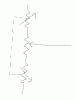
The best way to arrange a "coarse" and "fine" pot for what you're doing is as follows:
attachment.php


Please forgive the childish drawing.

The pot in the centre is your coarse adjustment, the 2 pots either side ate the fine adjustment.

They are wired so that one increases resistance while the other decreases, effectively moving the "coarse" pot up and down a little.

You use a dual gang pot for this. One side uses the wiper and (say) the left terminal) the other uses the wiper and the right terminal (the wiper it typically the centre terminal).
 

Attachments

  • pot.gif
    pot.gif
    3.2 KB · Views: 5,159

AutoNub

Oct 5, 2011
4
Joined
Oct 5, 2011
Messages
4
Hello, and thank you very much for the helpful reply, Steve! We've tried numerous different configurations, including the one you suggested, and are still have some difficulty achieving our objective. I decided to put together a very quick and concise word document explaining in more detail what exactly we are attempting to accomplish. Please view the following document: see attachment.


Note: In the configuration you drew, we were actually able to come fairly close to what we want. Your configuration gave us the partial linearity, but not the range. To be specific, with the 100 Ohm pot at its maximum resistance (turned clockwise fully), and with the 10k Ohm pot at its maximum, the 1k Ohm pot gives 11A max at its midpoint (clockwise 5 of 10 turns) and about 5.25 Amps at its min (counter-clockwise fully) and max (clockwise fully) positions.

The good thing, however, is that we got a linear control from 0.01A-5.25A by turning the knob of the 100 Ohm potentiometer (with the 10k Ohm pot maxed). So that part was good but the roughly 5A to 50A was not a linear increase as desired. Once again, please review the attached file for more details.

Your assistance is highly appreciated. Thank you!
 

Attachments

  • Desired Potentiometer Configuration Output.pdf
    56.5 KB · Views: 538

(*steve*)

¡sǝpodᴉʇuɐ ǝɥʇ ɹɐǝɥd
Moderator
Jan 21, 2010
25,510
Joined
Jan 21, 2010
Messages
25,510
If you can't get the full 50A then it is likely that either your reference voltage is incorrect, or your supply is not capable of 50A, or the current regulator is somehow maxing out.
 
Top