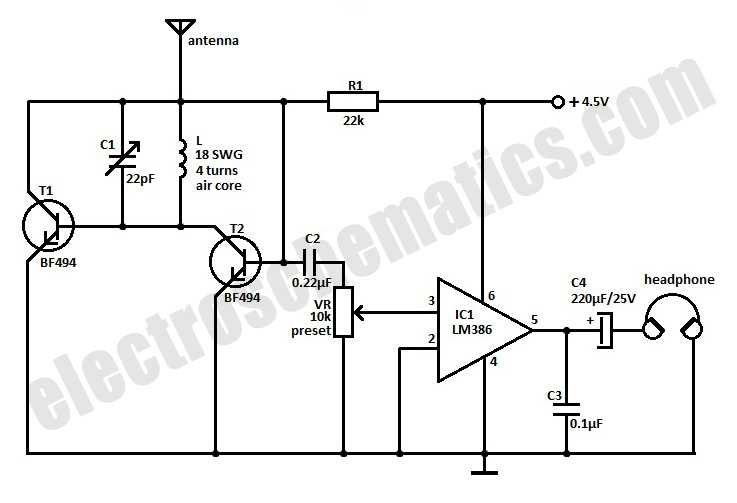
Simple FM Radio receiver

Acartare

Mar 22, 2016
4
Joined
Mar 22, 2016
Messages
4
Hi, Can you help me understand the work of those two transistors? I'm really confused how come the tuned received FM signal inter the collector of T2 and out of its base to feed to the audio amplifier.. any ideas? I've managed to build it and it works without any faults, i'm able to receive major stations with ease and the sound maybe isn't as good but clear enough to listen to the radio. So now, i'm trying to understand the principles of how this circuit work, ignoring the audio amplifier.. i'd be grateful for any help.
Thanks in advance! :)
small-fm-radio.jpg
 

Attachments

  • small-fm-radio-550x375.jpg
    small-fm-radio-550x375.jpg
    21.9 KB · Views: 144
Last edited:

duke37

Jan 9, 2011
5,364
Joined
Jan 9, 2011
Messages
5,364
It looks as if this is a superregenerative circuit. These are fiendishly complicated for such a low component count.The two transistors are connected as a fast oscillator, collector to base, collector to base. The audio comes from T1 collector which also drives T2 base. The timing of the oscillator is modified by the RF signal, hence the audio output.
I am surprised there is no high frequency by-passing before IC1.
 

Audioguru

Sep 24, 2016
3,656
Joined
Sep 24, 2016
Messages
3,656
it is not a Superregen, it is an ordinary regenerative radio that produces very poor performance.
It actually detects AM and all the interference on AM. It is tuned to one side of an FM station to produce FM detection using slope detection.
 

timff

Apr 13, 2018
19
Joined
Apr 13, 2018
Messages
19
I haven't heard about slope detection for over 40 years. As I understand it a frequency modulated carrier can also vary in amplitude providing a proportional signal to detect. It would not have the fidelity one would expect from FM demodulation.
 

Audioguru

Sep 24, 2016
3,656
Joined
Sep 24, 2016
Messages
3,656
I haven't heard about slope detection for over 40 years. As I understand it a frequency modulated carrier can also vary in amplitude providing a proportional signal to detect. It would not have the fidelity one would expect from FM demodulation.
Of course it does not have high fidelity, it is simple.
It is difficult to tune and difficult to adjust the amount of regeneration, it has poor sensitivity, poor selectability, high noise and high distortion. It does not have the pre-emphasis that all FM radio stations have so it will sound muffled with no high audio frequencies reduced by the de-emphasis that all FM radios have.
 

AnalogKid

Jun 10, 2015
3,045
Joined
Jun 10, 2015
Messages
3,045
If a slope detector has no *de*-emphasis, the audio will sound brighter than it should, not muffled. If it has proper de-emphasis, the audio will sound normal. There is no reason to have pre-emphasis in a receiver; pre-emphasis is a modulator/transmitter function.

Slope detection is not something different from FM demodulation. It is one of several different methods that achieve the same thing, converting a change in the carrier frequency to a change in the amplitude of the output signal. There is nothing in the slope detection process that is inherently lower in "fidelity". Fidelity comes from

At its heart, a slope detector circuit is a bandpass filter with a non-flat bandpass. Usually, the amplitude of the FM signal out of the IF strip is constant because it has been intentionally clipped. The response of the slope detector circuit to an FM signal is that at the output, the higher frequencies now have an amplitude different from the lower frequencies. Now that the amplitude of the signal is directly proportional to the instantaneous frequency of the signal, an AM detector can convert the FM signal into audio. Sensitivity and selectivity are handled somewhere else.

Note that I am talking about acircuit designed specifically to be a slope detector. This is not the same as detuning a radio so the station signal you want is sitting at the edge of the IF bandwidth. This causes the FM signal to acquire an amplitude variation that is loosely proportional to frequency, but because the IF bandwidth envelope slope is (hopefully) very steep, the results do have high distortion and excessive interference from other signals within the IF bandpass.

ak
 

Audioguru

Sep 24, 2016
3,656
Joined
Sep 24, 2016
Messages
3,656
If a slope detector has no *de*-emphasis, the audio will sound brighter than it should, not muffled. If it has proper de-emphasis, the audio will sound normal. There is no reason to have pre-emphasis in a receiver; pre-emphasis is a modulator/transmitter function.
Yu are absolutely correct. Hardly anybody makes an FM receiver but many people make a simple FM transmitter without pre-emphasis. This horrible simple radio does not have the proper de-emphasis so the high noise and high distortion will be even higher than a proper FM radio circuit.

Slope detection is not something different from FM demodulation. It is one of several different methods that achieve the same thing, converting a change in the carrier frequency to a change in the amplitude of the output signal. There is nothing in the slope detection process that is inherently lower in "fidelity".
The distortion is caused because the slope is not linear. The slope non-linearity does not affect a proper FM demodulator that has very low distortion.

Note that I am talking about acircuit designed specifically to be a slope detector. This is not the same as detuning a radio so the station signal you want is sitting at the edge of the IF bandwidth. This causes the FM signal to acquire an amplitude variation that is loosely proportional to frequency, but because the IF bandwidth envelope slope is (hopefully) very steep, the results do have high distortion and excessive interference from other signals within the IF bandpass.
I have never seen a real slope detector. This very simple circuit is simply tuned to one side of an FM radio signal and the non-linear slope produces distorted audio plus all the noise of AM.
 
Top