Simple Question about Capacitors

Chat_Ghosty

Jun 30, 2012
49
Joined
Jun 30, 2012
Messages
49
Caps have both Positive and negative sides. Can you use both for say the positive side.

Ex. Using a Bridge Rectifier I read its common to use 1,000uf per Amp. So if I needed to draw lets say 2 amps then I would need a 2,000uf. So could I use both sides of a 1,000uf Cap? Assuming both sides are 1,000uf each.
 

davenn

Moderator
Sep 5, 2009
14,470
Joined
Sep 5, 2009
Messages
14,470
SOME caps have a positive and negative terminal

many caps are not polarised.

So could I use both sides of a 1,000uf Cap?

that doesnt really make sense. if you need ~ 2000uF use a 2000uF cap or a couple of 1000uF caps in parallel

Dave
 

Harald Kapp

Moderator
Moderator
Nov 17, 2011
14,271
Joined
Nov 17, 2011
Messages
14,271
Caps have both Positive and negative sides. Can you use both for say the positive side

1) not all caps ale polarized. Your reference to power supplies leads me to assume that you mean electrolytic capacitors. Those mainly are ploraized.

2) no you can't. guess why the have the "+" and "-" marking? An electrolytic capacitor can explode when used with the wrong polarity.

3)
So could I use both sides of a 1,000uf Cap? Assuming both sides are 1,000uf each.
Please explain, I don't understand. A capacitor has two pins and the capacitance is between these two pins. It is not like each pin having a capacitance of its own. Look up the function of a capacitor.
You connect the capacitor between "+" and "-" after the bridge rectifier. you need either one 2200µF capacitor (2200 being a standard value) or 2*1000µF in parallel.

Harald
 

CiaranM

May 19, 2012
74
Joined
May 19, 2012
Messages
74
You can get non-polarised electrolytics.
Here's what Wikipedia has to say about them: 'Special capacitors designed for AC operation are available, usually referred to as "non-polarized" or "NP" types. In these, full-thickness oxide layers are formed on both the aluminum foil strips prior to assembly. On the alternate halves of the AC cycles, one of the foil strips acts as a blocking diode, preventing reverse current from damaging the electrolyte of the other one.'
I read that you can approximate a non-polarised electrolytic by placing two polarised electrolytics with their positive or negative leads connected together. This would halve the capacitance. I'm not sure about this practice, however.
 

Chat_Ghosty

Jun 30, 2012
49
Joined
Jun 30, 2012
Messages
49
My teacher did Two days on Electronics. Only because we asked.

But he said that a cap is two plates separated by a Dielectric. And when the Sine wave (Pulsating DC) when on the Peak the Positive side gains more Protons and become positively Charged. And the same for the Negative only more Electrons.

I was thinking that because of this then you can make both side of the cap Positive by Connecting Both Negative and Positive side of the Cap together so that you have Double the Capacity. The point of this, is to save space or get more out of the cap. \

Also somebody said that after a Bridge Rectifier you need a Smoothing Cap of 1,000uf to 1 amp of Draw. Then the Caps for the Voltage Regulator and then a 10uf cap after. What is this cap for?
 

davenn

Moderator
Sep 5, 2009
14,470
Joined
Sep 5, 2009
Messages
14,470
OK ...
A couple of misconceptions :)
but that's ok cuz you are asking questions and the answers are reasonably straight forward --- never be afraid to ask :)


My teacher did Two days on Electronics. Only because we asked.
But he said that a cap is two plates separated by a Dielectric. And when the Sine wave (Pulsating DC) when on the Peak the Positive side gains more Protons and become positively Charged. And the same for the Negative only more Electrons.

yes, 2 plates separated by a dielectric
Nothing gains more protons, protons dont come and go from a capacitor plate, bit of wire or a circuit in general.
Its the outer valence electrons of a conductor that are free to move between atoms and slowly make their way around a circuit. Its that movement that is the electrical current.
Note I used the word ... slowly ... this is because electrons DONT rush around a circuit at near the speed of light ... this is another misconception many people have.
Electrons move around a circuit quite slowly in what is called electron drift... its on the order of ~ 1 metre / hr ( partly dependant on the type of metal)
So something having a positive charge just implies the lack of electrons :)


I was thinking that because of this then you can make both side of the cap Positive by Connecting Both Negative and Positive side of the Cap together so that you have Double the Capacity. The point of this, is to save space or get more out of the cap. \

capacitors dont work that way ;)
in an AC circuit, a capacitor plate can alternate back and forward between positive and negative as the electrons move back and forward as part of the AC cycle

Also somebody said that after a Bridge Rectifier you need a Smoothing Cap of 1,000uf to 1 amp of Draw. Then the Caps for the Voltage Regulator and then a 10uf cap after. What is this cap for?


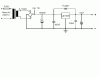
OK here's a pretty standard 5V regulated PSU....

attachment.php


the 10uF electrolytic on the output is just additional smoothing

Dave
 

Attachments

  • PSU2a.GIF
    PSU2a.GIF
    4.1 KB · Views: 211

Chat_Ghosty

Jun 30, 2012
49
Joined
Jun 30, 2012
Messages
49
Ok. Thank You very much.
I understand now.

The only thing I don't is that you have a Diode on the Input and Output of the Regulator. Why is that?

I keep thinking when I see things like that, it will cause it to short out and blow a fuse. I guess the main question is that I know you need about 2 or so volts higher then the Output volts. But I get confused on what happens when you have two different voltages going through the same wire. The 8 - 15v from the Bridge and the 5v from the Regulator going to the input.
 

davenn

Moderator
Sep 5, 2009
14,470
Joined
Sep 5, 2009
Messages
14,470
Ok. Thank You very much.
I understand now.

The only thing I don't is that you have a Diode on the Input and Output of the Regulator. Why is that?

.

its for reverse voltage protection of the regulator.

When power is turned off, there may be capacitors etc in the circuit that the regulator is supplying, that will slowly discharge, if that protection diode isnt there, that current will flow into the output pin of the regulator ... not good for the regulator.
Instead it gets bypassed to the input pin via the diode where it wont do any harm

Dave
 

Chat_Ghosty

Jun 30, 2012
49
Joined
Jun 30, 2012
Messages
49
What would happen if you replaced the Diode with a Resister?
Or what if you have both?
 

Chat_Ghosty

Jun 30, 2012
49
Joined
Jun 30, 2012
Messages
49
I'm thinking that if you added a High Resistance then it will dispate the Discharge into heat or too high and it acts like a Diode.
 

davenn

Moderator
Sep 5, 2009
14,470
Joined
Sep 5, 2009
Messages
14,470
if you had a resistor instead of a diode there, you would have unregulated voltage being fed from the regulator input side to the output side .... it would negate the use of the regulator.
Using a diode stops that from happening as current only flows one way through it

Dave
 

(*steve*)

¡sǝpodᴉʇuɐ ǝɥʇ ɹɐǝɥd
Moderator
Jan 21, 2010
25,510
Joined
Jan 21, 2010
Messages
25,510
If you place a resistance across the regulator it will provide an alternate current source that may cause the output voltage to rise under low load conditions.

If you place it in series with the diode it will prevent the diode from doing its job. The resistor will drop some voltage, and that voltage is what we want to eliminate (i.e. it's the reason for the diode) in order to protect the regulator.

edit: and I should not get distracted while I am typing my reply :)
 
Last edited:

Chat_Ghosty

Jun 30, 2012
49
Joined
Jun 30, 2012
Messages
49
Ok. Let me get this Straight.

You add a Diode to prevent the Discharge of the Caps into the Regulator when Power is Shut off.

Will the Discharging Caps power and Keep Regulated 5v. until the caps hit about <6v,?
Then how is the that Extra Energy Removed?
 

davenn

Moderator
Sep 5, 2009
14,470
Joined
Sep 5, 2009
Messages
14,470
Ok. Let me get this Straight.

You add a Diode to prevent the Discharge of the Caps into the Regulator when Power is Shut off.

Will the Discharging Caps power and Keep Regulated 5v. until the caps hit about <6v,?
Then how is the that Extra Energy Removed?

.... of the caps and anything else in the circuit being powered that will store a charge after the power is switched off.
I have also read that its one way to also protect the regulator from any fault currents that may come into contact with the circuit..... but I suspect that this is a bit irrelevent as those fault currents are likely to do more expensive harm to that circuit.... and who, in that situation really cares about a $1.50 regulator, its the least of their worries.

Its dissapated by going back into the input to the regulator :)

Just in case you are going down the wrong track ... this isnt from the 1000uF or whatever cap in the input to the regulator that we are referring to ... ok?

Dave
 

(*steve*)

¡sǝpodᴉʇuɐ ǝɥʇ ɹɐǝɥd
Moderator
Jan 21, 2010
25,510
Joined
Jan 21, 2010
Messages
25,510
Most of these regulators have a transistor as a pass element. Normally the input voltage is higher than the output voltage (that is true even if the input voltage falls to a value lower than the rated output voltage since the output will fall too).

In this case, the base-emitter junction is forward biased.

If power is removed, and the input capacitor discharges (say due to some other load), but the output capacitor retains its voltage, the voltage on the output capacitor will reverse bias the base-emitter junction of the pass transistor.

Base-emitter junctions have a low tolerance to reverse voltage (6 to 8 volts is not uncommon).

If the output voltage is higher than the input voltage plus the b-e breakdown voltage, the output capacitor will discharge through the base-emitter junction, potentially destroying the regulator.

The purpose of the diode is to allow any output capacitance to discharge at close to the same rate as the input capacitance. The base-emitter junction will not get significantly reverse biased and the regulator is safe.

In theory, a 5v regulator shouldn't need one because the BE junction should be able to withstand 5V. However the cost of a single diode is small.
 

Chat_Ghosty

Jun 30, 2012
49
Joined
Jun 30, 2012
Messages
49
Ok. I see now. I think the first project I'm going to work on is a 5 volt psu with five USB out puts to power my Phone, mp3 and etc devices.

I was looking into how to make a Regulator handle more Current and the data sheet said to add a 3 ohm resistor and a NPN transistor.

I think this will be the best thing to start with. As it is useful and basic.
 
Top