Speaker & Amplifier Impedances

Resqueline

Jul 31, 2009
2,848
Joined
Jul 31, 2009
Messages
2,848
If you have one of those modern receivers that checks speaker impedance and refuses to operate if it's too far out of range then you can compensate with resistors.
But since resistance in series with speakers is detrimental to sound quality I'd want to us as little resistance as I could get away with.
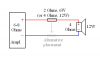
Resistors of 4 ohms - even down to 12W should work, but modern receivers can usually work wih 6 ohms so in this case I'd try to use 2-2.2 ohm 6-7W resistors.
 

icor1031

Apr 27, 2010
65
Joined
Apr 27, 2010
Messages
65
Is anything polarity sensitive? If I put the speaker's negative into the receiver's positive, will it cause damage?

The speakers I have are from a computer set, the positive and negative are not marked. I don't want to buy new speakers, there are 7 of them.

My receiver does allow 4ohm speakers, but I also have a pair of 8's connected. I'm concerned if I turn them both on at the same time by accident, that I'll damage the receiver.

It's a 7.1 / 2.1 receiver, A/B.
 
Last edited:

Resqueline

Jul 31, 2009
2,848
Joined
Jul 31, 2009
Messages
2,848
No damage will ensue, but the sound is polarity sensitive. If you connect speakers at random the sound image will be mushy & poor.
Use a 1.5V battery to (briefly) test which polarity makes the speaker diaphragm push out.
If you have an A/B switch with speakers connected to both output sets then it might be best to use resistors (if not for anything else but to equalize the sound levels).
The amp won't be damaged unless you crank the volume up really high anyway.
 

icor1031

Apr 27, 2010
65
Joined
Apr 27, 2010
Messages
65
Thanks for your help, Resqueline.

I cut the cables, found the positive on them like you said, and went to connect them ( I don't care if sound level is equal ) to find out that only my front supports 4 ohm, the side/rear, etc. are 6.

Guess I have to get the resistors now.

I just connect the resistor's positive And negative to the positive on the speaker cable, right?
 

davenn

Moderator
Sep 5, 2009
14,470
Joined
Sep 5, 2009
Messages
14,470
Resistors dont have a positive or negative, it doesnt matter which way around they are connected

Dave
 

Resqueline

Jul 31, 2009
2,848
Joined
Jul 31, 2009
Messages
2,848
What Dave said. Also it doesn't matter in which wire they go. But it does matter where, or in which way they are connected (series or parallell that is). Here's how.:
 

Attachments

  • Spk.PNG
    Spk.PNG
    9.2 KB · Views: 187

icor1031

Apr 27, 2010
65
Joined
Apr 27, 2010
Messages
65
Okay, I bought some resistors. I found them somewhere else for cheaper, in the USA.

Now, when I strip the cable to add the resistor, is that going to affect the audio quality much? Should I cover up where the wire and resistor connect, will that retain some quality?

What do I cover it with, just electrical tape?
 

Resqueline

Jul 31, 2009
2,848
Joined
Jul 31, 2009
Messages
2,848
Adding resistors in series with speakers makes such sound quality concerns a moot point. Just add any insulation as neccessary to prevent shorts to anything nearby.
 

Resqueline

Jul 31, 2009
2,848
Joined
Jul 31, 2009
Messages
2,848
That depends on the impedance curve of the speakers. 4 Ohms is just the nominal (average) impedance. You can try to search for some curves on the net.
Typically there is a high impedance at the woofer resonance, low impedance at mid frequencies, and then gradually higher impedance at higher frequencies.
That translates into that you can expect to experience a higher volume at woofer resonance, a weak mid-range, and a "crisp" treble.
If this is pronounced enough to notice is impossible for me to predict in advance. It all depends on the speakers properties and the ears (or mind) listening to it.
Just to clarify: I'm of the opinion that super-special super-expensive super-cables is a load of religious mumbo-jumbo. There are other tings that matters 10k times more.
Almost all speakers employ passive filters inside. Those consists of resistors, coils with 100's of feet of wire, and bipolar electrolytic capacitors with (poor properties).
So never mind insulation properties as a sound quality issue, and be aware that speakers are not perfect to begin with - almost no matter how expensive.
 
Top