Trying to find a vibration or sound sensing switch / circuit

Tha fios agaibh

Aug 11, 2014
2,253
Joined
Aug 11, 2014
Messages
2,253
Wouldn't it be wise to add additional suppression, aside from the relay diode?
I'd be worried about a spike when the compressor motor turns off.

Speaking to simplicity...I suppose a temp switch would not achieve what you want?
 

Arouse1973

Adam
Dec 18, 2013
5,178
Joined
Dec 18, 2013
Messages
5,178
Wouldn't it be wise to add additional suppression, aside from the relay diode?
I'd be worried about a spike when the compressor motor turns off.

Speaking to simplicity...I suppose a temp switch would not achieve what you want?

That's a very good idea John. I think some arc suppression across the contacts is worth mentioning.
Adam
 

Arouse1973

Adam
Dec 18, 2013
5,178
Joined
Dec 18, 2013
Messages
5,178
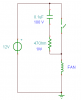
Here is the arc suppression circuit I mentioned earlier which John requested. 1W Carbon resistor and 100 V Ceramic capacitor should be fine.
Adam

SNUB.PNG
 

Tha fios agaibh

Aug 11, 2014
2,253
Joined
Aug 11, 2014
Messages
2,253
Thanks Adam. I was expecting something like a MOV across the compressor (inductive load), to minimize transient spikes that'd feed back to the power rail and your transistor circuit.

Which raises a few questions for me; Why the rc (snubber) circuit instead of a blocking diode? I realize it protects the relay contacts, but can't some reverse (reactive) current reach back to the power supply?
Can you explain when and why one method of suppression is preferred over the other?
Thanks for letting me pick your brain.

Regards, John
 

Arouse1973

Adam
Dec 18, 2013
5,178
Joined
Dec 18, 2013
Messages
5,178
Hi John.

There are lots of different types of arc suppression and the one I chose is a cheap popular method. It stores some of the energy from the inductor in the capacitor, reducing the overall voltage spike. The energy stored in the capacitor is then is fed back to the load when the contacts closes again, hence the resistor which limits the current from the capacitor on closing of the contacts.

The diode you mentioned will work for D.C applications but has the drawback of reducing the time for the load to stop drawing current. Sometimes this can be a problem with very large solenoids like used for door magnets in which it may take a noticeable time for the magnet to release once the solenoid is de-energized. But for the fan it's not going to make much difference.

This is where the MOV comes in and basically shorts the coil out reducing the energy in the coil very quickly.

There are other methods using zener diode and a combination of capacitors, diodes and MOVs. The devices can get quite expensive when the voltages and current required to be handled go up. That's why the snubber is so popular. How ever for A.C applications the snubber can still supply current to the load in some cases this is undesirable, it all depends on the application.

Adam
 

Tha fios agaibh

Aug 11, 2014
2,253
Joined
Aug 11, 2014
Messages
2,253
(Diode has the)..... drawback of reducing the time for the load to stop drawing current. Sometimes this can be a problem with very large solenoids like used for door magnets...

Is this because of reverse leakage current thru the diode?
 

Arouse1973

Adam
Dec 18, 2013
5,178
Joined
Dec 18, 2013
Messages
5,178
Is this because of reverse leakage current thru the diode?

The diode make a circuit with the coil and the current just keep going round and round and round until all the energy is used up. This is how the standard diode across relay coil works. But when you have a large coil with a high ish resistance this can take some time.
Adam
 
Top