Use 2v Signal to Control 12v LED strip

C

classyturkey

Jan 1, 1970
0
I'm sorry if this title is confusing, but let me try to explain. If this is in the wrong section please let me know.

I am currently working on a DIY project where I currently have a board that runs on 3v that is a receiver for motorcycle signals. So whenever my blinkers activate, the device will turn on the 2v LEDs for that signal. Ex Left, Right, or Brakes.

I want to modify this and attach it to 10 LED strips that are 12v with 60ma per strip. The LEDs have their own separate power supply, but I am needing to control/complete the circuit with the 2v LED signal. I am willing to actually remove the LEDs on the board with transistor or MOSFET, but I am confused on what is the correct way to do this. Also if I am even going about it the correct way. Any help would be amazing.
eBHG56b.jpg


audioguru2

Apr 6, 2004
12,026
Joined
Apr 6, 2004
Messages
12,026
We do not know how much current the 2V signal has. Therefore we do not know if you need a normal transistor or a darlington transistor. A darlington transistor has voltage loss that might dim the LED strips.
Most Mosfets need a 10V input to turn on but some 'logic-level" ones need only 4.5V. Therefore you need a normal transistor "level-converter" to turn on a Mosfet that turns on the LED strips.

Do the LED strips have built-in current limiting resistors?


Hero999

Oct 28, 2007
2,433
Joined
Oct 28, 2007
Messages
2,433
The 2V signal is probably only 2V because it has an LED across it which is driven off 3V with an appropriate series resistor.

You need find out how the LEDs are wired before you can interface with the board.


audioguru2

Apr 6, 2004
12,026
Joined
Apr 6, 2004
Messages
12,026
The new load will be 600mA. An ordinary transistor saturates fairly well when its base current is 60mA which is too much for an LED unless it is a big very bright one. So the receiver output must be analysed to see if it can be modified to supply 60mA.

 
C

classyturkey

Jan 1, 1970
0
Hero999 said:
The 2V signal is probably only 2V because it has an LED across it which is driven off 3V with an appropriate series resistor.

You need find out how the LEDs are wired before you can interface with the board.
I believe that board is dropping the voltage down before the LEDs on the board reason being, if I check the voltage between the positive of the LEDs and ground on the board it is 2v. So from that I assume that board is already dropping the voltage before it gets to the LEDs.

The 12v LEDs are meant to be hooked up to the bike battery, as thats why they are 12v with a 60ma per strip. These are just the specs from the manufactures, but I don't have them with me currently to test.
 
C

classyturkey

Jan 1, 1970
0
audioguru said:
We do not know how much current the 2V signal has. Therefore we do not know if you need a normal transistor or a darlington transistor. A darlington transistor has voltage loss that might dim the LED strips.
Most Mosfets need a 10V input to turn on but some 'logic-level" ones need only 4.5V. Therefore you need a normal transistor "level-converter" to turn on a Mosfet that turns on the LED strips.

Do the LED strips have built-in current limiting resistors?
If the drop in voltage is minimal then it wouldn't really effect these LEDs that much. The manufactuer stated that they can run easily at 9v. I believe they have to as if not they would blow from the motorcycle battery correct?


Hero999

Oct 28, 2007
2,433
Joined
Oct 28, 2007
Messages
2,433
classyturkey said:
I believe that board is dropping the voltage down before the LEDs on the board reason being, if I check the voltage between the positive of the LEDs and ground on the board it is 2v. So from that I assume that board is already dropping the voltage before it gets to the LEDs.

The 12v LEDs are meant to be hooked up to the bike battery, as thats why they are 12v with a 60ma per strip. These are just the specs from the manufactures, but I don't have them with me currently to test.
It's more likely that each LED has a series resistor to limit the current and the LED foward voltage is 2V.

If you remove an LED, you'll probably find the voltage increases to 3V.

The new load will be 600mA. An ordinary transistor saturates fairly well when its base current is 60mA which is too much for an LED unless it is a big very bright one. So the receiver output must be analysed to see if it can be modified to supply 60mA.
The BC337 might do. It's specified with a minimum Hfe of 40 when IC = 500mA and VCE = 1V
http://pdf.datasheetcatalog.com/datasheet/philips/BC337_3.pdf
 

audioguru2

Apr 6, 2004
12,026
Joined
Apr 6, 2004
Messages
12,026
I think a little BC337 will get too hot with a current of 600mA and a saturation voltage loss of maybe 1.2V. Also its maximum allowed current is 500mA which is too low.
The 12V battery might be 13.8V.


Hero999

Oct 28, 2007
2,433
Joined
Oct 28, 2007
Messages
2,433
That's odd. The ON semiconductor datasheet lists a maximum IC of 800mA but Hfe is only specified at 300mA, Hfe > 60 VCE = 1V.
http://www.onsemi.com/pub_link/Collateral/BC337-D.PDF

600mA with a forced beta of 30 doesn't seem unreasonable but a heatsink would be a good idea. Don't forget the minimum beta is normally specified across the temperature range (-55C to 100C) so at room temperature or warmer, it'll be much higher than the minimum.

Failing that, use an higher beta transistor:
http://pdf.datasheetcatalog.com/datasheet/sanyo/ds_pdf_e/2SC3807.pdf
http://www.classiccmp.org/rtellason/transdata/2sc3616.pdf
http://www.diodes.com/datasheets/ZTX690B.pdf

 
Last edited by a moderator:
C

classyturkey

Jan 1, 1970
0
Hero999 said:
It's more likely that each LED has a series resistor to limit the current and the LED foward voltage is 2V.

If you remove an LED, you'll probably find the voltage increases to 3V.
...So you were correct. I removed one of the LEDs and it is just below 3v. It only reached 2.8v. So with this I have a question how to use it will the BC337. On the BC337 there is the base, emitter, and collector. How would I hook this to my board? The board is always sending power to the positive and only completes with negative. I know you need to connect the base to allow the flow of current, but how will I do this when there is only 1 pin I can hook into....

Sorry if this doesn't make sense.
 
C

classyturkey

Jan 1, 1970
0
Hero999 said:
That's odd. The ON semiconductor datasheet lists a maximum IC of 800mA but Hfe is only specified at 300mA, Hfe > 60 VCE = 1V.
http://www.onsemi.com/pub_link/Collateral/BC337-D.PDF

600mA with a forced beta of 30 doesn't seem unreasonable but a heatsink would be a good idea. Don't forget the minimum beta is normally specified across the temperature range (-55C to 100C) so at room temperature or warmer, it'll be much higher than the minimum.

Failing that, use an higher beta transistor:
http://pdf.datasheetcatalog.com/datasheet/sanyo/ds_pdf_e/2SC3807.pdf
http://www.classiccmp.org/rtellason/transdata/2sc3616.pdf
http://www.diodes.com/datasheets/ZTX690B.pdf
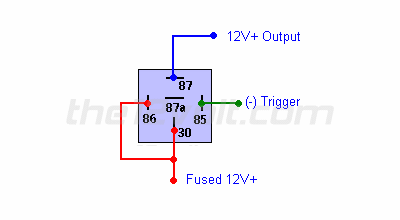
I had a new idea and I don't know if this would work, but my main issue is that I only have 3v to power the relay. Why not use the V from the 12v side like this relay and trigger the relay off the negative.
neg2pos.gif


Now, the only thing I don't know is using this setup would the current go through my board and possibly damage my board? Would I be able to use a diode to prevent this or am I thinking about this the wrong way?
 

audioguru2

Apr 6, 2004
12,026
Joined
Apr 6, 2004
Messages
12,026
The Sanyo transistor is fantastic and will work well in a new circuit to drive your LED strips but Sanyo was recently purchased by Panasonic and might not make transistors anymore.

Now you are talking about a relay but forgot to tell us how much current its coil needs.
 

Hero999

Oct 28, 2007
2,433
Joined
Oct 28, 2007
Messages
2,433
I doubt the circuit is capable of driving a relay.

You can probably connect the base to the output of the circuit which drives the LED. It will already have a current limiting resistor for the LED which should also be fine for a transistor.

The ZTX690 is widely available. Digikey and Rapid Electronics stock them.
http://www.digikey.com/product-search/en?vendor=0&keywords=ZTX690B
http://www.rapidonline.com/Electronic-Components/Ztx690b-Tran-Npn-45v-2a-Eline-81-0230

 
Top