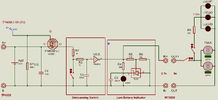
Hi everyone. Can you help me with this circuit I am working on, please?. (Image 1)
It consists of a TP4056 charger/controller connected to a 3.7v/1.4Ah Li-Ion battery to supply a low battery indicator and a load (3 leds + 2 fans) through a MT3608 Step Up to raise voltage from 3.7v to 9v. When the TP4056 is charging the battery through the USB port, the load is disconnected by the P-Mosfet.
PROBLEM: Voltage drops significantly when the load is connected.
Test1: Circuit without Debouncing/Load connected:
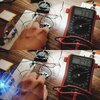
Voltage drops from 3.68v to 3.46v (image 2).
Low Battery Indicator: Blinks.
Test2: Circuit with Debouncing/Load connected:
1) Debouncing Circuit: The voltage drops to 2.19v at the output of the Smichtt Trigger, therefore it isn't possible to energize the Step Up and the rest of the circuit.
2) Low Battery Indicator: Blinks when switch is pressed.
Test3: Circuit with Debouncing/Load disconnected:
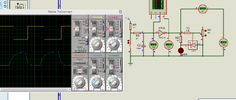
1) Debouncing Circuit: Works fine (image 3).
2) Low Battery Indicator: Doesn't blink when the switch is turned ON/OFF.
Is there something that I am forgetting to put in the circuit so the voltage is dropping?
I would suppose that the problem is at the DC/DC conversion of the Step Up, but everything is meeting its requirements (Vin:2v-24v/Imax: 2A).
My system details:
Power consumption: 1.702W
Low Bat Indicator: (0.037W, 3.7v/0.01A)
Load: 2 Fans (1.44W, 9v/0.16A), 3 Leds (0.059W, 2.92v/0.02A).
Debouncing Circuit based on a Schmitt Trigger 74HC14 (Vin:2-6v/Vout:2-VCC, VCC and GND connected to battery line).
It consists of a TP4056 charger/controller connected to a 3.7v/1.4Ah Li-Ion battery to supply a low battery indicator and a load (3 leds + 2 fans) through a MT3608 Step Up to raise voltage from 3.7v to 9v. When the TP4056 is charging the battery through the USB port, the load is disconnected by the P-Mosfet.
PROBLEM: Voltage drops significantly when the load is connected.
Test1: Circuit without Debouncing/Load connected:
Voltage drops from 3.68v to 3.46v (image 2).
Low Battery Indicator: Blinks.
Test2: Circuit with Debouncing/Load connected:
1) Debouncing Circuit: The voltage drops to 2.19v at the output of the Smichtt Trigger, therefore it isn't possible to energize the Step Up and the rest of the circuit.
2) Low Battery Indicator: Blinks when switch is pressed.
Test3: Circuit with Debouncing/Load disconnected:
1) Debouncing Circuit: Works fine (image 3).
2) Low Battery Indicator: Doesn't blink when the switch is turned ON/OFF.
Is there something that I am forgetting to put in the circuit so the voltage is dropping?
I would suppose that the problem is at the DC/DC conversion of the Step Up, but everything is meeting its requirements (Vin:2v-24v/Imax: 2A).
My system details:
Power consumption: 1.702W
Low Bat Indicator: (0.037W, 3.7v/0.01A)
Load: 2 Fans (1.44W, 9v/0.16A), 3 Leds (0.059W, 2.92v/0.02A).
Debouncing Circuit based on a Schmitt Trigger 74HC14 (Vin:2-6v/Vout:2-VCC, VCC and GND connected to battery line).


