What will be the output signal of op-amp?

za_slovom

Apr 20, 2017
4
Joined
Apr 20, 2017
Messages
4
Hi everyone. I am stuck on op-amp. There are some problems that I can deal with, and some thay I can't. I know that if our signal is applied into inverting input then there will be phase shift of 180 degrees in the output. For the example below, this rule doesn't work. The signal applied to the non-invering input doesn't have to change in the output. What am I doing wrong?
bandicam 2017-06-20 20-14-43-072.jpg
 

Attachments

  • bandicam 2017-06-20 20-14-43-072.jpg
    bandicam 2017-06-20 20-14-43-072.jpg
    10 KB · Views: 74

davenn

Moderator
Sep 5, 2009
14,470
Joined
Sep 5, 2009
Messages
14,470
double ended output ???
what is the op-amp ?

what I see in that diag. doesn't even make sense
 

(*steve*)

¡sǝpodᴉʇuɐ ǝɥʇ ɹɐǝɥd
Moderator
Jan 21, 2010
25,510
Joined
Jan 21, 2010
Messages
25,510
The input signal is the difference between the two input voltages.
 

Audioguru

Sep 24, 2016
3,656
Joined
Sep 24, 2016
Messages
3,656
Your opamp has no power supply.
Its inputs have no biasing.
It has no negative feedback.
It has an extra output (opamps have only one output). Some audio power amplifiers have a differential outputs (two outputs) and some have built-in biasing and negative feedback.

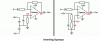
Here are two opamp circuits that amplify AC signals. One has a single polarity power supply and the other has a dual polarity power supply.
They are biased at half the supply voltage so their outputs can swing up and down.
They have negative feedback.
They have only one output.
 

Attachments

  • inverting opamps.png
    inverting opamps.png
    10.6 KB · Views: 153

(*steve*)

¡sǝpodᴉʇuɐ ǝɥʇ ɹɐǝɥd
Moderator
Jan 21, 2010
25,510
Joined
Jan 21, 2010
Messages
25,510
It has an extra output

Perhaps you should Google for op amps with differential output.

The other points are not relevant either.

There is no suggestion that this is a practical circuit, and it is not uncommon to omit the power supply connections.
 

Audioguru

Sep 24, 2016
3,656
Joined
Sep 24, 2016
Messages
3,656
I explained why his circuit did not work and I showed all the details on my schematic that works perfectly.
 

(*steve*)

¡sǝpodᴉʇuɐ ǝɥʇ ɹɐǝɥd
Moderator
Jan 21, 2010
25,510
Joined
Jan 21, 2010
Messages
25,510
It's not a working circuit. It's a demonstration of how the device works.

You've probably never seen the equation Vo = a(V+ - V-)
 

Laplace

Apr 4, 2010
1,252
Joined
Apr 4, 2010
Messages
1,252
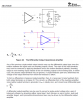
Texas Instruments has an application note (sboa092b.pdf) that covers operational amplifiers with balanced output.
Screenshot from 2017-06-21 22-19-04.png
 

Harald Kapp

Moderator
Moderator
Nov 17, 2011
14,272
Joined
Nov 17, 2011
Messages
14,272
An opamp with differential output needs feedback, too, which is missing in the circuit from post #1.
Assuming the amplifier shown in post #1 has finite gain (e.g. internal feedback or feedback simply not shown). one would still expect the differential output voltage
Vd = Vo1-Vo2 to be in phase with the input voltage Vi.
The graphical representation in the figure suggests that the definition of Vd is Vd = Vo2-Vo1 which explains the 180 ° phase shift. In fact, this is the only exlanation I can think of lacking more information from the op. The app note shown by @Laplace in post #8 supports this.
 

Audioguru

Sep 24, 2016
3,656
Joined
Sep 24, 2016
Messages
3,656
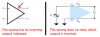
The OP says that his input is applied to the inverting input but it is shown applied to the non-inverting input!
Another problem is that his inverting output is not indicated.
 

Attachments

  • balanced outputs opamp.png
    balanced outputs opamp.png
    25.5 KB · Views: 59
Top