Why 50 50 50 maximum power

Kevin Weddle

Feb 23, 2004
1,620
Joined
Feb 23, 2004
Messages
1,620
The term nonresonant applies to the condition where the reactance is cancelled out and the line impedance is equal to the source impedance is equal to the load impedance and describes maximum power transfer. The maximum power transfer is difficult to see because you might think that a high impedance load would consume the most power. Remember that amplifiers use low value resistances to make the bias independent of the changing load. Hence the low ouput impedance of most devices. You can see where a value of 20 30 40 is close enough to 50 50 50. The line impedance has to be low for obvious reasons. So it has to do with the bias of the amplifier more than anything else.If you don't make the bias independent of the changing load, you are going to have instability and this in part is what resonance is. This is my theory. Any other suggestions.


audioguru2

Apr 6, 2004
12,026
Joined
Apr 6, 2004
Messages
12,026
Hi Kevin,
The output impedance of an audio amplifier has nothing to do with its bias. An amplifier can have no bias (class-B) and still have a low output impedance.
The output impedance is totally dependent on the amplifier's negative feedback.
If an amplifier has an open-loop output impedance of 10 ohms and a voltage gain of 50,000, with feedback reducing its gain to 50 its output impedance is 0.01 ohms. Many audio amps have an output impedance that is much less.

The very low output impedance of an amplifier that is created by its negative feedback causes its output voltage to be independent of the changing load, for very good damping of a loudspeaker's resonance and ringing. Not the bias.

How can a high impedance load consume the most power? The power in an impedance is determined by the voltage across it. Therefore a high impedance load would need an enormous voltage to consume any power.


shekhar_dandya

Jun 18, 2004
136
Joined
Jun 18, 2004
Messages
136
Hi kevin,
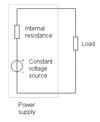
Considering the thevnin equivalent with a voltage source in series with a source resistance and a series load resistance,my theory goes like this:
If the load impedence is larger than the source impedence(open circuit)then power transffered to the load is zero.P=VI=0.
If the load impedence is less than the source impedence(short circuit)then also power transffered to the load is zero p=VI=0.
If the load impedence equals source impedence,voltage at the load is half the source voltage hence the power =1/2(VI) and this is the maximum power that can be transffered from source to load.If the load changes on either side,the power X'fered would drop.
I may be wrong or too priliminary
-Shekhar

 
A

Alun

Jan 1, 1970
0
Maximum power transfer will occur when the load resistance is equal to the internal resistance, but the efficiency of the system will only be 50% as half the power is dissipated in the driving system.

In general with resistances connected in series the most power is dissipated in the largest resistance, if the load resister is too small then most of the power is dissipated in the driving circuit, if it is too large then the current in the circuit will go down together with the power dissipated.

With most systems we don't want maximum power transfer we want maximum efficiency so we keep the internal resistance of the driving circuit a low as possible.

thevnin.GIF

 
Top