Would anybody help with a basic circuit design and spec please

Stu8

Jul 4, 2024
21
Joined
Jul 4, 2024
Messages
21
Hi, just signed to ask for a little help.
I'm looking to use a 1.8 - 2.0v LED supply to switch a relay to in-turn activate and deactivate a 12v solenoid.
The LED is on a receiver for a Laser, when this LED is activated, I want it to power a 12v solenoid to activate and deactive Hydraulics
The Receiver is powered @ 3v by 2 AA batteries, but the voltage across 1 LED is 1.8v, the other 2.0v, when they are activated

I'm assuming (per LED) I need a relay, transistor and a resistor. The 12v side of things from the solenoid to the relay is no issue for me, but the transistor is outside my experience

With a basic diagram, could someone give me a list of suitable parts/part numbers?

Thanks

Stu
 

danadak

Feb 19, 2021
1,062
Joined
Feb 19, 2021
Messages
1,062
Datasheet or specs for the relay coil ?

Do you want a triggerable relay, one pulse turns it on and it stays on until
another pulse to turn it off and stay off, rinse and repeat ?


Regards, Dana.
 

Stu8

Jul 4, 2024
21
Joined
Jul 4, 2024
Messages
21
Hi Dana, Thanks for the reply.
I've not chosen the relay yet, its part of the spec list i'm hoping someone will advise
The laser receiver has 3 led's , too high, too low and inline. The LED's appear to be on solid when in their range. So if, for too high for example, that too high LED stays on till the level changes to inline, or too low, when then the too high LED goes out and the new corresponding LED comes on. Idea is, to use the hydraulics to adjust the height, to try keep the receiver in the 'inline' range.
From, that, I want the relay to activate the solenoid when the led is on, and deactivate the solenoid when the LED is off. I could use the 'inline' LED as some sort of stop, but was hoping just the too high and too low leds, connected to the corresponding solenoids, would do the job

Thanks

Stu
 

Stu8

Jul 4, 2024
21
Joined
Jul 4, 2024
Messages
21
Opto isolator might be your best shot.
Thanks Bluejets

I have got 2 of them on the way, but at 3V, i'm worried the available 2ish volts at the LED's wont switch the relays reliably, or worse, the additional draw of the coils on the LED circuit may damage the receiver

Thanks

Stu
 

Bluejets

Oct 5, 2014
7,374
Joined
Oct 5, 2014
Messages
7,374
I have got 2 of them on the way, but at 3V, i'm worried the available 2ish volts at the LED's wont switch the relays reliably, or worse, the additional draw of the coils on the LED circuit may damage the receiver
The voltage at your existing LEDs is more than enough, only need to light the opto internal LED via a resistor.
After that, the open collector of the opto will drive your relay from whatever additional supply you require to match your relay.
You quoted 12v, I assume DC.
 

Stu8

Jul 4, 2024
21
Joined
Jul 4, 2024
Messages
21
The voltage at your existing LEDs is more than enough, only need to light the opto internal LED via a resistor.
After that, the open collector of the opto will drive your relay from whatever additional supply you require to match your relay.
You quoted 12v, I assume DC.
Ok, great, that sounds positive. Please bear in mind i'm completely out of my depth here, I enjoy electrics and electronics, but only learn as I go along and need to learn.
This is what I assume is the Opto I bought (2 of, 1 for each LED) - https://www.ebay.co.uk/itm/166388761285
If the ebay item is suitable, what resistor and where in the line would it go? Would I simple power the input side from the 2v led contacts, or is there more too it.
I could use the 12v, yes DC, to somehow power the switch too if needed, but I have no way round needing the 2v LED as the trigger

Thanks

Stu
 

danadak

Feb 19, 2021
1,062
Joined
Feb 19, 2021
Messages
1,062
I cant find on any sites what the high level logic level input spec is on the module,
other than an inferred 3.3V. Maybe set up on bench with variable supply and
raise V until you see contacts close with a ohmmeter.

I also saw some comments that they had to use 5V to get relay coil
to activate, even though it was speced at 3.3V.

What is part number on top of relay on module ? If you dont have its schematic
consider hand drawing one. There are different ways of switching both inside and coil
side and could impact how much current allowed thru coil as well.

Is there a part number on top of isolator as well ?

These Chinese suppliers terrible at documenting. You might be able to get the
schematic off the supplier you bought them from.

Basically you are trying to :

1) Insure you get min current thru coil to insure its on.
2) Insure you dont apply to much V to coil if not speced.
3) Insure input logic level allowed min and max V met

Hopefully the LED output V 's you are working with dont
have analog behaviour, they either switch on or off, no
in between V levels that would require hysteresis to cure.
To keep load/relay from "chattering". At minimum a bypass
cap on module Vcc, say a 20uF or greater electrolytic.

Regards, Dana.
 
Last edited:

Stu8

Jul 4, 2024
21
Joined
Jul 4, 2024
Messages
21
Im hoping they will arrive early next week, i dont have them yet, so will reply with info then.

I'm not sure what logic level is, as I say, my knowledge is limited to very basic circuit builds, or replacing components like for like.

As for the other info you have mentioned, i'll try do a bit of research to get a bit of an understanding.

I see no mention of transistors, was I wrong to think a simple resistor and transistor, linked to a relay coil was a simple answer?
Thanks

Stu
 

danadak

Feb 19, 2021
1,062
Joined
Feb 19, 2021
Messages
1,062
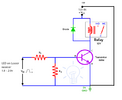
"Normally" one drives a relay like this :

1720182496725.png


R1 limits base current. To saturate (hard turn on, lowest Vce) transistor
Ib =~ Ic /10. Ib = Ibase, Ic = Icollector of transistor. Vce is V collector to emitter
of transistor. Ic would be relay on current needed.

R2 is for cases where the base can be open, floating, not connected to anything,
to insure transistor stays off in that situation.

R1 =~ (Vin_to_r1 - Vbe) / Ib

Diode across relay coil to prevent transistor turn off spike due to coil inductance.
Which could damage transistor and or whatever drives into R1, like a CMOS logic
gate or processor output.


Regards, Dana.
 

Stu8

Jul 4, 2024
21
Joined
Jul 4, 2024
Messages
21
Thanks, to be honest, i'm getting out of my depth here, im going to try over the weekend to do some learning, see if I can get my head round all this, but I maybe trying to work out something that its outside my current ability. I appreciate all help though, even if I fail, I find this all interesting

Thanks

Stu
 

Stu8

Jul 4, 2024
21
Joined
Jul 4, 2024
Messages
21
To add, that diagram looks to be as I was expecting to have to make, with an extra resistor and diode, but spec'ing the components just got me confused

o_O
 

Stu8

Jul 4, 2024
21
Joined
Jul 4, 2024
Messages
21
Laser Circuit.png
So, that earlier posted diagram was pretty much the type of thing I was expecting. I have added a few bit I assume to be correct, but not sure? So please correct me. To go along with the suggested diode,

what spec of resistors and transistor would I need (links would be perfect)?

Would a relay with built in diode work as well as separately as in the diagram?

Am I right to assume the 12v supply and the 1.8-2.0v supply grounds linked as I've edited?

Thanks again for all the help so far

Stu
 

danadak

Feb 19, 2021
1,062
Joined
Feb 19, 2021
Messages
1,062
We start with relay, pick a 12V relay that meets your contact V and I.
Then we need to know its coil current to energize it.

So R1 = (Vlaser - Vbe*) / ( Icoil / 10) so assuming I coil is 100 mA
then R1 = (1.8V- .7V) / (.1A / 10) = ~ 1.1 / .01 =~ 110 ohms. But use
the Icoil from the relay you pick. R1 is 1/2 W

*Vbe is transistor V base to emitter, typically .7V when it is on for a NPN bipolar.

R2 is 10K, 1/2 W

Transistor, say a TIP31C overkill but should be fine.

12V and 1.8-2.0 grounds common.

Diode 1N4002/3/4 fine. Use outside relay.


Regards, Dana.
 
Last edited:

Stu8

Jul 4, 2024
21
Joined
Jul 4, 2024
Messages
21
We start with relay, pick a 12V relay that meets your contact V and I.
Then we need to know its coil current to energize it.

So R1 = (Vlaser - Vbe*) / ( Icoil / 10) so assuming I coil is 100 mA
then R1 = (1.8V- .7V) / (.1A / 10) = ~ 1.1 / .01 =~ 110 ohms. But use
the Icoil from the relay you pick. R1 is 1/2 W

*Vbe is transistor V base to emitter, typically .7V when it is on for a NPN bipolar.

R2 is 10K, 1/2 W

Transistor, say a
I think that all makes sense, thanks. So I also have this on its way, but I cant see the info you need:
the solenoid the relay will be driving is 12vDC and 37W
When I tired to work out a transistor before I came her asking for help, I got too 2N3904, but I had so many guesses to get there, i'd guess that is wrong?
I'll also come back here once the relays turn up

Cheers

Stu
 

danadak

Feb 19, 2021
1,062
Joined
Feb 19, 2021
Messages
1,062
All my earlier comments on what to use are not for using a module,
just individual components.

Otherwise the interface has to account for the low V from LED/Laser
signal, eg. make that signal bigger.
 

danadak

Feb 19, 2021
1,062
Joined
Feb 19, 2021
Messages
1,062
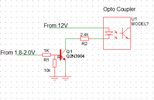
If you use module then this is interface to input to optocoupler. It would
be helpful to know what the part number is of the optocoupler.
To make sure you give it enough drive thru LED to turn its output
transistor hard on.

1720213033444.png

OK, I think I found opto coupler datasheet and 5 mA is roughly what
one wants to drive into its LED, so the 2.4K is correct.
 
Last edited:

Stu8

Jul 4, 2024
21
Joined
Jul 4, 2024
Messages
21
All my earlier comments on what to use are not for using a module,
just individual components.

Otherwise the interface has to account for the low V from LED/Laser
signal, eg. make that signal bigger.
thanks, yes, I understood that, and the ebay option I ordered for the module was the 12v version, not the 5v
I may have bought various modules, but I ordered before I came here for help, if the modules help, great, if not, happy to buy the items needed to do it the simplest acceptable way

Thanks
 

Stu8

Jul 4, 2024
21
Joined
Jul 4, 2024
Messages
21
If you use module then this is interface to input to optocoupler. It would
be helpful to know what the part number is of the optocoupler.
To make sure you give it enough drive thru LED to turn its output
transistor hard on.

View attachment 64085
Perfect, thanks again. When it turns up, i'll see what info I can get. As I said, happy to use other more reliable parts, rather than cheap ebay stuff, if it is advisable

Thanks
 
Top