 login
login


Automotive 12V to +-20V converter (for audio amplifier)
- Jonathan Filippi
- jonathan.filippi@virgilio.it
- 43.110 Views
- medium
- Non tested
- 0 Likes


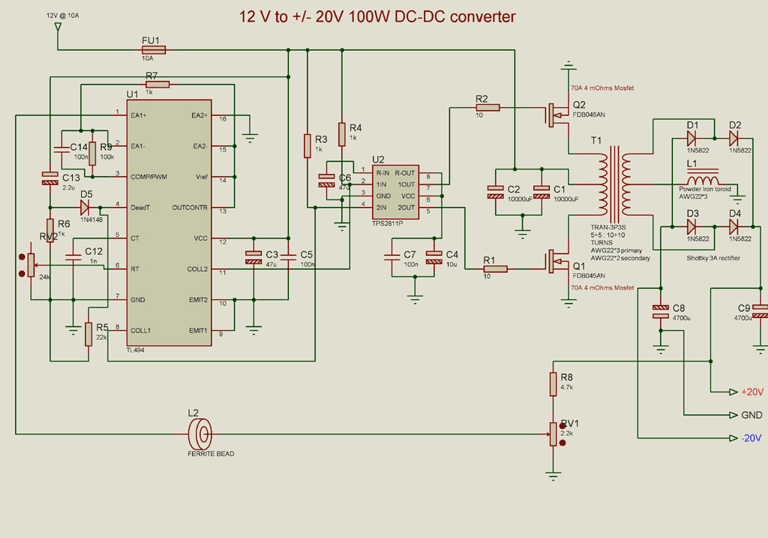
The limitation of car supply voltage (12V) forces to convert the voltages to higher in order to power audio amplifiers.
In fact the max audio power x speaker (with 4 ohm impedance) using 12V is (Vsupply+ – Vsupply-)^2/(8*impedance) 12^2/32 = 4.5Watts per channel, that is laughable…
For powering correctly an amplifier the best is to use a symmetric supply with a high voltage differential. for example +20 – -20 = 40Volts in fact 40^2/32 = 50 Watts per channel that is respectable.
This supply is intended for two channels with 50W max each (of course it depends on the amplifier used). Though it can be easily scaled up or the voltages changed to obtain different values.
Overview – How it works
It is a classic push-pull design , taking care to obtain best symmetry (to avoid flux walking). Keep in mind that this circuit will adsorb many amperes (around 10A) so take care to reinforce power tracks with lots of solder and use heavy wires from the battery or the voltage will drop too much at the input.
The transformer must be designed to reduce skin effect, it can be done using several insulated magnet wire single wires soldered together but conducting separately. The regulation is done both by the transformer turn ratio and varying the duty cycle. In my case i used 5+5 , 10+10 turns obtaining a step up ratio of 2 (12->24) and downregulating the voltage to 20 via duty cycle dynamic adjust performed by the PWM controller TL494.
The step-up ratio has to be a little higher to overcome diode losses, winding resistance and so on and input voltage drop due to wire resistance from battery to converter.
Transformer design
The transformer must be of correct size in order to carry the power needed, on the net there are many charts showing the power in function of frequency and core size for a given topology. My transformer size is 33.5 mm lenght, 30.0 height and 13mm width with a cross section area of 1,25cm^2, good for powers around 150W at 50khz.
The windings , especially the primary must be heavy gauged, but instead of using a single wire it is better to use
multiple wires in parallel each insulated from the other except at the ends. This will reduce resistance increase due to skin effect. The primary and secondary windings are centertapped, this means that you have to wind 5 turns, centertap and 5 windings again. The same goes for the secondary, 10 turns, centertap and 10 turns again.
The important thing is that the transformer MUST not have air gaps or the leakage inductance will throw spikes on the switches overheating them and giving a voltage higher than expected by turn ratio prediction, so if your voltage output (at fully duty cycle) is higher than Vin*N2/N1 – Vdrop diode, your transformer has gap (of course permit me saying you that you are BLIND if you miss it), and this is accompanied with a drastical efficiency reduction. Use non-gapped E cores or toroids (ferrite).
Output diodes, capacitors and filter inductor
For rectification i preferred to use shottky diodes since they have low forward voltage drop, and are incredibly fast.
I used the cheap 1N5822, the best alternative for low voltage converters (3A for current capability).
The output capacitors are 4700uF 25V, not very big, since at high frequency the voltage ripple is most due to internal cap ESR fortunately general purpose lytics have enough low esr for a small ripple (some tens of millivolts). Also at high duty cycle they are feed almost with pure DC, giving small ripple. The filter inductor on the secondary centertap furter increases the ripple and helps the regulation in asymmetrical transients.
Power switch and driving
I used d2pak 70V 80A 0.004 ohms ultrafets (Fairchind semiconductor), very expensive and hard to find. In principle any fet will work, but the lower the on-resistance, the lower the on-state conduction losses, the lower the heat produced on the fets, the higher efficiency and smaller the heatsinks needed. With this fets i am able to run the fets with small heatsinks and without fan at full rated power (100W) with an efficiency of 82% and perceptible heating and with small heating at 120W (some degrees) (the core starts to saturate and the efficiency is a bit lower, around 75%)
Try to use the lowest resistance mosfet you can put your dirty hand 🙂 on or the efficiency will be lower than rated and you will need even a small fan. The fet driver i used is the TPS2811P, from Texas instruments, rated for 2A peak and 200ns. Is important that the gate drive is optimized for minimal inductance or the switching losses will be higher and you risk noise coupling from other sources. Personally i think that twisted pair wires (gate and ground/source) are the best to keep the inductance small. Place the gate drive resistor near the Mosfet, not near the IC.
Controller
I used the trusty TL494 PWM controller with frequency set at around 40-60 Khz adjustable with a potentiometer. I also implemented the soft start (to reduce powerup transients). The adjust potentiometer (feedback) must be set to obtain the desired voltage. The output signals is designed with two pull-up resistors on the collector of the PWM chip output transistor pulling them to ground each cycle alternatively. This signal is sent to the dual inverting MOSFET driver (TPS2811P) obtaining the correct waveform.
Power and filtering
How i said before the power tracks must be heavy gauged or you will scarify regulation (since it depends of transformer step up ratio and input voltage) and efficiency too. Don’t forget to place a 10A (or 15A) fuse on the input because the car batteries can supply very high currents in case of shorts and this will save you face from a mosfet explosion in case of failture or short, remember to place a fuse also on the battery side to increase the safety (accidental shorts->fire, battery explosion, firemen, police and lawyers around). Input filtering is important, use at least 20000uF 16V in capacitors, a filter inductor would be useful too (heavygauged) but i decided to leave it..
Final considerations
This supply given me up to 85% efficiency (sometimes even 90% at some loads) with an input of 12V because i observed all these tricks to keep it functional and efficient. An o-scope would be useful, to watch the ripple and gate signals (watching for overshoots), but if you follow these guidelines you will avoid these problems.
The cross regulation is good but keep in mind that only the positive output is fully regulated, and the negative only follows it. Place a small load between the negative rail and ground (a 3mm led with a 4.7Kohm resistor) to avoid the negative rail getting lower then -20V. If the load is asymmetric you can have two cases:
- More load on positive rail-> no problems, the negative rail can go lower than -20V, but it is not a real issue for an audio amplifier.
- More load on negative rail-> voltage drop on negative rail (to ground) especially if the load is only on the negative rail.
Fortunately audio amplifiers are quite symmetrical as a load, and the output filter inductor/capacitors helps to maintain the regulation good during asymmetrical transients (Basses).
ATTENTION: Keep in mind that THIS IS NOT A PROJECT FOR A BEGINNER, IT CAN BE VERY DANGEROUS IN CASE OF PROBLEMS, NEVER BRIDGE, BYPASS OR AVOID FUSES THESE WILL SAVE YOUR BACK FROM FIRE RISK.
FOR FIRST TESTING USE A SMALL 12V power supply and use resistors as load monitoring switches heat and current consumption (and output) and try to determine efficiency, if it is higher then 70-75% you are set, it is enough. Adjust the frequency for best compromise between power and switching losses, skin effect and hysteresis losses
Bill Of Materials
=================
Design: 12V to 20V 100W DC-DC conv
Doc. no.: 1
Revision: 3
Author: Jonathan Filippi
Created: 29/04/05
Modified: 18/05/05
Parts List
— ——— —–
Resistors
———
2 R1,R2 = 10
4 R3,R4,R6,R7 = 1k
1 R5 = 22k
1 R8 = 4.7k
1 R9 = 100k
Capacitors
———-
2 C1,C2 = 10000uF
2 C3,C6 = 47u
1 C4 = 10u
3 C5,C7,C14 = 100n
2 C8,C9 = 4700u
1 C12 = 1n
1 C13 = 2.2u
Integrated Circuits
——————-
1 U1 = TL494
1 U2 = TPS2811P
Transistors
———–
2 Q1,Q2 = FDB045AN
Diodes
——
4 D1-D4 = 1N5822
1 D5 = 1N4148
Miscellaneous
————-
1 FU1 = 10A
1 L1 = 10u
1 L2 = FERRITE BEAD
1 RV1 = 2.2k
1 RV2 = 24k
1 T1 = TRAN-3P3S
Please follow and like us:







Pcb ?
We are sorry, no PCB available for this project.
email??
?
A couple of things here to ask about. I would assume the use of ferrite cores would be in order since running at 50khz, seems to me iron laminates would be less efficient. So, I have been looking for options for construction of transformer. I found a couple of offerings that appear to be acceptable. Who did you get your core/s from and perhaps a part/s #s. It looks like most sources require a minimum order which is out of reason for a project like this.