Sorry steve!! I must be the most annoying member!! i dont quite understand... if the fuse is in series with the 12V input, wont it blow up as soon as some power comes in??
yes thats it as said above, rated a bit above the current being drawn.
is if thats 0.6A (600mA) I would probably use a 1 to 1.5A fuse. That will allow for a bit of current inrush when the unit is switched on.
So, when the power is being fed, it wont blow the fuse cause the current is lower than the rate of the fuse... so why does it blow when is the power is reversed?
I imagine is cause Ohms law, since the resistance in the diode is nearly 0, the current goes up...
What rating would the diode need to have then?? a massive one???
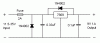
Here's how the 78-series linear regulators are used and protected.
They can pass a peak current of 1.8A so I'd choose a 2A fuse. No need for the fuse to blow except for a dead (fatal) short.
They need a 2.5V headroom, so in order for it to stay working on 11.5V input you can't put a diode in series, hence the parallel diode.
The 1A 1N4000 series diodes should stand up to shorting out a 2A fuse without being damaged.
The other diode across the 7809 is there to protect the regulator from a reverse current flow in case the input gets shorted.
The capacitors are there to ensure stable regulation under all operating conditions. The values indicated are the minimum.
The 7809 needs to be heatsinked according to the voltage it's running off. A 24V supply will require a much larger heatsink.
If the heatsink is too small the regulator will just shut itself off in order to protect itself, then restart when it cools down.
So, when the power is being fed, it wont blow the fuse cause the current is lower than the rate of the fuse... so why does it blow when is the power is reversed?
I imagine is cause Ohms law, since the resistance in the diode is nearly 0, the current goes up...
What rating would the diode need to have then?? a massive one???
the fuse blows when the power polarity is reversed because the diode is fully conducting. That is placing a short circuit across the power supply through the fuse and therefore blowing it. Diodes of 3-5A rating are readily available and a 1 - 1.5 Amp fuse should blow first when used in your situation.
I am building the circuit and model resqueline posted works ok but gets too hot for what im building. So im trying similar process but with a LM317T switched mode voltage regulator.
In this link you can find a calculator to choose the resistors to adjust the output voltage. http://www.reuk.co.uk/LM317-Voltage-Calculator.htm
I have chosen 220 ohms for R1 and 1.5k ohms for R2 which should give me and output of 9.5 ish volts but all im getting is 5 V!!! Can some1 explain me what have i done wrong to get such a lot value?? thanks
Hi Saripitu and others
I have noticed that during charging, voltage on a nominally 12V battery can be more than 16V, almost 17V. Not that this changes anything much that's been said but it's as well to be prepared.
Thank u steve! I slapped myself for not reading properly the product description...
Heatsink hasnt arrived yet. I think i short circuit it accidentally, which may be why it got so hot. I am bit too scared to connect it to the router yet...The voltage measurements seem fine...
For the LM317:
Vin = 12.27V
V across 220R = 0V?????
and now it doesnt seem to be drawing any current...can i have breaking it??
Maybe a switching regulator could be better but i dont seem to be able to find one that delivers 1A and 9V...
Just make sure you have the pins identified correctly. Neither device should dissipate any noticeable power unless you have a load attached. If it was getting hot with no load then you have wired up something badly wrong.
These devices are pretty rugged. As long as you're not powering them from a high current supply (like a lead acid battery) then you may not have damaged them.
if you can take a photo of your circuit we may be able to see what you've done wrong.
Compare your circuit to those examples. Look very carefully and closely. If you still feel it should be working properly, some good, clear, crisp, close-up photos (and/or a schematic) should be in order.
Got it sort it now! It was one of the pins, wrong connected... :S
And you were right steve, the regulators still work perfectly even after short-circuit it!! O.O