Help with voltage controlled switch

VideoTechGuides

Feb 23, 2012
2
Joined
Feb 23, 2012
Messages
2
Hi, I am trying to design a circuit that switches a power supply on and off depending on whether the engine is running in my car. When the engine is off, supply voltage is 12.6v or below. With the engine running it is 14.0v The load is about 2A (LED running lights)

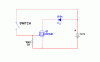
I've come up with the below circuit which I hope will switch on at 13v plus the fets internal diode forward volt drop (13.6v?) and then off again below 13v, which would be ideal for my application. Can someone tell me if this would work, or point me in the right direction?

Thanks

tPGnr.png
 
Last edited:

jackorocko

Apr 4, 2010
1,284
Joined
Apr 4, 2010
Messages
1,284
As far as I can tell the above schematic will not work. You have a p-channel mosfet, the gate has to be more negative then the source to turn on.

edit: I should read more closely. You want the on and off switch to be automatic when you start the car. I get it now.
 
Last edited:

duke37

Jan 9, 2011
5,364
Joined
Jan 9, 2011
Messages
5,364
Your fet looks to be the wrong way round?

The main problem here is that the fet will need a few volts to turn on so that diagram you have given, will need 13V plus a few to get the fet into the start of conduction. You need several volts on the gate to turn it on fully.

You will need a voltage reference and a comparator to drive the fet.
 

arg733

Dec 14, 2010
89
Joined
Dec 14, 2010
Messages
89
Completely wrong!

This circuit is completely wrong.
see attachment

you can connect the gate of mosfet to an electronic device that takes power when you start the engine or to the alternator or you may have a separate switch
you need to use n-channel mosfet because the p-channel closes when it receives a positive pulse at the gate.
you can buy any n-channel mosfet like irf 540 (100v 33A so you should be ok)
 

Attachments

  • untitled.GIF
    untitled.GIF
    5.9 KB · Views: 6,053
Last edited:

VideoTechGuides

Feb 23, 2012
2
Joined
Feb 23, 2012
Messages
2
Ok guys perhaps I got carried away trying to design something myself with no prior experience. Maybe just ignore my little sketch above.

Just to clarify the purpose of my circuit:

I want a circuit to switch on a 12v load when the supply exceeds 13.0 volts, and switch off the load when the supply drops below 13.0 volts. That is all. And I want to make it as simple and compact as possible, and use a FET of some kind to switch the load, rather than a relay.

Thanks
 

Rleo6965

Jan 22, 2012
585
Joined
Jan 22, 2012
Messages
585
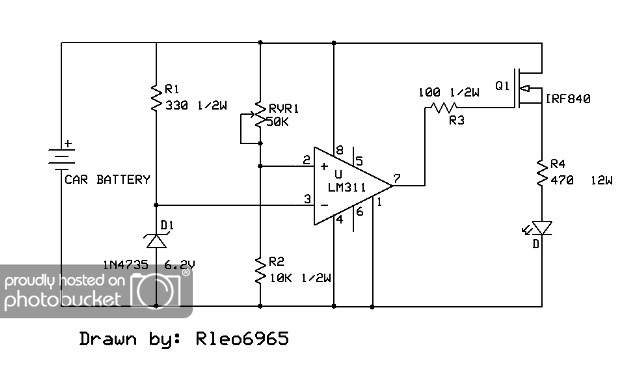
Try this circuit. It might work. You can change Mosfet and load components to your requirement.
Voltagesensor.jpg
 

twister

Feb 12, 2012
172
Joined
Feb 12, 2012
Messages
172
Try this circuit. It might work. You can change Mosfet and load components to your requirement.
Voltagesensor.jpg

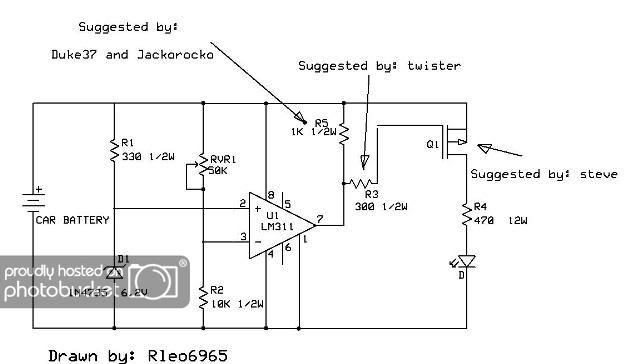
That's a nice circuit, but I would make a couple of changes. From my playing around with mosfets, I found out that they won't turn on completely in a voltage follower circuit. I would recommend putting the load on the drain and ground the source. Also if the mosfet shorts it will overload the LM311 and take it out. I would change the R3 to at least 300 ohms. Don't ask me how I learned this lesson!
 

duke37

Jan 9, 2011
5,364
Joined
Jan 9, 2011
Messages
5,364
Does the LM311 need a pull-up resistor (1k) output to 12V?
 

Rleo6965

Jan 22, 2012
585
Joined
Jan 22, 2012
Messages
585
Yes, just saw datasheet. It's an open collector output that can switch voltage up to 50V.

I rely on components library of ExpressSch Software when I draw the diagram.:)
 

(*steve*)

¡sǝpodᴉʇuɐ ǝɥʇ ɹɐǝɥd
Moderator
Jan 21, 2010
25,510
Joined
Jan 21, 2010
Messages
25,510
If you're wanting a high side switch, you really have to use a P channel MOSFET
 

(*steve*)

¡sǝpodᴉʇuɐ ǝɥʇ ɹɐǝɥd
Moderator
Jan 21, 2010
25,510
Joined
Jan 21, 2010
Messages
25,510
You also may want to pup a capacitor across R2 so that it's not affected by brief transients.

You also probably want to protect the LM311 from transients. Unfortunately this may affect the sensitivity to supply voltage changes that you want to detect.

The answer is to place RVR1 and R2 outside the protection. An 8V (ish) zener diode across R2 should provide protection for the LM311 from transients entering via this route.
 

twister

Feb 12, 2012
172
Joined
Feb 12, 2012
Messages
172
You also may want to pup a capacitor across R2 so that it's not affected by brief transients.

You also probably want to protect the LM311 from transients. Unfortunately this may affect the sensitivity to supply voltage changes that you want to detect.

The answer is to place RVR1 and R2 outside the protection. An 8V (ish) zener diode across R2 should provide protection for the LM311 from transients entering via this route.

A 8 volt zener would stop the op amp from working. It would have to be lower than the other zener.
 

jackorocko

Apr 4, 2010
1,284
Joined
Apr 4, 2010
Messages
1,284
must be I am slightly confused, anyone care to explain this high side low side thing?

I thought for a high side load the transistor has to source current(connected to the battery side) and a low side has to sink current(be connected to ground). Is that not true?


also, why couldn't you have used an N-channel depletion mode mosfet in the above example?
 

Rleo6965

Jan 22, 2012
585
Joined
Jan 22, 2012
Messages
585
A 8 volt zener would stop the op amp from working. It would have to be lower than the other zener.

8V zener ( non-inverting ) was still higher than 6.2V reference voltage ( inverting ). Non-inverting input need only around 0,5V difference voltage from the 6.2V reference voltage to change its output. 8V zener was only for transient protection as steve suggested.

Initially at 13V car battery voltage RVR1 setting voltage of inverting input was 6.25 and causing the Load on.. When battery voltage drop to 12V. Inverting input voltage 5.7V and causing the output load off.
 
Last edited:

twister

Feb 12, 2012
172
Joined
Feb 12, 2012
Messages
172
8V zener ( non-inverting ) was still higher than 6.2V reference voltage ( inverting ). Non-inverting input need only around 0,5V difference voltage from the 6.2V reference voltage to change its output. 8V zener was only for transient protection as steve suggested.

Initially at 13V car battery voltage RVR1 setting voltage of inverting input was 6.25 and causing the Load on.. When battery voltage drop to 12V. Inverting input voltage 5.7V and causing the output load off.

What was I thinking? You are right. The 8v zenner would only keep the voltage from going higher not lower. :eek:
 

Rleo6965

Jan 22, 2012
585
Joined
Jan 22, 2012
Messages
585
also, why couldn't you have used an N-channel depletion mode mosfet in the above example?

We can use N-channel Depletion Mosfet with its drain connected to ground and source connected to the LED ,

I wrongly placed N-channel Depletion Mosfet as voltage follower in my 1st schematic.:D

twister notice my mistake.:D

That's a nice circuit, but I would make a couple of changes. From my playing around with mosfets, I found out that they won't turn on completely in a voltage follower circuit. I would recommend putting the load on the drain and ground the source. Also if the mosfet shorts it will overload the LM311 and take it out. I would change the R3 to at least 300 ohms. Don't ask me how I learned this lesson!
 
Last edited:

jackorocko

Apr 4, 2010
1,284
Joined
Apr 4, 2010
Messages
1,284
Now that I am looking at it, that symbol you posted in last schematic is for p-channel depletion mode mosfet. Enhancement mosfets have dashed lines if I recall correctly. Or is that what you meant?

I am just now getting used to mosfets. Never really used them before

edit: http://www.electronics-tutorials.ws/transistor/tran_6.html this is what I am referencing.
 
Last edited:
Top