Help to measure 10K sub amplifier voltage output with 20:1 voltage divider and envelope follower circuit fed into an arduino

SpaceGoat

Mar 1, 2025
6
Joined
Mar 1, 2025
Messages
6
Bass Head garage came out with a audio watt meter that is capable of measuring up to 20K watt output from a car stereo monoblock subwoofer amplifier. I believe they are just using a diode to protect the arduino and a voltage divider circuit with some monkey business in the code to filter out an average...not very accurate by any means.
I've been searching for some better ways to measure AC audio output and most of them use a "envelope follower" circuit that is usually a pre-amp input.
For those out there that know circuitry (which obviously I am not good at), can someone put together a circuit that will be able to handle an AC signal that is 100volts peak-to-peak and output a signal that is 0-5 volts that roughly follows the peak of the AC signal "voltage follower".
 

AnalogKid

Jun 10, 2015
3,045
Joined
Jun 10, 2015
Messages
3,045
Diodes are not only large and small, but also fast and slow. What is the "flat" bandwidth you want to measure?

Also, what is an acceptable minimum voltage to be measured. A bridge rectifier yields a smoother and more accurate waveform to be sampled and calculated, but adds a second diode drop to the minimum voltage that can be detected.

ak
 

SpaceGoat

Mar 1, 2025
6
Joined
Mar 1, 2025
Messages
6
Subwoofers usually run 20Hz-120Hz and the minimum voltage voltage can be in the 2-5 volt range. 5 volts feeding a 1 ohm load would be only 25 watts. I have one amplifier that outputs max at 45VAC (2000 watts at 1ohm) and another that outputs max at 100VAC (10000 watts at 1 ohm)
 

SpaceGoat

Mar 1, 2025
6
Joined
Mar 1, 2025
Messages
6
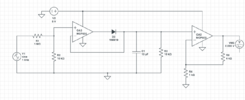
This is what I put together so far. I can't figure out how to get the model to work in the circuit lab.

1741057778647.png
 

Harald Kapp

Moderator
Moderator
Nov 17, 2011
14,270
Joined
Nov 17, 2011
Messages
14,270
I can't figure out how to get the model to work in the circuit lab.
What is the error (message)?

I don't know that software, but I'm fairly suret hat the lower connection at the voltmeter to the right needs to be connected to GND as a voltameter always measures a potential difference between two points. Without only one connetcion (top in your schematic) there is no potential difference to be measured.

Also V1 seems to lack a voltage as parameter. It states 1 kHz sine, but which amplitude? As shown on V2 I'd expect a voltage for V1, too.
 

SpaceGoat

Mar 1, 2025
6
Joined
Mar 1, 2025
Messages
6
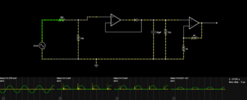
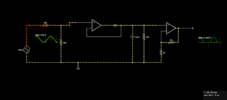
This is out of falstad. On the first opamp used as a regulator, there is some weird ripple (yellow) diode feedback? and the voltage follower circuit is not dropping fast enough. I'm not sure how to calculate the RC network for faster drop when I want the circuit to function for 20Hz-120Hz.
1741098373652.png
 

Harald Kapp

Moderator
Moderator
Nov 17, 2011
14,270
Joined
Nov 17, 2011
Messages
14,270
first opamp used as a regulator
This is not a regulator but a half wave rectifier. only the positive half of the sine is present at the cathode of the diode. This is the "weird ripple" you see.
the voltage follower circuit is not dropping fast enough.
Unfortunately in your screenshots I can't identify which signal trace (waveform) belongs to which circuit node. Anyway: Contrary to what you state, The signals show all drop very fast, they almost follow the input.
I want the circuit to function for 20Hz-120Hz.
Please describe in detail what you really want. The thread started with a request for an envelope follower (also named envelope detector) which would follow not the waveform but the envelope of the waveform. In the case of a steady sine wave - as in your simulation - the envelope is a straight line.
Now you seem to ask for the output of the circuit to follow the sine wave's curve but only the positive half of it.

It seems there is a misunderstanding either on my side or on yours - maybe on both.
 

SpaceGoat

Mar 1, 2025
6
Joined
Mar 1, 2025
Messages
6
I've made some robots with arduino, I'm not all that electronics savy. Learning as I go. From my Google searching and seeing what others have done, I am seeing if there is an easy circuit to measure the output power of a car stereo amplifier. I know i will need a circuit to find current....right now I am just focusing on trying to read output voltage from an amplifier. In particular, rockford fosgate R2-1200x1 1200 watt rms into 1 ohm amplifier. Looking for help because I'm having a difficult time trying to figure it out.
 

Harald Kapp

Moderator
Moderator
Nov 17, 2011
14,270
Joined
Nov 17, 2011
Messages
14,270
easy circuit to measure the output power of a car stereo amplifier. I know i will need a circuit to find current....right now I am just focusing on trying to read output voltage from an amplifier.
Depending on the accuracy you need you may be on the wrong track or not.

First of all there are different flavors of power to measure:
- rms power
- average power
- peak power

Since you mention rms power in your post, I suppose that's what you're loking for.
Rms power is computed by integrating the square of the power over time, then dividing by the integration time and taking the square root (link). There are circuits available (example) that can do this calculation comparatively simple for voltae or current, but not so easily for power. Today the way to go would be to measure both voltage and current by an analog-digital converter (ADC) and do the math in a micorocontroller.

The issue here is that the speaker is a non-linear and not purely resistive impedance. Nevertheless, as a first approximation you may assume the impedance being fixed, say 4 Ω (a typical value), then use P = V²/R to compute the power. This reduces the measurements to voltage only.
The next step will be to define the integration interval. Since your lowest frequency is 20 Hz (post #3), you need to integrate for at least 1/20 s = 50 ms. Now you have the basic parameters for either an analog circuit or a digital solution.
However, and that's where I think you may be on the wrong track, the above method is comparatively complicated and prone to error due to the simplified assumption about the speaker's impedance.
For reference: here's a project page that shows the construction of an audio Wattmeter.

You may therefore as well simply measure the peak voltage using a comparatively simple audio VU meter. This one probably fits your skill level better (no offense meant) and may be sufficient for practical purposes (e.g. check for overload of the speakers).
 
Top