Solar Panel Control Circuit

preacher23

Jun 6, 2012
6
Joined
Jun 6, 2012
Messages
6
Hey guys, I bought a few lights from Canadian Tire last year, they're pretty cool, they have a solar panel built in and when it's charging the little led light turns off and the solar panel charges the nicad batteries inside and when it gets dark the light goes on and begins discharging the battery.

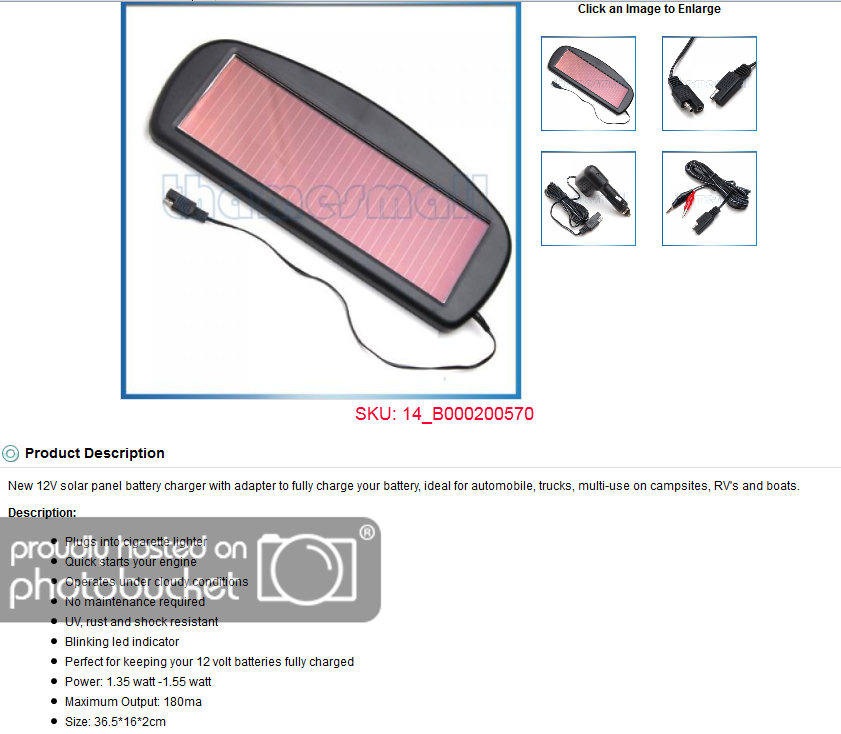
I would to know if someone can help or point me to the right place where i can learn to assemble some parts to make a control circuit board for a solar panel i got off ebay and a lead acid battery i also have from a busted 3million candle power flash light i used to have. I saved the battery lol

Here's what i got:

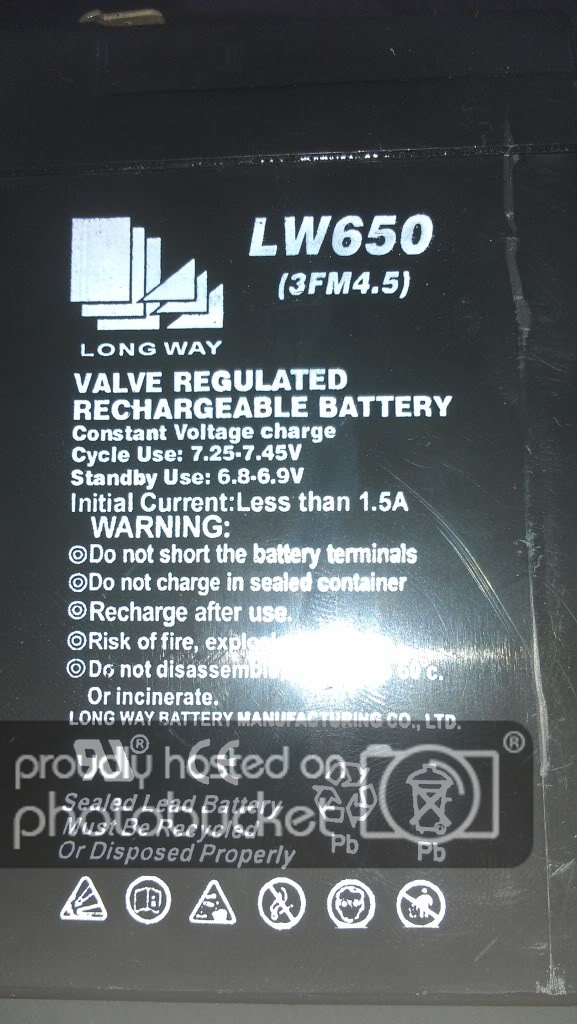
Lead-Acid-Battery-3FM4-5-6V-4-5AH-20HR.jpg


SolarPanel.png


I'm really good at soldering and i've done a few projects before thanks
 

alfa88

Dec 1, 2010
349
Joined
Dec 1, 2010
Messages
349
What you speak of is a charge controller. If one were to overcharge or over discharge a battery that lessens the life of a battery. A charge controller has set limits as to these levels. In addition deep cycle batteries are used that are more tolerant to the discharge / charge cycles. A quick search came up with this:
http://www.solorb.com/elect/solarcirc/ccntlvd/
 

preacher23

Jun 6, 2012
6
Joined
Jun 6, 2012
Messages
6
ah yes, that's actually the one that i was looking at when i did some research yesterday. But what i'm not sure about, is will the solar panel that i got from ebay be enough to charge the battery i have. The solar panel when i tested it with the multimeter showed 24v when the sun hits it, and the battery that i have is 6v. The solar panel has a max output of 180ma and the battery has a max output of 1.5a. Because what i'd like to do is hookup a bunch of L.E.D's on the battery and have them turn on at night, then off when it's charging during the day.
 

Mongrel Shark

Jun 6, 2012
260
Joined
Jun 6, 2012
Messages
260
You will need to step the 24v down to 7-8.5v to charge your battery. That will leave you with around 500ma after losses (this is approximate, every transformer varies.) which will charge your 4.5ah battery in about 9 hours. could be a little fast for long battery life, but not too bad...

For your light switch. you need to make a "Dark sensor" You can do this with a "Light Dependant Resistor" (LDR) and a transistor, or a number of other ways. I think you can even use the panel as a sensor.

Let me google that for you:

http://lmgtfy.com/?q=24v-8v+transformer

http://lmgtfy.com/?q=Dark+sensor+how+to+make

Good luck.
 

(*steve*)

¡sǝpodᴉʇuɐ ǝɥʇ ɹɐǝɥd
Moderator
Jan 21, 2010
25,510
Joined
Jan 21, 2010
Messages
25,510
Some useful information:

open circuit voltage of 24V and short circuit current of 180mA does not mean that you can draw anything close to 180mA and retain a voltage anywhere near 24V.

MPPT (maximum power point tracking) regulators will continually adjust the current being drawn to maximise the power being delivered to the battery. Also important is what you do once the battery is fully charged.

Although not as efficient, you can just connect the panel up to the battery and it will charge it. Something (a schottky diode) to prevent power flowing in the reverse direction is advisable.

MPPT gives you about 20% better efficiency from what I hear (it's not magic).

You can't use a transformer to reduce the voltage from a solar panel as the solar panel produces DC.

As MS suggests, you can use the solar panel to sense ambient light, or you can use some other sensor.
 

CocaCola

Apr 7, 2012
3,635
Joined
Apr 7, 2012
Messages
3,635

Transformers require AC voltage, useless in this application... You will need to use a DC - DC step down, or regulator...

The solar panel when i tested it with the multimeter showed 24v when the sun hits it

Interesting are you sure, did you have the multimeter set to DC and not AC? For one it's advertised as a 12v panel, for two the math simply doesn't work well with 24 volts when you push around the watts and mA ratings @ 24 volts...
 

Mongrel Shark

Jun 6, 2012
260
Joined
Jun 6, 2012
Messages
260
Yea I thought it looked like a 12v panel too. A closer look at the pic and there it is, right under the panel. 12v. It should have a diode setup built in, but worth checking.

As to transformer. I stuffed up. lucky the others here where onto it...

Going to take more like 20 hours to charge at that rating... Thats if you have the panel at the ideal angle to the sun the whole time. Which would require either you move the panel every few min, or a tracker, which will use more power and slow down you charge rate even more.

Would you consider a 6v panel with higher watts?
 

preacher23

Jun 6, 2012
6
Joined
Jun 6, 2012
Messages
6
I had the voltmeter set to DC when i tested it and that's when it showed 24v.
You see, this solar panel is actually to charge the car battery, the reason why i purchased it was originally to put it in the car, it hooks up to the car cigarette lighter and it goes on the dashboard. It's said it's supposed to charge the car battery using the sun.

I thought it was a little high too when i tested it, because i was expecting around 13-16v If i remember, i always see transformers labelled 1 - 2v higher than the battery voltage.

Question for ya guys. I have another unit already built. It works on 3 ni-cd batteries at 1.2v each. If I was to take the electronics from it and hook everything up to the solar panel i have, as well as the battery i have, do u think it would work?

Because the one that i have, the batteries are dead, so it's not working, needs replacements, so i was thinking i take the guts from it since it already shuts off during day to charge and on during night.
 

preacher23

Jun 6, 2012
6
Joined
Jun 6, 2012
Messages
6
So i've googled using your links mr Mongrel Shark and i found this:
LM2596 DC-DC Converter Step down Adjustable Power Supply Module
on ebay. It's an adjustable dc-dc step down transformer that has a potentiometer to get the output voltage. The question is, does it increase the current?
Second question, how does this differ from the charge control circuit board from alfa88's link ? and would this adjustable power supply do?

I also am looking at the dark sensor, all i need i guess after the step down dc-dc transformer is to wire it in such a way where it charges during the day and drain during the night. Lot's of reading to do on the dark sensor

And yes for sure i would consider a 6v panel with more watts.

I was thinking of pluggin in something, maybe a fan or something that can draw power from the solar panel and then use the multimeter to see how many amps are being drawn. What do u think?
 
Last edited:

Mongrel Shark

Jun 6, 2012
260
Joined
Jun 6, 2012
Messages
260
Can't say if you can use the circuit from your 3.6v (assuming the battery's where hooked up in parallel, is it a garden light perhaps?) unit, without knowing the parts inside. They may be rated to handle higher power they may not. Might not even need to handle power, just operate a relay, although I suspect a NPN transistor will be used (with an LDR as a voltage divider to activate) to do the switching.

If your multimeter has a 10A range and the panel only puts out 180ma, It should be safe to put red probe to + and black probe to - and see how many amps it makes. 200ma range should be safe to use, but if it goes over the range it will blow a fuse at best, and destroy the meter at worst (I've also had leads melt in my hands in under a second when measuring a current much higher than expected, so be careful, ask for help if unsure) Although I suspect your multimeter is not good or your using it wrong. As that panel should be making closer to 15v as you expected. As Cocacola said, The maths are not working.
Watts law says VxA=W so W/A=V and W/V=A

There is no way you can make the numbers in the advert work. it's a lie.

If you divide 1.55w by 0.18a (180ma) you get a 8.33333...volts. That's not going to charge a 12v car battery....
12v @ 180 gives you 2.16w
It just doesn't work out....

24v will charge a car battery, but it will shorten its life. Perhaps the panel puts out that much to allow for losses in the wire and connectors between panel and battery. The amp's and watts could be a guesstamate on what actually makes it to the battery. (p.s. Wouldn't you need to leave ignition on accessory for it to charge your car via cigarette plug?) Can you verify your multimeter by testing a few known voltages?

Why do you think that battery has a 1.5A max? If it is holds 4.5 amp hours as stated on the side it should be capable of putting out say 27amps for about 10 min. or 100ma for 45 hours. Depends what you plug in...... So no. Hooking a fan up and measuring current will just tell you what the fan draws.... Not total output of panel.Sounds like you have some more Googling and reading to do!

Make sure you understand how to measure amps!! doing it wrong can be dangerous. Even with that little battery! Put the leads straight to the terminals of a battery capable of putting out decent amps, and you will kill the meter every time! Possibly even start a fire.....


What a Charge controller (Like the one afa88 posted a link to) is monitor your battery and control charging and discharging of the battery. Which will seriously extend its lifespan, and in the case of lead acid, which produces hydrogen when charging (Lots of it when over charging), help prevent explosion!!... It will "trickle" down the charge current as the battery fills up. When you apply a load, it will disconnect it if you try and flatten the battery too low. I'd strongly advise getting one. Some of the flash models even have the ability to turn on a load when charge from panel stops(Like night lights, exactly what you want to do)....

As to the DC step down. I don't know heaps about them. But I would assume watts law applies. Almost all power converters change the volts and amps, while leaving watts almost the same. there is always a loss, sometimes more than others. you can expect anything up to about 95% of the watts in, to come out the other side in a different Amp to Volt ratio. Some systems can be very lossy. For example I was messing around with induction coils and stepping up voltage the other day. my system was only 17% efficient. So I was wasting 83% of my power...


Sounds like you have a lot to learn! I don't want to discourage you. Your project is fairly simple. It could be both fun and rewarding to make it work. If you want the easy way out. Just get a 6v solar charge controller with the ability to switch on a load in darkness.

MPPT's are more efficient. But I've never seen one that can do more than charge control. So no light switch. They tend to cost more too.

If you want to continue. First thing you need to do is make sure you can use that multimeter, then make sure it's working correctly and calibrated...

If Google is not making things clear. Ask here. there are ton's of people way smarter than me that work in the industry for a living, that come here to help people learn.

I'm also kind of curious about that panel. So I'd love to know what you find.

Good Luck ;)
 
Last edited:

preacher23

Jun 6, 2012
6
Joined
Jun 6, 2012
Messages
6
awsome info Mr Mongrel Shark, i've been using multimeters for 10 years now and i've never tested amp's, but i knew how to hook it up cuz i used to work at an arcade 10 years ago and the technician taught me how it hooks up. I never thought testing amp's is that dangerous, geez thank God i never tried. Of course i know it doesn't take many mili amp's to kill u, but i never though about the multimeter not being able to handle say 2 amps!

I think what i'm gonna do is buy a brand new multimeter that the pro's use, hopefully it can handle some high amps. This project i'm working on is gonna be something like the lights i purchased from canadian tire, the solar ones, only on a bigger scale right. I'm thinking about 20 - 30 led's on that battery. Now i haven't researched the led's, how much power they draw out and the battery i have that is in the first picture, the reason why i thought 1.5 amps is because this is what it says on the other side:

IMAG0063.jpg


and the solar panel was definitely advertised as "able to charge car battery" nothing said about ignition on, that's weird, good thing i never used it in the car! last thing i need is another car repair!

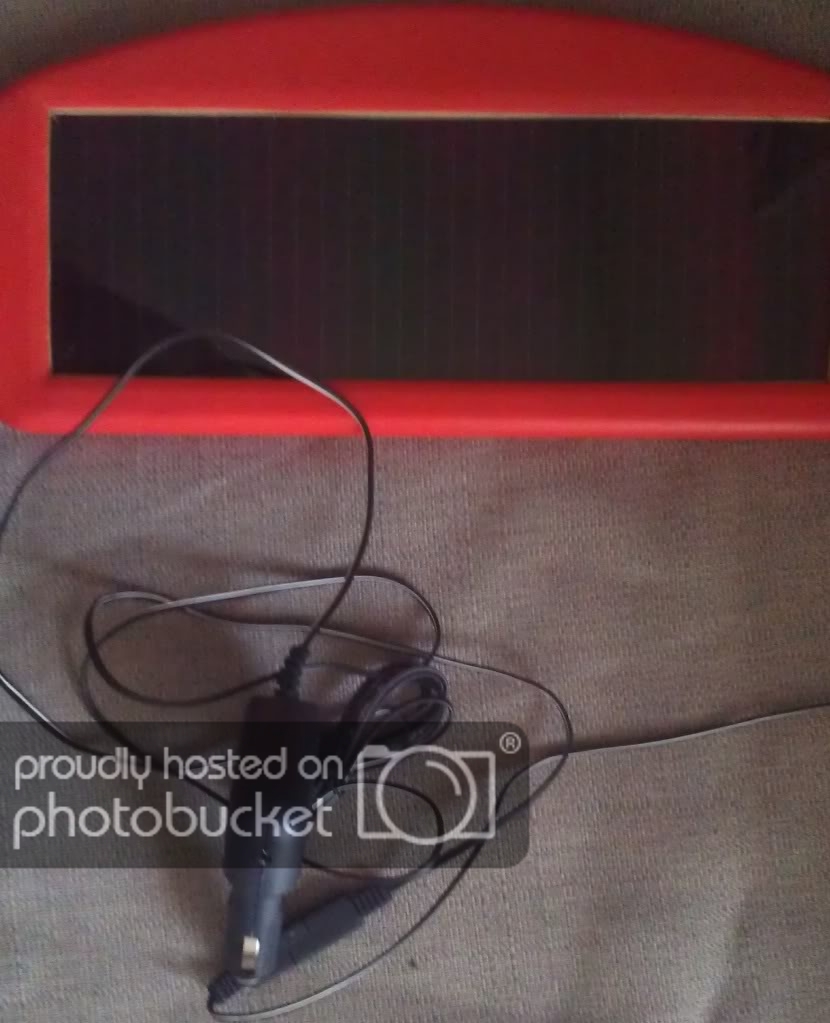
here it is, maybe i should open up the little cigarette lighter plug and show you what's inside it.

IMAG0066.jpg


I just wanna know one thing though, does the Charge controller in the schematic from the link that alfa88 provided actually detect the input voltage from the solar panel and detect the input voltage the battery needs automatically, or do i actually have to modify that schematic by putting different parts to make it match the solar panel and the battery that i have?

Not that great with schematics, i can read basic schematics np, that one in alfa88's link will take me a little while to understand lol Now i'm nooooooo electrical engineer yet, but in 4 years i will be :D then i'll be able to redesign/modify and create my own!
 

(*steve*)

¡sǝpodᴉʇuɐ ǝɥʇ ɹɐǝɥd
Moderator
Jan 21, 2010
25,510
Joined
Jan 21, 2010
Messages
25,510
I had the voltmeter set to DC when i tested it and that's when it showed 24v.

Open circuit voltage of a solar panel means little (other than any components need to be able to handle that voltage if there is no load). The voltage will drop under load (e.g. when charging another battery).

If you can find some specs on voltage vs. current for solar panels you'll see what I mean.

You see, this solar panel is actually to charge the car battery, the reason why i purchased it was originally to put it in the car, it hooks up to the car cigarette lighter and it goes on the dashboard. It's said it's supposed to charge the car battery using the sun.

And it's probably fine for that. The low current is also unlikely to damage your battery unless you left it connected for a long time. At worst you may lose a little water from your electrolyte.

I thought it was a little high too when i tested it, because i was expecting around 13-16v If i remember, i always see transformers labelled 1 - 2v higher than the battery voltage.

Try measuring it when connected to the battery :)

[/quote]Question for ya guys. I have another unit already built. It works on 3 ni-cd batteries at 1.2v each. If I was to take the electronics from it and hook everything up to the solar panel i have, as well as the battery i have, do u think it would work?

Because the one that i have, the batteries are dead, so it's not working, needs replacements, so i was thinking i take the guts from it since it already shuts off during day to charge and on during night.[/QUOTE]

This one is harder as I don't know what you're connecting it to. It may not load the panel sufficiently to drop the voltage to a safe level. In this case a regulator would be a good option.
 

(*steve*)

¡sǝpodᴉʇuɐ ǝɥʇ ɹɐǝɥd
Moderator
Jan 21, 2010
25,510
Joined
Jan 21, 2010
Messages
25,510
If your multimeter has a 10A range and the panel only puts out 180ma, It should be safe to put red probe to + and black probe to - and see how many amps it makes. 200ma range should be safe to use, but if it goes over the range it will blow a fuse at best, and destroy the meter at worst (I've also had leads melt in my hands in under a second when measuring a current much higher than expected, so be careful, ask for help if unsure)

I agree with this. I'd try the 10A range first (in bright sun) and see what I get. If it was less than 200mA and I was sufficiently interested in the additional resolution I would stick it in the 200mA range and try again.

Remember that you often need to change the location where the probe connects for the 10A range on many cheaper multimeters.

Although I suspect your multimeter is not good or your using it wrong.

Not necessarily. Here is a 12V solar panel which produces 21.67 volts open circuit. Sure it's possible the meter is reading a bit high, but voltages in this range are to be expected.

Watts law says VxA=W so W/A=V and W/V=A

And they rely on you measuring the voltage and current simultaneously...

There is no way you can make the numbers in the advert work. it's a lie.

There is no way *YOU* can make the numbers work.

I find it to be a very honest advert. It gives you the maximum power, and the maximum current (note that max current does not mean max power). A dishonest advert would measure max voltage and max current and multiply them together!

You need some understanding of how solar panels react to loads.

If you divide 1.55w by 0.18a (180ma) you get a 8.33333...volts. That's not going to charge a 12v car battery....
12v @ 180 gives you 2.16w
It just doesn't work out....

If you divide 1.5W by 13.8V you get around 110 mA, which is the amout it will charge at when the battery is reasonably charged. That's less than the short circuit current of 180mA (which is to be expected)

24v will charge a car battery, but it will shorten its life.

It will never happen. The battery will load down the voltage. Sure, it will be capable of continuing to provide some current up to 24V or so, but it would never charge a 12V lead acid battery so high. At the currents you're looking at here, even connecting it to a fully charged car battery all day, it is unlikely to cause a problem.

You also may wish to consider the static load the car is imposing on the battery. Presumably as this is connected to the cigarette lighter the key must be in the Acc position. If the radio is on you're likely to find that it draws more than this can supply. Are any of the car's electronics powered up?

I'd be more worried that the battery was going to go flat(er) with this connected than overcharging.

Can you verify your multimeter by testing a few known voltages?

Never a bad thing, but WAY more instructive to measure the actual current this panel supplies at certain likely voltages (say between 10V and 14V)

If it is holds 4.5 amp hours as stated on the side it should be capable of putting out say 27amps for about 10 min.

Unlikely (probably more like 7 minutes)

or 100ma for 45 hours.

At least... (maybe 50 hours)

Make sure you understand how to measure amps!! doing it wrong can be dangerous. Even with that little battery! Put the leads straight to the terminals of a battery capable of putting out decent amps, and you will kill the meter every time! Possibly even start a fire.....

s/amps/current/g

You don't measure amps, you measure current -- the unit is amps. (As you don't measure km/h, you measure speed -- the unit is km/h)

As to the DC step down. I don't know heaps about them. But I would assume watts law applies. Almost all power converters change the volts and amps, while leaving watts almost the same. there is always a loss, sometimes more than others. you can expect anything up to about 95% of the watts in, to come out the other side in a different Amp to Volt ratio. Some systems can be very lossy. For example I was messing around with induction coils and stepping up voltage the other day. my system was only 17% efficient. So I was wasting 83% of my power...

Most of the stuff your saying here is right, but you're clearly self-taught. :) Not entirely a criticism -- I'm self taught too.

If you want to continue. First thing you need to do is make sure you can use that multimeter, then make sure it's working correctly and calibrated...

Heh, "calibrated" is NOT the word you want to use. Perhaps "checked for accuracy". In the electronics world, "calibrated" with respect to measuring equipment tends to mean a piece of paper and a hole in your wallet :D
 

(*steve*)

¡sǝpodᴉʇuɐ ǝɥʇ ɹɐǝɥd
Moderator
Jan 21, 2010
25,510
Joined
Jan 21, 2010
Messages
25,510
Why do you think that battery has a 1.5A max?

I was going to guess this, but now we have an image that states it is effectively the maximum charge current. Never foing to be an issue with this panel.

HOWEVER Because this battery is a much lower capacity than a typical car battery (that this product is designed to charge) you WILL have to be careful that you don't overcharge it.

One option is to get a small switchmode buck power supply (and an additional diode for isolation) and set the output to the voltage specified for float charging) Oh an maybe a larger input capacitor for the regulator (am I talking Greek yet?)

Whilst a simple SMPS is not a MPPT regulator, it is perhaps a simple option that will be fairly safe. Keeping the battery at the float voltage will not ensure it is fully charged, but it is a safe voltage to maintain without damage to the battery.

For extra bonus points, consider that the float voltage actually needs to change with temperature. That may be an issue if you have wildly fluctuating temperatures, especially if they get well below freezing.
 

Mongrel Shark

Jun 6, 2012
260
Joined
Jun 6, 2012
Messages
260
Those details on the other side of the battery are charging rates!

So it "likes" 7.25v-7.45v at no more than 1.5 amps to start with. When it says initial current. It is assuming you will use some kind of charge controller (Like a plug into the wall charger or a solar controller) which will trickle down the current as battery fills, Thus keeping it in it's "sweet spot" for charging, 7,25-7.45v You can almost certainly charge it with more volts or amps, but it will shorten lifespan and total amount of cycles ( number of times it will go from full to flat to charged again). You can charge it at those volts with lower current though, in my experience that tends to give a better charge. I know Gel cells for eg will give you more amp hours per charge if you charge them very slowly. Down side is it takes ages to charge at low current. So mostly it's a bit of a compromise. you start with high current and slowly lower it so your battery ends up charged in a reasonable time. I Don't think it would "accept" a charge less than 7v. But you could try, again it does say on the battery what it likes, so I'd be inclined to keep it at those rates.


I agree 100% with what *steve* said. Especially about hooking it to a car battery and measuring voltage (I'd do this at battery terminals, and back of solar panel where the diodes are likely to be. It will be different)

If you open up the plug on the panel, You'll probably just find some soldered wires and the rest of the LED you can see. If Diodes are built in (I'd be surprised if this is not the case) they are most likely to be attached directly to the panel.

I wouldn't be to concerned about getting a flash multimeter. A cheap one should be all you need.
If you really want a second one, and it can be handy to be able to compare them, or monitor amps and volts at the same time etc.... I'd suggest something like this http://www.ebay.com/itm/Digital-Mul...695?pt=LH_DefaultDomain_0&hash=item3a6dde0baf
If you spend more than $30 it's probably overkill. Unless there are other features you really want for something specific. If you just want to measure amps over 10a, You can get an amps gauge or meter, like any of these: http://www.ebay.com/sch/i.html?_nkw...MM&LH_BIN=1&_osacat=0&clk_rvr_id=351483804175 If you are playing with more than an amp or two. Please be very careful. check everything 3 times before you connect etc. I have been using 12v battery's daily for 20 years, and I still occasionally melt a jumper or something due to not paying attention, or accidentally bumping a stray wire onto the wrong terminal. It is too easy to do. Fuse's are a great safety feature to prevent this. But not 100% reliable, there are fire dangers a fuse wont always prevent.

As for LED's. They vary a lot depending on what type colour and brightness. so until you pick some you like or give more info on what you want to do, (ie do you want to make something pretty, or just light an area?) I cant help a lot. Except to say read the LED guide *steve* is writing. https://www.electronicspoint.com/got-question-driving-leds-another-work-progress-t228474.html I know Leds well, still found answers to some things I'd always wondered here. (Good work *steve* and other contributors)


The link for the solar controller seems to point at a 12v one. I'm no expert here, but I would think putting 24v to it might not go too well. It's also only for charging 12v battery's from what I can see.


This one I found on eBay http://www.ebay.com/itm/12V-2-5A-40...138?pt=LH_DefaultDomain_0&hash=item3377152f32 looks close to what you want, But if your panel puts 24 volts into it I would expect to blow a fuse or see smoke.
Perhaps someone else here can help you step the voltage down to something more useable. It could be as simple as extending the cord (usally long thin cords are not used in solar as they loose a lot of power, I always went 4x minimum rating to at least, to avoid unnecessary losses, Perhaps you can extend the cord and use this to your advantage? You'll lose amps too though) or adding a few resistors, or getting a step down converter. I really don't know enough about it to give advice. Or you can go back to getting another panel more suited to 6v. There could be advantages to a step down, you'd get more amps that way.


Hope that helps clear some stuff up. With a little luck someone else can help you with a step down.

MS
 

Mongrel Shark

Jun 6, 2012
260
Joined
Jun 6, 2012
Messages
260
Most of the stuff your saying here is right, but you're clearly self-taught. Not entirely a criticism -- I'm self taught too.

Yes. Mostly. Thanks for clearing a few point's up. My descriptions are a little sloppy. What you say is more accurate.

One option is to get a small switchmode buck power supply (and an additional diode for isolation) and set the output to the voltage specified for float charging) Oh an maybe a larger input capacitor for the regulator (am I talking Greek yet?)

(nod) I can just follow that, with a quick google. So preacher23 probably needs a little more help

I'll study up a bit more before I go dispensing too much advice.

Thanks *steve*

I have reading to do.

I leave you in good hands preacher23


I'll check back in a few days to see how your project is looking.

:) MS.
 

Mongrel Shark

Jun 6, 2012
260
Joined
Jun 6, 2012
Messages
260
You do realize RMS amps are not the same as "regular" amps right?

I'll leave it for someone else to explain. But here's the wiki link http://en.wikipedia.org/wiki/Root_mean_square as you can see its a kind of average. More than that I'm not game to say. I've avoided that one for years. I'm quire happy working with DC

Personally I think you could get a better DMM for the cash. Although being able to measure DC amps with a clamp meter would be handy, and safe.

See what the others here have to say before you make up your mind. Just my advice :)


Other than that. lots more reading. I know how that feels. Seem's like all I'm doing the last few days.

Don't try to cram it all in at once. Just take your time. I like to play with each new concept in a practical way before I move on, to make sure I am grasping enough to make stuff work (without frying myself).. Small voltages and single LED's can be good to visulise stuff. If you screw up and fry an LED your only down a few cents and aren't likely to start any fires.

Perhaps try and revamp that nicad solar light you mentioned. Get that working (and understand it) and your off to a good start.

Good to see your still Keen! Happy studies.
 

(*steve*)

¡sǝpodᴉʇuɐ ǝɥʇ ɹɐǝɥd
Moderator
Jan 21, 2010
25,510
Joined
Jan 21, 2010
Messages
25,510
You do realize RMS amps are not the same as "regular" amps right?

They are for DC, and generally they're the measurement of preference for AC too.

Personally I think you could get a better DMM for the cash. Although being able to measure DC amps with a clamp meter would be handy, and safe.

DC clamp meters are great. The main issue is one of resolution. You may find that the resolution is 10mA (it could even be 100mA on this device!). Fine for loads of several amps or more, less good for smaller currents.

The only current measure is via the clamp, so that is a real problem for lower currents.

For a lot of beginner uses, a cheap ($10) digital meter may be all you ever need. If you do something really bad and blow a current shunt (not hard to do) a new meter is cheaper than the fuse used in some expensive meters.
 
Top