FM modulator light only and no transmitting

KrisBlueNZ

Sadly passed away in 2015
Nov 28, 2011
8,393
Joined
Nov 28, 2011
Messages
8,393
The white wire is apparently the antenna :)
Ah! That makes sense, at last! So C2 capacitively couples the RF onto the +12V wiring. Thanks Adam!

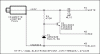
OK, I think it's best to rebuild that circuit on a bit of stripboard. Here's the schematic.

271045.001.GIF

I've guessed at the value of C2; if you can borrow a capacitance meter, you can measure the capacitor on that board, as long as the white wire is disconnected.

If you tell us where you're located (better yet, put that information in your profile) and what electronics supplier(s) you use, I can give you catalogue numbers for the components, but I doubt that you will find a suitable transistor for Q1 locally.
 

pharaon

Oct 28, 2014
458
Joined
Oct 28, 2014
Messages
458
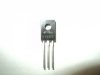
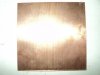
1.jpg 2.jpg ok today I bought the transistor and copper board
I wonder if you can support me with the circuit diagram to print it on the board
many thx

yet I didn't know what was the cause of that issue..i mean there was power and light in the screen so what is the cause of the issue is it the transistor or something else
 

Gryd3

Jun 25, 2014
4,098
Joined
Jun 25, 2014
Messages
4,098
yet I didn't know what was the cause of that issue..i mean there was power and light in the screen so what is the cause of the issue is it the transistor or something else

Looks like you're getting ready to go all the way to make a new board.
Kris had mentioned using strip-board, but perfboard or veroboard would work as well. It's easy to prototype with, as there is no etching or drilling required. If this is the route you want to take, we can help. You will need transfer paper, a half-decent printer, and some chemical etchant to remove exposed copper from the board. Tin-snip will also be helpful to cut-down and size the board. (Useful for your method, or the strip/perf/veroboard method)

Typical troubleshooting starts at the power supply. Probing usually begins at some of the ICs on the board to ensure they receive proper voltage from the power supply, or the power supply is looked at directly.
When we started I was attempting to do so, but got scared off by the datasheet for the AS6001 showing two separate power supplies. This led me to the actual plug, but due to the mess on the plug board, and the (manufacture/design) mistake noted by Kris, we had you remove the transistor. It's unfortunate that this resulted in the board being damaged to this extent, but it's part of the troubleshooting process. Once a new power source is built, we can ensure that it is reliably arriving to the required components on the board. If this checks out, then we can check to determine that the components are functioning correctly. Hopefully it is not the component under that black hardened goop...

*As a side note. This is still a troubleshooting step, so a rough/imperfect replacement power source is acceptable as long as it is electrically the same. Once troubleshooting is complete, and the device is repaired or deemed unrecoverable then you can clean-up and polish things up again to make it look/feel factory. This is personal preference, but can help keep costs and time down if the repair does not go as planned.


So how would you like to proceed building the replacement plug board? Are you wanting to etch your own, or will you use an alternative like perfboard, veroboard, or stripboard? (You could also build one on a breadboard temporarily)
 

pharaon

Oct 28, 2014
458
Joined
Oct 28, 2014
Messages
458
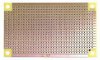
well what is available also is Veroboard so you can show me how to do it on Verboard
the one I can get is look like this one
1.jpg
 

Gryd3

Jun 25, 2014
4,098
Joined
Jun 25, 2014
Messages
4,098
Does anyone have any drawing software for Veroboard? Or am I stuck to drawing it with paint?
You could build this quite easily using 4 rows, but you will require an OLFA cutter (Xacto blade) to cut one of the rows.
I'll try to get something drawn up, but I encourage you to try to sketch something up in the mean time.

It is a simple circuit and would be great for learning.
 

KrisBlueNZ

Sadly passed away in 2015
Nov 28, 2011
8,393
Joined
Nov 28, 2011
Messages
8,393
I was concerned about the reversed pinout used for the 13003 transistor on that board so I did some more investigatin'. There is a "standard" pinout for this type of transistor (which is called a TO-126 transistor outline), and this is it:
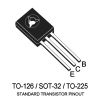
TO-126 standard transistor pinout 300x300.png

The Fairchild KSE13003 (http://www.fairchildsemi.com/datasheets/KS/KSE13003.pdf) uses this pinout, which I will call the ECB pinout, and so does the STMicroelectronics ST13003 (http://www.st.com/web/en/resource/technical/document/datasheet/CD00160678.pdf), but the ON Semiconductor MJE13003 (http://www.onsemi.com/pub_link/Collateral/MJE13003-D.PDF) uses the reverse pinout: BCE.

So the transistor on the original board was probably installed correctly but used the reverse pinout, like the ON Semi MJE13003.

Gryd3:

There are a number of programs that are supposed to let you draw up stripboard designs, but I've tried them all at various times and found all of them to be unworkable. Please feel free to try them yourself and give your opinions! They're listed under the EDA packages resource at https://www.electronicspoint.com/resources/list-of-eda-packages.39/ and flagged with "stripboard" in the comment field of the table. It would be great if one of them turned out to be practical; I've often wanted to draw up stripboard layouts for Electronics Point users.

If you want to draw it in a graphical editor I recommend something that supports multiple layers, like paint.net, not MS Paint. You could draw the stripboard on the bottom layer, and add layers for track cuts, jumper wires, and components.

pharaon:

I think it would be worth checking the new transistor you have there, to check that its pinout matches the Fairchild KSE13003 data sheet. Set your multimeter to the diode test range, touch the red probe to the right hand lead (B in the picture above), and touch the black lead to each of the other pins. You should get a reading of between 0.500 and 0.700 in each case. If not, repeat the test with the red lead to the left pin (E in the picture); if you get those readings with the black lead on the other two pins, your transistor has the reversed pinout, i.e. base on the left, the reverse of the image above.

The Veroboard you show in post #26 is also called stripboard. I recommend this, instead of the solid copper clad board in post #24, since you're doing a one-off construction. It's quick to work with, as Gryd3 said in post #25.

Even if you replace this board, there's no guarantee that it will fix your problem. There could well be a fault in the main unit. I just want to make sure you realise this. It sounds like Gryd3 will help you diagnose any problem on the main board as well. Great!
 

pharaon

Oct 28, 2014
458
Joined
Oct 28, 2014
Messages
458
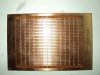
i bought these today
1.jpg board.jpg

the diode have number in4007 / m10
the R is 470 ohm
I couldn't find the capacitor with 1nf so I guess I have to take it out of an old board. I only find 0.1 nf at the shop
will this component work for the new board or not
 

KrisBlueNZ

Sadly passed away in 2015
Nov 28, 2011
8,393
Joined
Nov 28, 2011
Messages
8,393
Yes, try to remove the capacitor from the old board.

I don't know why you bought a 1N4007. The diode on the board is a 1N5232B 5.6V zener diode.

Have you measured the transistor to confirm the pinout?
 

pharaon

Oct 28, 2014
458
Joined
Oct 28, 2014
Messages
458
well when I tried to by the diode the seller told me they measure diode with amber like 1 amber 2 amber and so on...so I said give me 1 amber diode since it will work on 12v .
so he gave me that diode.

I measured the transistor red to the left and black on both other led it gave me 630and 670
so if red on left that mean its ECB right
 

KrisBlueNZ

Sadly passed away in 2015
Nov 28, 2011
8,393
Joined
Nov 28, 2011
Messages
8,393
well when I tried to by the diode the seller told me they measure diode with amber like 1 amber 2 amber and so on...so I said give me 1 amber diode since it will work on 12v . so he gave me that diode.
I don't know what you mean. You need a 1N5232B diode, not a 1N4007.
I measured the transistor red to the left and black on both other led it gave me 630and 670 so if red on left that mean its ECB right
Hold the transistor like in the first photo in post #24, so you can see the number and the leads are pointing downwards. Put the red probe on the left pin, and the black probe on each of the other pins. If the meter shows 630 and 670, then the pinout is BCE, the opposite of the drawing in post #28.
the diode on the board is 790 the one I bought is 530
You mean if you measure them with a multimeter on diode range? OK, but that's not important. The diode you bought is the wrong kind. You need a 1N5232B diode.
 

pharaon

Oct 28, 2014
458
Joined
Oct 28, 2014
Messages
458
the diode on the board is 790
the one I bought is 530
and I find diode on old board is 620
 

pharaon

Oct 28, 2014
458
Joined
Oct 28, 2014
Messages
458
ok the 13003 is BCE I did as you said so it's BCE
I can't find 1N5232B..and how a different diode will effect?
 

Gryd3

Jun 25, 2014
4,098
Joined
Jun 25, 2014
Messages
4,098
the diode on the board is 790
the one I bought is 530
and I find diode on old board is 620
The diode you need is a bit of an odd-ball... in that it does not simply prevent current flowing backwards. This diode is used to 'set' a voltage with the transistor by using it backwards and relying on it conducting at a specified voltage.
A regular diode will not do this, regardless of what you measure it at with a multi-meter.

Please heed Kris's words and hunt for the part # he gave you.
He know's what he is doing, and I am grateful for him stopping in to help out.

Once the power supply is fixed, we can move back to the main board and make sure the power is arriving at all the right places.
 

pharaon

Oct 28, 2014
458
Joined
Oct 28, 2014
Messages
458
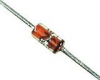
untitled.png
I have an old power supply board with diodes looks like that
but how can I tell if it's 1N5232B since theirs no numbers on it
 

pharaon

Oct 28, 2014
458
Joined
Oct 28, 2014
Messages
458
is there any other diode can work rather than 1N5232B in case I couldn't find 1N5232B
 

Gryd3

Jun 25, 2014
4,098
Joined
Jun 25, 2014
Messages
4,098
At the very least, you need a 5.6V Zener diode as stated above.
I am sorry, but I have very little experience with zener diodes so I cannot quote you any part numbers.
 

pharaon

Oct 28, 2014
458
Joined
Oct 28, 2014
Messages
458
how can I measure the diode volt to know if its 5.6 or not
 
Top