Designing a Time Delayed Relay

chopnhack

Apr 28, 2014
1,576
Joined
Apr 28, 2014
Messages
1,576
@KrisBlueNZ - If the clearance between the Allegro's pads is 23 mil and the minimum slot clearance allowed is 32 mil - is it worth it? I.e. - I can isolate the large pads approaching the pins, however, when they get to those pads, then there is only a 23 mil clearance, so they can not route that narrow of a channel. Does the 23 mil clearance negate the routed channel? The teal color is the proposed routed slot.
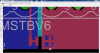
upload_2014-11-26_23-24-48.png
 

KrisBlueNZ

Sadly passed away in 2015
Nov 28, 2011
8,393
Joined
Nov 28, 2011
Messages
8,393
There's no point putting a slot between the two pairs of pins on the same side, because there's almost no voltage between them - they're joined together by a bit of metal inside the device, and the only voltage that appears between them is a few millivolts caused by current flowing through the resistance of that piece of wire. There's also no significant voltage between the pins on the current input connectors, although there is on the mains input and the relay output connectors.

If you want to use slots, use them on the isolation barriers, where there's significant voltage between two points in the circuit.
 

chopnhack

Apr 28, 2014
1,576
Joined
Apr 28, 2014
Messages
1,576
There's no point putting a slot between the two pairs of pins on the same side, because there's almost no voltage between them - they're joined together by a bit of metal inside the device, and the only voltage that appears between them is a few millivolts caused by current flowing through the resistance of that piece of wire. There's also no significant voltage between the pins on the current input connectors, although there is on the mains input and the relay output connectors.

If you want to use slots, use them on the isolation barriers, where there's significant voltage between two points in the circuit.
Thanks Kris, I almost feel like you did go over that before, my apologies! Voltage = potential difference between points!!! I will get that one day ;)
There is a lot of area under the transformer - I was thinking of using it in the ground plane, but then thought that there may be some inductance into it from the coils? Should I just isolate that entire area or should I make use of the copper?


Edit: With cap 8 buffering the incoming AC signal, would I want to put that and its associated resistor in an isolated area and then isolate the trace to the pic?
 
Last edited:

KrisBlueNZ

Sadly passed away in 2015
Nov 28, 2011
8,393
Joined
Nov 28, 2011
Messages
8,393
Thanks Kris, I almost feel like you did go over that before, my apologies! Voltage = potential difference between points!!! I will get that one day ;)
:)
There is a lot of area under the transformer - I was thinking of using it in the ground plane, but then thought that there may be some inductance into it from the coils? Should I just isolate that entire area or should I make use of the copper?
I don't think there's any good reason not to put a copper fill under it, but I don't think you'd gain anything by putting groundplane there, so I advise you leave that area blank - unless you want to put SMT parts there, as I suggested in an earlier post. (In which case you need to keep them well clear of the primary, obviously.)
Edit: With cap 8 buffering the incoming AC signal, would I want to put that and its associated resistor in an isolated area and then isolate the trace to the pic?
No; everything connected to the secondary of the mains transformer is at relatively low voltage compared to the circuitry and doesn't need any isolation clearances or slots.

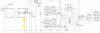
Here's schematic 10 with all needed isolation barriers shown in red, just to make things absolutely clear.

268425.010 isolation barriers in red.png
 

chopnhack

Apr 28, 2014
1,576
Joined
Apr 28, 2014
Messages
1,576
No; everything connected to the secondary of the mains transformer is at relatively low voltage compared to the circuitry and doesn't need any isolation clearances or slots.

Here's schematic 10 with all needed isolation barriers shown in red, just to make things absolutely clear.

Cool, thanks for the clarification. I was thinking that perhaps noise could go onto the ground plane and affect the other pins of the pic if the AC signal carrier wasn't isolated and drawn back to its own ground.
 

chopnhack

Apr 28, 2014
1,576
Joined
Apr 28, 2014
Messages
1,576
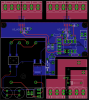
I think this looks good. I will still need to cleanup the silkscreen layer, but if you think this looks good, I will order the remaining parts and verify physical layout.
I couldn't find much information regarding via density and decreased surface area of copper. Should I ask for the via's to be solder filled?

upload_2014-11-27_23-20-20.png

upload_2014-11-27_23-22-43.png
upload_2014-11-27_23-24-11.png
 

KrisBlueNZ

Sadly passed away in 2015
Nov 28, 2011
8,393
Joined
Nov 28, 2011
Messages
8,393
There's no clearances around the mains inputs - Phase and Neutral. Also, do you have a 0.1" connector for the mains input? If so, you can't! Personally, I would move the transformer north, put the mains connector south of it, and put most of the power supply circuitry "under" the transformer (on the opposite side of the PCB, I mean).

Also, you can't let C2 hang over the isolation area like that. It has a metal case.

Should I ask for the via's to be solder filled?
I don't know. I never have. I think the normal recommendation is to "tent" vias, i.e. don't have gaps in the solder mask for them; have them covered on both sides. Google tented vias to find some better advice!
 

chopnhack

Apr 28, 2014
1,576
Joined
Apr 28, 2014
Messages
1,576
There's no clearances around the mains inputs - Phase and Neutral. Also, do you have a 0.1" connector for the mains input? If so, you can't! Personally, I would move the transformer north, put the mains connector south of it, and put most of the power supply circuitry "under" the transformer (on the opposite side of the PCB, I mean).

Also, you can't let C2 hang over the isolation area like that. It has a metal case.


I don't know. I never have. I think the normal recommendation is to "tent" vias, i.e. don't have gaps in the solder mask for them; have them covered on both sides. Google tented vias to find some better advice!
Thanks Kris - I thought since the circuit wouldn't draw much current I could use the smaller connector, oops! Lol

Thanks for the suggestions, I will try to work on them tonight. Can you recommend a small connector for incoming power?

Edit: I have seen a 4 pin connector used omitting one pin between phase and neutral, would that be ok? (seen in a line level smoke detector)
 
Last edited:

chopnhack

Apr 28, 2014
1,576
Joined
Apr 28, 2014
Messages
1,576
Kris, would it be a good manner of matching wiring needs for the incoming power to compare circular mill area of the feeder wires (two 12 gauge wires)?
12ga = 6530 circular mill x 2 = 13,060.
I was thinking of using six 18ga wires to bring power to the allegro chip, but I noticed the cumulative area would only be 1624 x 6 = 9,744.
Would six 16 ga be more appropriate at 2582 each, total of 15,429 circular mil?
Thanks
 

KrisBlueNZ

Sadly passed away in 2015
Nov 28, 2011
8,393
Joined
Nov 28, 2011
Messages
8,393
The incoming power requirement (into the transformer) is tiny. Your wires just need to be insulated to safety standards, and thick enough to be strong enough not to break.

The current paths you're monitoring and switching are a different story. Personally I would probably use stranded wire of the largest total diameter that the connector is designed to accept, for each of the six wires in each connector.

According to the table at https://en.wikipedia.org/wiki/American_wire_gauge#Tables_of_AWG_wire_sizes for 15A "ampacity" you should use 14 AWG wire with a diameter of 1.628 mm (or thicker). This will fit comfortably into a Phoenix plug.

This is just me erring on the safe side. Others here have direct experience. Any other guidance, anyone?
 

chopnhack

Apr 28, 2014
1,576
Joined
Apr 28, 2014
Messages
1,576
The incoming power requirement (into the transformer) is tiny. Your wires just need to be insulated to safety standards, and thick enough to be strong enough not to break.
Agreed, for cost savings I would use whatever wire I order for the monitoring/switching side.
The current paths you're monitoring and switching are a different story. Personally I would probably use stranded wire of the largest total diameter that the connector is designed to accept, for each of the six wires in each connector.

According to the table at https://en.wikipedia.org/wiki/American_wire_gauge#Tables_of_AWG_wire_sizes for 15A "ampacity" you should use 14 AWG wire with a diameter of 1.628 mm (or thicker). This will fit comfortably into a Phoenix plug.

This is just me erring on the safe side. Others here have direct experience. Any other guidance, anyone?
The incoming will be 12 gauge from the mains. I thought I would be able to use several smaller wires to "feed" from the 12 gauge to the connector. You have a point though, how would current apportion itself through each of the smaller wires without burning them out... So you are saying that they each have to be sized accordingly to the highest load that can come through? I wonder if I will have enough space inside the box to accommodate all the wiring - forget about box fill, LOL
 

KrisBlueNZ

Sadly passed away in 2015
Nov 28, 2011
8,393
Joined
Nov 28, 2011
Messages
8,393
The current should split roughly evenly because each wire will have roughly the same resistance. I was just being paranoid when I assumed that each wire would be rated for the maximum load. But I still think you should use the thickest feasible wire, if for no other reason than it will make the best contact with the plug.
 

chopnhack

Apr 28, 2014
1,576
Joined
Apr 28, 2014
Messages
1,576
The current should split roughly evenly because each wire will have roughly the same resistance. I was just being paranoid when I assumed that each wire would be rated for the maximum load. But I still think you should use the thickest feasible wire, if for no other reason than it will make the best contact with the plug.
Fair enough, I still have to shoehorn it in to the box! ;) So either 16ga or 14ga are acceptable, 14 obviously better than 16.

I was reading about tinned multi-strand conductor wire and thought it would be a good idea until I read that tin only has 15% the conductivity of bare copper. Being humid and hot down here, I wondered how quickly I could count on that bare wire keeping in said condition... Lots of variables in design!

Your thoughts on use of tinned wire vs. bare copper? Anyone feel free to chime in as well!
 

KrisBlueNZ

Sadly passed away in 2015
Nov 28, 2011
8,393
Joined
Nov 28, 2011
Messages
8,393
Fair enough, I still have to shoehorn it in to the box! ;) So either 16ga or 14ga are acceptable, 14 obviously better than 16.
Cool :)
I was reading about tinned multi-strand conductor wire and thought it would be a good idea until I read that tin only has 15% the conductivity of bare copper. Being humid and hot down here, I wondered how quickly I could count on that bare wire keeping in said condition... Lots of variables in design! Your thoughts on use of tinned wire vs. bare copper?
These are my thoughts on tinned vs. untinned copper wire:

kris thinking.jpg

Anyone feel free to chime in as well!
Please!
 

chopnhack

Apr 28, 2014
1,576
Joined
Apr 28, 2014
Messages
1,576
Ok, I moved the incoming power connectors to the bottom, which required moving the caps too - I don't think that they are in the most ideal location, but I don't think that its a deal breaker either - your thoughts?
V.reg and bridge are on back side of board under transformer, power is first pin on bottom of 3 pin connector. Isolation between neutral trace (off of center pin) to relay plane is 100 thou. Ground trace on opposite side of board (blue trace off of third pin).

upload_2014-12-1_22-12-54.png

Also, for ease of routing I changed where I got the AC signal from off of the bridge and transformer. I don't think it matters, but to be sure, I included the change I made. Thanks again for all your help.

upload_2014-12-1_22-21-58.png
 
Last edited:

KrisBlueNZ

Sadly passed away in 2015
Nov 28, 2011
8,393
Joined
Nov 28, 2011
Messages
8,393
The power and power switch connectors are still too small and the clearances around them are too tight.

The electrolytics are OK there but the track from the negative terminal to the earth pin on the incoming power connector doesn't need to go there - I would run it north-east from the negative pad of the bridge rectifier, then east, then south between the legs of the regulator and onto the pad. You can also move the bridge and the regulator north quite a long way and increase the pad area for the regulator.

You can reduce the north-south dimension if you move the relay closer to its connector (move the resistor to the west of the capacitor instead of having it north of the west corner; the terminals of the resistor don't need to be isolated from each other) and around U3, the two capacitors can be moved north to sit either side of the device, not wasting so much north-south space.

Edit: Have another look at the isolation barriers I drew up a few posts back.
 

chopnhack

Apr 28, 2014
1,576
Joined
Apr 28, 2014
Messages
1,576
The power and power switch connectors are still too small and the clearances around them are too tight.

The electrolytics are OK there but the track from the negative terminal to the earth pin on the incoming power connector doesn't need to go there - I would run it north-east from the negative pad of the bridge rectifier, then east, then south between the legs of the regulator and onto the pad. You can also move the bridge and the regulator north quite a long way and increase the pad area for the regulator.

You can reduce the north-south dimension if you move the relay closer to its connector (move the resistor to the west of the capacitor instead of having it north of the west corner; the terminals of the resistor don't need to be isolated from each other) and around U3, the two capacitors can be moved north to sit either side of the device, not wasting so much north-south space.

Edit: Have another look at the isolation barriers I drew up a few posts back.
:eek:Damn, I forgot where I left off!!! I was supposed to draw up the new component!
Thanks for the input and optimization, I will redo this as soon as I layout the connector.
 
Last edited:

chopnhack

Apr 28, 2014
1,576
Joined
Apr 28, 2014
Messages
1,576
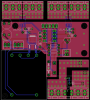
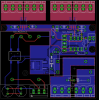
Just realized that I didn't need to include a separate connector for the switch! I just need to wire the switch inline with phase coming into the three pin power connector! Yea, more space :) The board now measures 2.7x2.7 in - a large reduction from original size (-40%). I think its as small as it can get due to connector sizes and the transformer. I will include an inline fuse holder for the added protection.

Pin 3, phase, pin 2 neutral, pine 1 Ground/EGC. Nice call on that ground lead from the caps, thanks!!! I swapped from through hole to SMD for cap 3, next to the v. regulator

I need to do some clean up and add via's - but does the general layout look good or are there areas that need to be fixed? Thanks in advance.

upload_2014-12-2_16-26-42.png
 
Top