ok, I am new here...
and, I am relatively new to electronics as well (my main thing is mostly programming, but I have been messing a bit with electronics over the past several months).
but, one thing I have noticed is an annoyance with trying to build H-bridges which work well...
in comparison, simpler on/off drivers are easier to get working well.
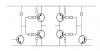
one design I had got working ok involves 2x PNP and 2x NPN drive transistors (per H-bridge), with 2x NPN booster transistors (to boost up from 3.3v 6mA signal currents), and a bunch of biasing resistors.
basically, an NPN transistor drives a pulldown, which is then fed (via resistors) to the Base for the drive PNP/NPN transistors, with additional pullup/pulldown for each transistor.
a big drawback that it needs a bunch of resistors (8 resistors per H-bridge), has a bit of leakage current (there is a path to ground via the resistors), and puts a limit on base current (base current needs to be kept low enough to not fry the resistors), which limits output current (mostly due to issues with gain). had to fiddle a fair bit with this design to get it to work correctly (want both good switching power, and also the transistors to be fully off when not active)
this generally being with transistors like the MJE2955T and MJE3055T (TO-220).
usually using a Darlington pair of a 2N3904 and an MJE3055T as boosters (yes, a 2N2222A would be better, but I don't have any yet, although some have been ordered and should show up eventually, along with some 30A N-MOSFETs, and a few 4A H-bridge driver ICs...).
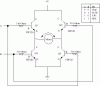
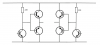
another design I had seen had used 4x NPN transistors for the H-bridge. this seems more simple/elegant by eliminating the need for biasing things.
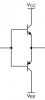
I had tried building one, with an NPN/PNP booster pair (3094 and TIP42A in this case) being used to drive each side of a dual H-bridge (with the wires flipped from the booster to drive the opposite transistor on the opposite side of the bridge, for each bridge).
this being for trying to build a dual H-bridge to run a bipolar stepper motor, without much success at getting the stepper going. it seems I get weak output (low output voltage and current, was only getting around +/- 1V with minimal current), and most of the current (several amps) just seems to go through the transistors when it is active (not sure if it is going between the H-bridge transistors, or is mostly going through the transistor bases), though it stops when no signal is applied.
possible fiddling is possible, for example, unlike the designs online I had skipped most of the base-resistors (some designs had showed a resistor for each base, but this would be an issue in this case, and I had ran the output of the main boost transistors directly into the base pins of the bridge transistors).
in some past tests, it seemed like the transistor base pin will pull current regardless of whether there is significant collector current. maybe most of the current is being sucked up by the transistor bases?... (originally, I had thought Ib was proportional to Ic, in addition to Ic depending on Ib, but some tests imply that Ib is more "whatever you throw at it").
the eventual goal here to drive 3 stepper motors (for XYZ movement), and a tool-head motor (target output is approx 20 amps, at 12 VDC, and will likely be spinning a 1/4 inch endmill or similar, intended to carve aluminum).
when the driver ICs get here, will probably just use these for the steppers, but probably will still need a good/powerful H-bridge for the tool motor (though, should hopefully produce at least 15A and power use should not exceed 20A, mostly for sake of the power-supply). there will also be approx 2A for each stepper.
I may be able to use the MOSFETs as well, when they get here.
thoughts?...
and, I am relatively new to electronics as well (my main thing is mostly programming, but I have been messing a bit with electronics over the past several months).
but, one thing I have noticed is an annoyance with trying to build H-bridges which work well...
in comparison, simpler on/off drivers are easier to get working well.
one design I had got working ok involves 2x PNP and 2x NPN drive transistors (per H-bridge), with 2x NPN booster transistors (to boost up from 3.3v 6mA signal currents), and a bunch of biasing resistors.
basically, an NPN transistor drives a pulldown, which is then fed (via resistors) to the Base for the drive PNP/NPN transistors, with additional pullup/pulldown for each transistor.
a big drawback that it needs a bunch of resistors (8 resistors per H-bridge), has a bit of leakage current (there is a path to ground via the resistors), and puts a limit on base current (base current needs to be kept low enough to not fry the resistors), which limits output current (mostly due to issues with gain). had to fiddle a fair bit with this design to get it to work correctly (want both good switching power, and also the transistors to be fully off when not active)
this generally being with transistors like the MJE2955T and MJE3055T (TO-220).
usually using a Darlington pair of a 2N3904 and an MJE3055T as boosters (yes, a 2N2222A would be better, but I don't have any yet, although some have been ordered and should show up eventually, along with some 30A N-MOSFETs, and a few 4A H-bridge driver ICs...).
another design I had seen had used 4x NPN transistors for the H-bridge. this seems more simple/elegant by eliminating the need for biasing things.
I had tried building one, with an NPN/PNP booster pair (3094 and TIP42A in this case) being used to drive each side of a dual H-bridge (with the wires flipped from the booster to drive the opposite transistor on the opposite side of the bridge, for each bridge).
this being for trying to build a dual H-bridge to run a bipolar stepper motor, without much success at getting the stepper going. it seems I get weak output (low output voltage and current, was only getting around +/- 1V with minimal current), and most of the current (several amps) just seems to go through the transistors when it is active (not sure if it is going between the H-bridge transistors, or is mostly going through the transistor bases), though it stops when no signal is applied.
possible fiddling is possible, for example, unlike the designs online I had skipped most of the base-resistors (some designs had showed a resistor for each base, but this would be an issue in this case, and I had ran the output of the main boost transistors directly into the base pins of the bridge transistors).
in some past tests, it seemed like the transistor base pin will pull current regardless of whether there is significant collector current. maybe most of the current is being sucked up by the transistor bases?... (originally, I had thought Ib was proportional to Ic, in addition to Ic depending on Ib, but some tests imply that Ib is more "whatever you throw at it").
the eventual goal here to drive 3 stepper motors (for XYZ movement), and a tool-head motor (target output is approx 20 amps, at 12 VDC, and will likely be spinning a 1/4 inch endmill or similar, intended to carve aluminum).
when the driver ICs get here, will probably just use these for the steppers, but probably will still need a good/powerful H-bridge for the tool motor (though, should hopefully produce at least 15A and power use should not exceed 20A, mostly for sake of the power-supply). there will also be approx 2A for each stepper.
I may be able to use the MOSFETs as well, when they get here.
thoughts?...