Drilling pcbs

swagguy8

Dec 10, 2014
73
Joined
Dec 10, 2014
Messages
73
hey guys, what drill bit type and size do you guys use to drill your pcbs? The small ones always break, and the big ones are too big, and i can't find any suitable ones.

thanks
 

davenn

Moderator
Sep 5, 2009
14,470
Joined
Sep 5, 2009
Messages
14,470
0.5 mm for standard component legs, larger when needed for big components terminal blocks etc

Yes they do break, you have to use them really carefully ( and buy lots of them)
I probably average 80 - 100 holes between breaks :)

Dave
 

Laplace

Apr 4, 2010
1,252
Joined
Apr 4, 2010
Messages
1,252
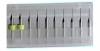
To drill PCBs use solid tungsten carbide drills with a 1/8" shank. Spin them at 10,000 RPM in a sturdy drill press and there should not be much of a breakage problem. I use a Jet micro-drill press that does not seem to be available anymore, but a Dremel tool in a drill press attachment should work fine.
PCB-drills.png
 

hevans1944

Hop - AC8NS
Jun 21, 2012
4,968
Joined
Jun 21, 2012
Messages
4,968
The key is to eliminate wobble and run-out. Never try to drill with a tungsten carbide bit that is spun up in a hand-held drill. Guaranteed to break, usually immediately. The usual drill press attachment for a Dremel tool is a piece of crap, but better than trying to hold the Dremel tool in your hand. Make sure it is solidly clamped or attached to your work bench. Try to find a real drill press, like the Jet micro-drill press that @Laplace uses. A manually operated X-Y index table that you mount the PCB on will help keep things steady while you locate a pad under the drill. Use a magnifying headset to visually center the drill on the pad. Or, do what I do now: send Gerber files to a PCB manufacturer and let them etch the circuit traces and drill the tiny holes. Yeah, yeah, I know real DIYers drill their own holes... but life is short and tungsten carbide drills are expensive.

BTW, never use an ordinary steel twist-drill on a PCB. Even those shiny yellow ones, for which you pay three or four times the cost of the "ordinary" twist-drills, will rapidly dull after cutting through fiberglass-epoxy board material. Solid tungsten carbide is the only drill you should ever use on a PCB. When it eventually dulls and fails to cut as quickly or as cleanly as it did when new, throw that puppy away before it breaks! AFAIK it is not cost-efficient to professionally re-sharpen tungsten carbide drills in small quantities, and this is not something you can successfully do by hand.
 

Laplace

Apr 4, 2010
1,252
Joined
Apr 4, 2010
Messages
1,252
FYI - This is interesting, mainly for the drill press used:
"Drilling PCB with tungsten carbide bit"
 

hevans1944

Hop - AC8NS
Jun 21, 2012
4,968
Joined
Jun 21, 2012
Messages
4,968
Thanks for the video. I guess a good "drill press" for a Dremel-like tool isn't all that hard to cobble together. Maybe I will have another look at the "drill press" attachment that I have for my Dremel Moto-tool.
 

swagguy8

Dec 10, 2014
73
Joined
Dec 10, 2014
Messages
73
Thanks guys for the replies, but i really want to avoid buying a drill press, especially since i have limited space in my garage. whats the price range for the carbide drill bits, and how often do they break?
 

hevans1944

Hop - AC8NS
Jun 21, 2012
4,968
Joined
Jun 21, 2012
Messages
4,968
You don't need a LARGE drill press. Watch the video uploaded by @Laplace. Tungsten carbide drills are expensive, ranging in price from slightly less than five dollars each to about seven dollars each, depending on length and diameter. Get at least five of each size hole you need to drill, more for frequently-drilled sizes. One source is McMaster-Carr. Without a drill press, expect to break the smaller size drills each time you attempt to use one. Larger diameter drills may only last a little longer. Tungsten carbide is brittle, like glass, only more so. It does not tolerate any appreciable bending moment applied between the cutting tip and the shank. OTOH, a fresh, sharp, solid tungsten carbide drill goes through FR4 PCB stock like a hot knife through butter if you spin it up to 10,000 RPM or more. Use a collet chuck, NOT a 3-jaw chuck, to hold the 1/8-inch shank.
 

Colin Mitchell

Aug 31, 2014
1,416
Joined
Aug 31, 2014
Messages
1,416
I get double-sided PTH boards 100mm x 100mm, 800 holes, legend and HASL made for $2.50 each.
I wouldn't waste my time drilling the first hole for $2.50.
I used to make my own resistors, then I found I could buy them for 1 cent each.
Gee . . . .I am so clever.
 

Canobi

Jul 25, 2014
87
Joined
Jul 25, 2014
Messages
87
I don't recommend the dremel drill press attachment, they have enough play in the mechanics that its not much better than by hand.


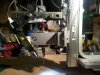
Due to space restrictions I too had to find a way to drill neatly, so I opted to make my own mini PCB drill press with auto motor activation (I used a micro switch with a long lever so when one of the bolt heads reached a certain point, the motor turns on). This is the result:
IMG_20140511_094828.jpg

Most of it was made from scrap aluminium I got from work, but there's plenty of easy access materials like extruded engineer's T slot frame (also known as speed frame). This is a semi solid extruded box frame that has T slots running the length on each side.

Very handy stuff for making 3D printers and the like, and easy on the wallet for short lengths and small projects.

I recommend the 20mm x 20mm T frame as it's still rigid enough for the job but small enough to make the press compact.

Couple lengths of that, some simple draw slide rails, a lever, retention spring and a motor mount (I used a CNC rail guide to mount my motor with) and you have a quick and simple press for cheap that won't take up much room or cost much to make.

The best bit about using the T frame is, you can simply undo the bolts and rearrange everything; kind of like Lego (assuming you've not cut specifically angled pieces that is).

I'll post a simple guide on putting one together using the T frame if anyone is intersted, it needs basic tool handling skills only so just about anyone can make a PCB drill press with this stuff.
 

BobK

Jan 5, 2010
7,682
Joined
Jan 5, 2010
Messages
7,682
I don't recommend the dremel drill press attachment, they have enough play in the mechanics that its not much better than by hand.
That is not my experience. It works like a dream compared to hand drilling, which I did before I got the press.

Bob
 

Canobi

Jul 25, 2014
87
Joined
Jul 25, 2014
Messages
87
That is not my experience. It works like a dream compared to hand drilling, which I did before I got the press.

Bob

I'm glad you got a good one, mine was well below par, replacement wasn't much better so ended up getting a refund.

I will amend my earlier statement and say that it is better to use a dremel press attachment than drilling by hand, if its a good one. If there is a lot of play in it (a 1mm deviation at the drill bit tip is enough to break bits under 0.5mm), don't use it for PCB drilling.
 

Canobi

Jul 25, 2014
87
Joined
Jul 25, 2014
Messages
87
Hey Canobi, I'd love to see a short guide on how you made that press!

The guide will be for something very similar using readily available parts, the press in my OP was mostly cobbled together from random parts I got from the scrap metal bins at work

Here's an early WIP pic of it:

IMG_20140502_001220.jpg

Heatsinks from AC control drives of verious types/sizes went into making the main chassis, and I cut down a pnumatic flux spray head slide assembly from a solder wave machine to make the virtical slide mount for the motor (couldn't believe my luck when I spied that in the scrap).

The handle and pully mechanism is also made from scrap bin gems.
 

swagguy8

Dec 10, 2014
73
Joined
Dec 10, 2014
Messages
73
The guide will be for something very similar using readily available parts, the press in my OP was mostly cobbled together from random parts I got from the scrap metal bins at work

Here's an early WIP pic of it:

View attachment 19084

Heatsinks from AC control drives of verious types/sizes went into making the main chassis, and I cut down a pnumatic flux spray head slide assembly from a solder wave machine to make the virtical slide mount for the motor (couldn't believe my luck when I spied that in the scrap).

The handle and pully mechanism is also made from scrap bin gems.

Bru, thats so siiiick. how did you connect the motor to the drill bit?
 

Canobi

Jul 25, 2014
87
Joined
Jul 25, 2014
Messages
87
The motor I bought came with a small brass chuck (.8mm to 1.2mm bit sizes), but I've since changed the motor to a bigger one with a 3.17mm shank so I could use the proper tungsten carbide bits (I found a 3.17mm to 3.17mm chuck that was perfect).
 

royalmp2001

May 20, 2014
11
Joined
May 20, 2014
Messages
11
hey guys, what drill bit type and size do you guys use to drill your pcbs? The small ones always break, and the big ones are too big, and i can't find any suitable ones.

thanks
Hi swagguy8,
I encountered the same problem some years ago when I started a small business making pcbs by hand. I wanted to use a handheld power drill that I already had. I tried 0.8mm high speed twist drill bits - no good at all. Would snap if applying the slightest sideways pressure. Then I tried tungsten carbide drills- they were a little more durable but still broke too easily. Then I discovered dental burs- which have a steel shaft and carbide ball on the end. I ordered three from Patterson Dental. These three lasted me about three years, drilling boards virtually every day. Usually they would only break if I dropped the drill onto my garage floor by accident. Very durable and got me through hundreds of pcbs, and needed no special equipment.
 

swagguy8

Dec 10, 2014
73
Joined
Dec 10, 2014
Messages
73
Hi swagguy8,
I encountered the same problem some years ago when I started a small business making pcbs by hand. I wanted to use a handheld power drill that I already had. I tried 0.8mm high speed twist drill bits - no good at all. Would snap if applying the slightest sideways pressure. Then I tried tungsten carbide drills- they were a little more durable but still broke too easily. Then I discovered dental burs- which have a steel shaft and carbide ball on the end. I ordered three from Patterson Dental. These three lasted me about three years, drilling boards virtually every day. Usually they would only break if I dropped the drill onto my garage floor by accident. Very durable and got me through hundreds of pcbs, and needed no special equipment.

sweet man thanks, just to be sure, you used a hand drill right
 
Top