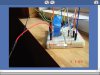
I can't see how this will work

KTW

Feb 22, 2015
273
Joined
Feb 22, 2015
Messages
273
schmitttrigger-gif.19189


My resistors came in and I attempted this circuit but it isn't working and I'm wondering where the base of the BC547 connects to the 100k resistor the schematic shows it going into the middle of the resistor so my question is what side of the 100k resistor should the base be connected?
All the other resistors are connected at one end or the other, this is the only one without clarity.
 

duke37

Jan 9, 2011
5,364
Joined
Jan 9, 2011
Messages
5,364
The 100k resistor is not simple resistor, it is a potentiometer with a twiddle adjustment.
 

KTW

Feb 22, 2015
273
Joined
Feb 22, 2015
Messages
273
This circuit isn't working for me so I tried to trace it back from the LED.
This is interesting, the LED has 5 volts from the 6 volt power supply and it won't light but when I take it out of circuit and put 3 volts directly to it, it lights.
 

duke37

Jan 9, 2011
5,364
Joined
Jan 9, 2011
Messages
5,364
That does not make sense. Have you got the LED connected the right way round?
 

KTW

Feb 22, 2015
273
Joined
Feb 22, 2015
Messages
273
Yes, the LED is positive in (long lead) and out to the 330 ohm resistor to the negative side of the board.
I'm measuring between the LED and the resistor where it connects to the negative side of the 6 volt supply.
I've reversed the LED, tested it with 3 volts and changed it out with another.catastrophe.JPG catastrophe2.JPG
 

BobK

Jan 5, 2010
7,682
Joined
Jan 5, 2010
Messages
7,682
If I understand what you are measuring, it is not across the LED it is across the resistor. i.e. the two probes are connected to either side of the resistor. Connect them to the two sides of the LED instead and see what you come up with.

Bob
 

KTW

Feb 22, 2015
273
Joined
Feb 22, 2015
Messages
273
It reads zero voltage across the LED which would explain white the LED doesn't light but I can't comprehend how the voltage gets through the LED, through the resistor and then reads 5 volts? Measure before the resistor and it's 0.
 
Last edited:

KTW

Feb 22, 2015
273
Joined
Feb 22, 2015
Messages
273
I've looked this over a few times and everything appears to be wired as the schematic shows. The LDR is working although very sensitive it turns the voltage on and off correctly but the LED won't light.
If anyone can see anything out of place in the photo I'll make the corrections or possibly some assistance in trouble shooting the problem.
The numbers with the dots are the three different BC547 transistors.
1=base
2=collector
3=emitter
4=base
5=collector
6=emitter
7=base
8=collector
9=emitter

light project.JPG
 
Last edited:

KTW

Feb 22, 2015
273
Joined
Feb 22, 2015
Messages
273
update: PROBLEM SOLVED

The LED was inline on the board and the two leads had to have separate connections on the board.
When I get it all boxed up I'll post a conclusion.
Thanks to everyone for helping.

Kevin.
 

KTW

Feb 22, 2015
273
Joined
Feb 22, 2015
Messages
273
A new problem is the 100k pot, the circuit is either on or off.
I can get it to light in the shade and turn it off by raising into direct sunlight but when I put it back in the shade it won't light unless I adjust the pot but then it stays on and won't shut off.
Is there another pot or device that might have better control over the LDR?
 

davenn

Moderator
Sep 5, 2009
14,470
Joined
Sep 5, 2009
Messages
14,470
where are the transistors ?
why are they not on the board ?
 

KTW

Feb 22, 2015
273
Joined
Feb 22, 2015
Messages
273
I put leads on them Dave so I could stretch them out for better spacing on that small board.
There are three transistors with three leads each.(1,2,3) (4,5,6) (7,8,9)
They are numbered in the above post.
It is working but I don't have enough adjustment in the 100k resistor, a hair either way with the screw causes it to be either on or off.
I can turn it on in a shady area of the room and can only turn it off if I put it in brighter light then when it does go off and I put it back in the shade it won't go back on.
 

duke37

Jan 9, 2011
5,364
Joined
Jan 9, 2011
Messages
5,364
The 1k resistor allows positive feedback. This makes the circuit have hysteresis.

You could drop this to say 100Ω or use a 1k variable resistor to set the hysteresis. It would be simpler to use a comparator where the hysteresis could be calculated.
 

KTW

Feb 22, 2015
273
Joined
Feb 22, 2015
Messages
273
1k variable doesn't want to work at all, I'm wondering if going the opposite to say 200k might work?
I don't know what a comparator is but I'm off to look it up.

I just tested the 100k and it's operational at 2.6k.
 
Last edited:

KTW

Feb 22, 2015
273
Joined
Feb 22, 2015
Messages
273
I have it working on a 5k variable resistor.
If I turn the ceiling light off the led will come on but when I turn the ceiling light back on the led stays lit.
If I bring a table lamp close to the ldr then the led will go out so I'm now stumped on why the ldr isn't working, are there better sensing ldr's out there or should I be looking at changing the 10k resistor at the ldr?
 

hevans1944

Hop - AC8NS
Jun 21, 2012
4,968
Joined
Jun 21, 2012
Messages
4,968
The LDR is not only a highly non-linear light-dependent resistor, it is also slow to recover to its "dark" resistance after exposure to a bright light that drops its resistance down into the k-ohm range. The "recovery" time for full dark resistance can be several minutes for some devices. This delay in dark recovery can mislead you into believing the threshold adjustment is incorrect, so you change it.

Because of the wide swings in LDR resistance, I would buffer it with an emitter follower. If you use a 10K potentiometer inserted as the emitter resistor, you can adjust the threshold input to the Schmitt trigger with the potentiometer wiper. I would also increase the resistor in series with the LDR to 100 kΩ so that about half the supply voltage appears across the LDR when it is dark, decreasing to almost zero when the LDR is illuminated.

I have a couple of LDRs that came with the Radio Shack Electronics Learning Lab Kit I purchased last year for one of my grandchildren. Since he lives in Virginia Beach, VA, and I live in Dayton, OH, when I got back home I purchased the same kit for me to "play" with in case he needed any help. It is still in the original box, unused, since I haven't heard from my grandson yet.

So, if I can find the time, I will dig out that LDR and breadboard the circuit. Meanwhile, @KTW will probably have solved his problem... .<sigh> ... and I can get back to messin' 'round with PICs and Arduinos. Interesting thread, though. The two-transistor Schmitt trigger is a classic (Google it) so I don't understand why it doesn't work with the LDR yet.

BTW, inserting both leads of the LED into the same in-line common tie point is an easy mistake. I've done that more times than I care to remember, but my excuse is old eyes.
 

KTW

Feb 22, 2015
273
Joined
Feb 22, 2015
Messages
273
Thanks hevans, even though I have old eyes, one with a cataract, I can't use that excuse as I just didn't know what I was doing but in my own defense I was on the verge of knowing what I was doing. :)
I focused in on the schematic and wired it led to resistor to neg. output not really thinking but failure can trigger thinking on occasion.
It seems much more responsive on the window sill in daylight than it does in artificial light.
Today it's slightly overcast and I'm quite happy how well it works in daylight on the window sill, not quite sure why it doesn't react the same with artificial light.
Light intensity is a factor.
 

hevans1944

Hop - AC8NS
Jun 21, 2012
4,968
Joined
Jun 21, 2012
Messages
4,968
... Light intensity is a factor.
Yep. And the CdS LDR is soooo non-linear. That is why I suggested earlier placing it inside a short tube with a tinfoil cap on the end that you punch a small hole into to let in some, but not an excessive amount, of light. As for artificial versus daylight, you might want to take a gander at the links on this Google results page...
 

KTW

Feb 22, 2015
273
Joined
Feb 22, 2015
Messages
273
:D
Success!
I changed out the 1k resistor with a 1k variable resistor as suggested and it works exactly as I hoped it would.
It wouldn't have happened if you guys didn't get involved.
Thanks again for all the help.

Kevin.
This is for you...
 
Top