leading or lagging of voltage?

astrostar

Apr 18, 2015
7
Joined
Apr 18, 2015
Messages
7
Please can anyone tell me what exactly it means to say voltage leads current or current leads voltage???
 

signalman72

Jan 26, 2014
57
Joined
Jan 26, 2014
Messages
57
I'll take a stab at it.

Alternating current is affected by capacitance and inductance. A capacitor will cause a voltage to lag current, because capacitors like to resist changes in voltage. The opposite is true of inductors. Current in an inductor will lag voltage, because inductors like to resist changes in current.

ELI the ICE man will help you remember what's what.

"E" (voltage) in an "L" (inductor) leads "I" (current)

"I" (current) in a "C" (capacitor) leads "E" (voltage)

This is known as reactance and causes impedance in a circuit ( the AC equivilant of DC resistance)
 
Last edited by a moderator:

Harald Kapp

Moderator
Moderator
Nov 17, 2011
14,272
Joined
Nov 17, 2011
Messages
14,272
by saing "leads" you mean is proportional right ?
No, that's not the issue. If it were proportional, we're dealing with a resistive circuit where current neither leads nor lags voltage but has the same phase.

Signalman has given a good explanation.
 

Ratch

Mar 10, 2013
1,102
Joined
Mar 10, 2013
Messages
1,102
Please can anyone tell me what exactly it means to say voltage leads current or current leads voltage???

That aphorism only applies to sinusoidal voltages and currents. Applying a voltage across the plates of a capacitor causes a charge imbalance. The relationship is Q = C*V, where Q is the charge imbalance in coulombs, C is the capacitance in farads, and V is the voltage is volts. As you can see from Q = C*V, the more the capacitance and the higher the voltage, the more the charge imbalance will be. So, one volt across a one farad capacitor will cause one plate of the capacitor to have a one coulomb excess of electrons, and the opposite plate to have a one coulomb deficiency of electrons.

Taking the derivative of both sides of the equation we get, d Q/dt = C* dV/dt . Since d Q/dt is current, the equation changes to I = C dV/dt. Now, stimulating the capacitor with a sine wave gives us I = C*d (V*sin(wt))/dt . Since the derivative of the sin is the cos, we get I = C*V*cos(wt) . The cosine phase leads the sine by 90°, so applying a sine wave voltage to a capacitor will cause the capacitor current to lead the voltage by 90° in phase. That is why current phase leads the voltage in when the stimulation is sinusoidal. Again, the lag or lead refers to the phase of the response with respect to the stimulus for a sinusoidal wave.

Ratch
 

astrostar

Apr 18, 2015
7
Joined
Apr 18, 2015
Messages
7
Thank you signalman....got the point.....but still in a capacitor current leads the voltage....does it mean that even before you apply voltage ,current will be present.....??
When you see the graph of a capacitor's voltage vs.current graph, u see that at time=0, voltage is zero...but current has certain value that is not equal to zero...what does that mean?
 

Ratch

Mar 10, 2013
1,102
Joined
Mar 10, 2013
Messages
1,102
Thank you signalman....got the point.....but still in a capacitor current leads the voltage....does it mean that even before you apply voltage ,current will be present.....??
When you see the graph of a capacitor's voltage vs.current graph, u see that at time=0, voltage is zero...but current has certain value that is not equal to zero...what does that mean?

Yes, the energy to move the charge and produce the current when the applied voltage is zero comes from the electrostatic field produced by grouping an excess charge on one capacitor plate and removing charges from the opposite plate. Whenever an unequal density of charges occur between two areas (the plates), there will be an electrostatic field occurring between the areas. As the energy is used up in equalizing the charge by moving it from one plate to the other, the electrostatic field will collapse and reach zero energy value when there is no charge imbalance between the plates.

Ratch
 

profbuxton

Nov 22, 2014
15
Joined
Nov 22, 2014
Messages
15
To answer your question re lead/lag in capacitors and inductors picture this. You have a capacitor (discharged), a switch and a power supply. Connect capacitor via switch to power supply plus and other terminal of capacitor to power negative. When you switch on the capacitor will "seem" like a "short circuit" to the power supply and draw a large current(depends on cap size etc) and the voltage measured across the capacitor will be (ideally) zero. As the capacitor charges up the current will drop and the voltage will increase to full supply volts. So if you measure capacitor current and capacitor voltage you will note that the current is at a maximum and voltage is at a minimum at the instant of switch on. So we say that the current "leads" the voltage by some phase angle(ideally 90 deg).

With inductor opposite happens. Replace cap. with inductor and switch on. Full supply voltage appears across inductor and current will flow. However, the magnetic field generated by the current will generate a "opposing" voltage to the applied voltage due to "self inductance" and this will "slow" full current build up (depends on inductor etc). So if you measure voltage across inductor it will be there as soon as switched on and current measurement will show a slow build up till steady state is reached. So we say that the current "lags" the voltage by some phase angle (ideally 90 deg).
 

Ratch

Mar 10, 2013
1,102
Joined
Mar 10, 2013
Messages
1,102
To answer your question re lead/lag in capacitors and inductors picture this. You have a capacitor (discharged), a switch and a power supply. Connect capacitor via switch to power supply plus and other terminal of capacitor to power negative. When you switch on the capacitor will "seem" like a "short circuit" to the power supply and draw a large current(depends on cap size etc) and the voltage measured across the capacitor will be (ideally) zero. As the capacitor charges up the current will drop and the voltage will increase to full supply volts. So if you measure capacitor current and capacitor voltage you will note that the current is at a maximum and voltage is at a minimum at the instant of switch on. So we say that the current "leads" the voltage by some phase angle(ideally 90 deg).

With inductor opposite happens. Replace cap. with inductor and switch on. Full supply voltage appears across inductor and current will flow. However, the magnetic field generated by the current will generate a "opposing" voltage to the applied voltage due to "self inductance" and this will "slow" full current build up (depends on inductor etc). So if you measure voltage across inductor it will be there as soon as switched on and current measurement will show a slow build up till steady state is reached. So we say that the current "lags" the voltage by some phase angle (ideally 90 deg).

Your description of phase difference is wrong. Using the transient response by a step voltage to describe phase difference is meaningless because a step voltage is not repetitive and has no phase reference. Always, the current to/from the plates of the capacitor will be I = C dV/dt .

Like most folks, you are using a technical slang such as "charging" and "discharging" to describe what happens when a voltage is applied across a capacitor. Slang usually does not describe what is really happening. The question becomes; 'What is the capacitor being charged with'? A cap has the same net number of coulombs of charge at 100 volts as it did at zero volts. For every electron that accumulates on one plate, another leaves from the opposite plate, and maintains a net charge change of zero. Actually, the capacitor is being "charged" with energy, is which case you might as well say the capacitor is being "energized".

Ratch
 

HellasTechn

Apr 14, 2013
1,579
Joined
Apr 14, 2013
Messages
1,579
No, that's not the issue. If it were proportional, we're dealing with a resistive circuit where current neither leads nor lags voltage but has the same phase.

Signalman has given a good explanation.

Got it !
 

profbuxton

Nov 22, 2014
15
Joined
Nov 22, 2014
Messages
15
Ratch, you are correct in your statement retransient response vs repetitive cycles. But the reasoning applies if you are able to at some increasing rate using a suitable switch alternately "charge" and "discharge" said components. Measuring volts across the components and current through them (with suitable component values) one will be able to see (and measure) the difference between volt and current.Of course if you then use the volts as reference there will be a "lead" "lag" of current.
I use this example as (hopefully) a simple example of this effect without going into great mathematical detail.
As far as using "charge" for a capacitor that is what is understood by most people.
A capacitor "energised" as you put it to some high voltage is not one I would care to contact even if the "net charge" is zero because electrons have been gathered on one side and sucked out of the other!
 

Ratch

Mar 10, 2013
1,102
Joined
Mar 10, 2013
Messages
1,102
Ratch, you are correct in your statement retransient response vs repetitive cycles. But the reasoning applies if you are able to at some increasing rate using a suitable switch alternately "charge" and "discharge" said components. Measuring volts across the components and current through them (with suitable component values) one will be able to see (and measure) the difference between volt and current.Of course if you then use the volts as reference there will be a "lead" "lag" of current.
I use this example as (hopefully) a simple example of this effect without going into great mathematical detail.
As far as using "charge" for a capacitor that is what is understood by most people.
A capacitor "energised" as you put it to some high voltage is not one I would care to contact even if the "net charge" is zero because electrons have been gathered on one side and sucked out of the other!

If you switch the circuit on and off, the voltage and current waveforms will not have the same shape in relation to each other as a sinusoidal waveform will. So how can you determine where the current phase reference is if you cannot relate it to the voltage shape? A step voltage is a composite of many frequencies. Which frequency will you use? Be easy on yourself. Use a sinusoidal wave to measure the voltage/current phase.

A capacitor can be energized at a low harnmless voltage also. I suggested "energized" to be exactly descriptive, and not ambiguous like "charged" is.

Ratch
 

davenn

Moderator
Sep 5, 2009
14,470
Joined
Sep 5, 2009
Messages
14,470
have been gathered on one side and sucked out of the other!

They haven't been sucked out of anywhere
The incoming electrons on the first plate and the electric field that develops between the two plates physically forces the electrons off the second plate
so plate one has an excess of electrons and plate two is deficient of the same number of electrons

And as Ratch said, tho the capacitor is energised, the overall net charge is balanced and therefore is zero
 
Last edited:

Laplace

Apr 4, 2010
1,252
Joined
Apr 4, 2010
Messages
1,252
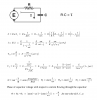
The concept of leading or lagging voltage arises from frequency domain analysis at some steady-state frequency where the phase angle is meaningful. So it is more appropriate to use the concept of phasors rather than using differential equations to explain signal phase. Consider the following example of a simple series RC circuit where phasor algebra is used to calculate the phase of the loop current & capacitor voltage with respect to the driving voltage. Note that the phase of the capacitor voltage with respect to the capacitor current takes the form (atan(-X)-atan(1/X) which always evaluates to -90° so as expected the capacitor voltage lags the current by 90°.
Phase-Angle.png
 

Ratch

Mar 10, 2013
1,102
Joined
Mar 10, 2013
Messages
1,102
Laplace,
Yes, since the R and C are in series, they will have the same accumulation/depletion current existing through the resistor and to/from the capacitor. Because the cap current is C dV/dt, and the applied voltage is sinusoidal, the cap voltage will be locked into at a 90° lag with respect to the circuit current.

Ratch
 

Laplace

Apr 4, 2010
1,252
Joined
Apr 4, 2010
Messages
1,252
...the same accumulation/depletion current...
I don't believe I've ever seen the topic of "capacitor accumulation/depletion current" discussed in any circuit theory textbook. Do you have a reference where it is explained?
 

Ratch

Mar 10, 2013
1,102
Joined
Mar 10, 2013
Messages
1,102
I don't believe I've ever seen the topic of "capacitor accumulation/depletion current" discussed in any circuit theory textbook. Do you have a reference where it is explained?

It is not a topic, it is an operational description of a happening event. No, I have not seen those terms used in documentation anywhere. Matter of fact, all the documentation I have seen uses the technical slang word "charge" to describe a capacitor energizing. Usually slang is not very descriptive. Anyone for a spacewalk? I have described what I mean by those terms in post #8 at https://www.electronicspoint.com/threads/capacitors-dielectric.273627/ . I believe it is more correct than most other descriptions you might have come across relating to how a capacitor works.

Ratch
 

Laplace

Apr 4, 2010
1,252
Joined
Apr 4, 2010
Messages
1,252
I believe it is more correct than most other descriptions
I don't dispute your description; however, it is not a very useful concept for doing circuit analysis where we like to pretend that current flows through the capacitor.
 

Ratch

Mar 10, 2013
1,102
Joined
Mar 10, 2013
Messages
1,102
I don't dispute your description; however, it is not a very useful concept for doing circuit analysis where we like to pretend that current flows through the capacitor.

The analysis proceeds correctly even though we know that charge does not pass through any capacitors in the circuit. That is because transient current still exists in the circuit itself due to the ability of capacitors to accumulate and deplete charge for finite period of time. No pretending is necessary and correct results are obtained because we use the correct mathematical operator to obtain the voltage from across the capacitor from the transitory accumulation/depletion current.

Ratch
 
Top