Yes, Harald is doing his usual, wonderful thing here... giving good advice.
I can't improve on what Harald says - he's exactly right. I can put it another way though, and sometimes that's what people need, so here goes...
The general subject is called
"Ohms Law", and it's so useful!
You need to understand that the amount of electrons (current) flowing through a resistance is defined by the relationship I=V/R.
- "I" is the number of electrons per second flowing through the resistances. This is called current.
- "V" is the amount of force driving electrons through the resistive circuit. Twice (or 3 times) as much force mean there will be twice (or 3 times) as many electrons flowing.
- R is the "resistance". The best way to understand resistance is to see that resistance limits current in a circuit.
You also need a good. preferably instinctual, understanding of the numbers.
For that, you need to be able to translate from algebra to English. It's easy!
"Divided by" means "per", or "for every". For instance, when someone tells you they drive at 100 km per hour, that means 100km/hr, or 100 km
for every hour traveling.
Let's apply the translation to Ohm's Law.
Say you have a 10,000Ω resistor, and you connect it to a 5V supply.
Ohms Law is
I=V/R, so current (I) is found by a process of division. Current is proportional to Volts (V) per Ohm (Ω). For more volts you get more current, and for more resistance you get less current.
A 5V supply will drive "5 divided by 10,000" Amps. The arithmetic gives a result of 0.0005 Amps. (This is usually called 0.5mA or 500μA)
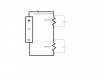
Now imagine that your 10,000Ω resistance has been made by connecting 2 resistors in series. Imagine there's a 9000Ω resistor in series with a 1000Ω resistor. We already know that the current is 0.0005 Amps, so this time we "invert" Ohms Law, and use it in another form in order to find out the 2 voltages on the 2 resistors.
V=IR, so we multiply the 0.0005 Amps by each resistance, then check...
Ohms Law says V=IR.
9000*0.0005 = 4.5V
1000*0.0005 = 0.5V
4.5V + 0.5V =5V
From the calculation we see that 0.5V can be measured across the 1000Ω resistor, and 4.5V can be measured across the 9000Ω resistor. Thus we have made a "resistive potential divider" and we can use it to produce voltages of 4,5V and 0.5V
I know it must make your head hurt a bit (it did mine at first) but it all becomes very easy once you get some practice. Find yourself a book! (Does anybody have a recommendation for Electro, please?)
Or even better find someone with some experience, who can give you some face-to-face help - which makes it all so much easier!
Mark