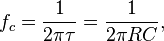
Hi, I have a question about LPF and HPF in RC circuit.
I know that in LPF when τ>>t the capacitor is close to be a short.
but what happens in HPF when τ>>t ? that capacitor is close to be a short also?
In
HPF when
τ>>t there is no problem. The changes at HF all take place in times less than
τ , so a series capacitor having a low impedance is just what a HPF wants.
In LPF when
τ>>t , ( ie looking at a time much shorter than the time constant), HF signals which change in times shorter than
τ are attenuated by the 'close to .. a short' of a parallel capacitor. But LF signals change over times greater than
τ . By the time a LF signal has reached its peak, t >
τ , the capacitor is charged up and is not anything like 'close to .. a short'. So LF signals are not greatly attenuated by the parallel capacitor.
Your comment, "the capacitor is close to be a short", is perfectly understandable, but you have to ask yourself, what does a short mean when the voltage and current are not in phase! With a capacitor you often find that the peak current occurs when there is no voltage across it and zero current flows when the voltage is maximum. Peak current with 0 voltage is a bit like a short, but since the current falls as the voltage rises, it is also very different.
Finally, I don't think it is helpful to talk about time when you are looking at the steady state properties of filters. Filters attenuate AC signals - HPF attenuates AC frequencies below the cut off, and LPF attenuates AC frequencies above the cut off. (DC is, if you like, the infinitely low frequency and is comparable with an infinitely high frequency. But infinities are always things to be cautious about.)
The properties of filters are calculated on the basis of AC signals which continue much longer than
τ and frequency is the parameter which helps here. Unless you are looking at the transient response of a filter (in which case, rather you than me!!) then always t >>>
τ ! And when you look at transient response, you are looking at the filter's response to a broad band signal containing frequencies from 0 (DC) to infinity, not just to a single frequency. So if you apply a transient to a filter, you always get some output, whether it is HP or LP.